

On this page
When you stack two blocks and pull the bottom one, they move together—up to a point. If you pull too hard, the bottom block yanks out from underneath, leaving the top one behind. Finding the maximum force before they slip is a classic mechanics problem in JEE and NEET. The secret is not to look at the block you are pulling, but the one you aren't.
Why do stacked blocks slip?
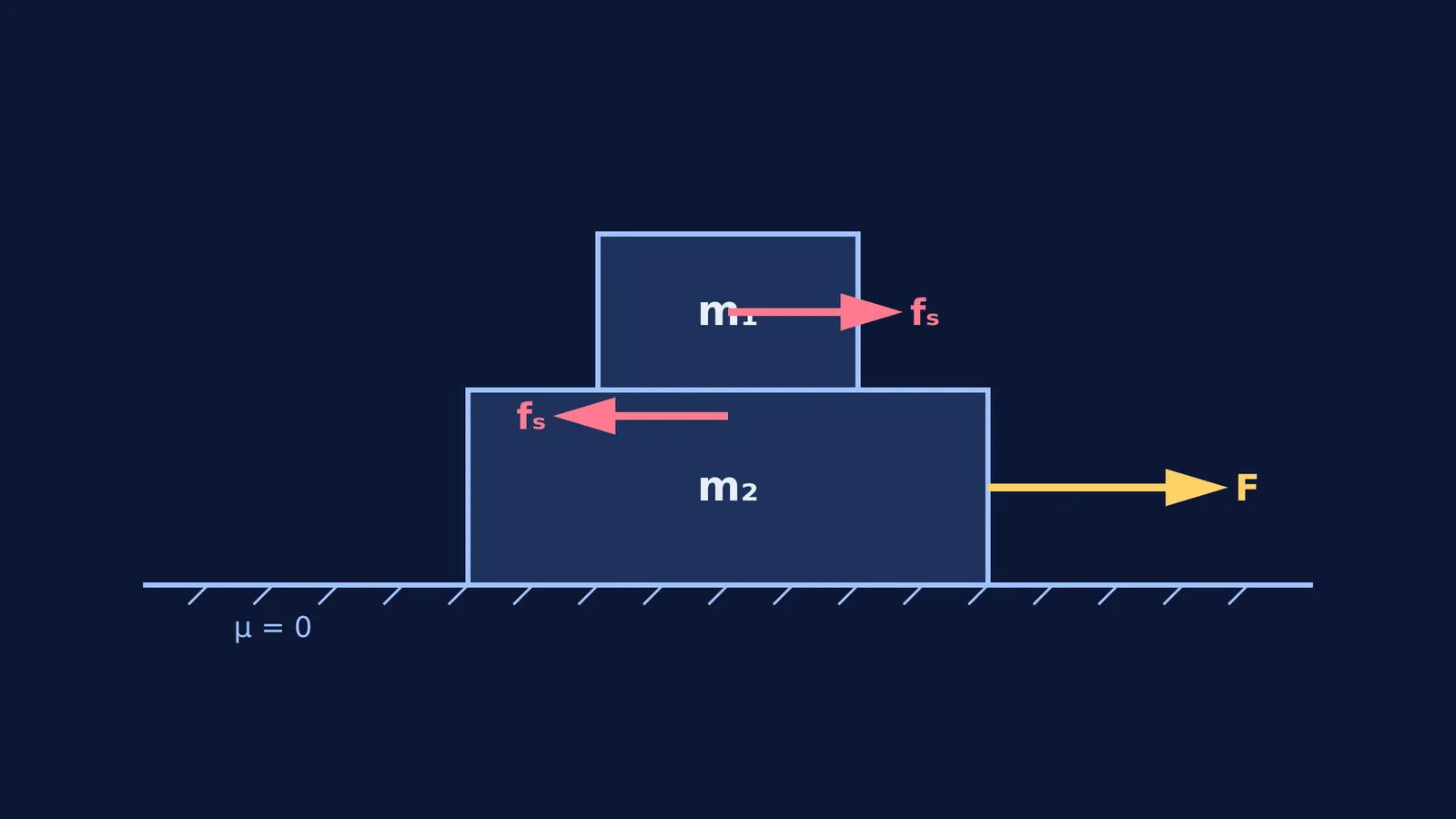
If you pull the bottom block (m₂) to the right, nothing is directly pulling the top block (m₁) to the right except friction.
Static friction acts between two surfaces that are not moving relative to each other, and it responds to an applied force up to a maximum limit of fₛ = μₛN (OpenStax University Physics). Here, N is the normal force between the blocks, which is just the weight of the top block, m₁g.
If setting up the free-body diagrams for these forces leaves you tangled in action-reaction pairs, the Fermi Problem Library has worked problems with a step-by-step solver that explains the reasoning rather than printing an answer.
How do you find the maximum common acceleration?
The golden rule for stacked blocks is to find the maximum acceleration of the unpulled block. That block sets the speed limit for the entire system because it relies entirely on friction to keep up with the block being pulled.
Because the only horizontal force on m₁ is static friction, Newton's second law says: fₛ = m₁a
Since friction cannot exceed μₛm₁g, the acceleration cannot exceed: m₁a ≤ μₛm₁g a_max = μₛg
This is a beautiful result. The mass of the top block cancels out completely from the equation. Whether you put a light textbook or a heavy iron weight on top, their maximum acceleration before slipping on the same surface is exactly μₛg. This counterintuitive fact often appears in multiple-choice questions.
To review the rules of static and kinetic friction before tackling blocks, head to the Fermi Concept Library.
What is the maximum force on the lower block?
As long as the blocks do not slip, they move together as one single object of mass (m₁ + m₂).
The applied force F on the bottom block accelerates this combined mass: F = (m₁ + m₂)a
To keep them together, their common acceleration a must be less than or equal to a_max. Substituting the maximum acceleration into the equation gives us the maximum pulling force before slipping occurs: F_max = (m₁ + m₂) × a_max F_max = μₛ(m₁ + m₂)g
If you pull with any force greater than this, the bottom block accelerates faster than μₛg. The static friction is "maxed out" and cannot pull the top block fast enough to keep up, so kinetic friction takes over and the blocks slide apart. The top block will then have a lower acceleration than the bottom block, and they will separate.
What if you pull the top block instead?
Let's flip the problem. What if you pull the top block (m₁) and rely on friction to drag the bottom block (m₂) along the smooth floor?
Now, m₂ is the unpulled block. The only force pulling it forward is the static friction from m₁.
The maximum static friction between the blocks is still fₛ = μₛm₁g, because the normal force between them hasn't changed. But this friction is now accelerating the mass m₂ across the floor.
The maximum acceleration of m₂ before it slips is: a_max = (μₛm₁g) / m₂
For the blocks to move together, the whole system (m₁ + m₂) can only accelerate at this specific a_max. The maximum force F on the top block is then found by multiplying the total mass by this acceleration: F_max = (m₁ + m₂) × a_max F_max = μₛm₁g(m₁ + m₂) / m₂
This force is usually much smaller than when you pull the bottom block, especially if the bottom block is heavy. A heavy bottom block is harder for friction to accelerate, so the top block breaks loose much more easily.
To practice more contact force scenarios, try finding the contact force between blocks pushed together on a smooth floor. If the ground itself has friction, you'll need to subtract the floor's kinetic friction from your pulling force before finding the acceleration, just like finding the minimum force to drag a block on a rough floor. Or you can explore the angle of repose and angle of friction for objects on an incline.


