On this page
Shadows and mirror images are two of the easiest parts of physics to test in your own room. NCERT's Class 7 science textbook Curiosity gives them a whole chapter, Light: Shadows and Reflections, built around a torch, a screen and a plane mirror. An AI chatbot can explain all of this in seconds. But an explanation is only worth trusting once you have seen it happen. Here is how to let the AI explain and use your home as the lab.
How should you use AI to learn about shadows and mirrors?
Use a loop: make your own prediction, ask the AI to explain, then test it.
The order matters. In a 2004 Harvard study of classroom physics demonstrations, Crouch, Fagen, Callan and Mazur found that students who only watched understood the ideas no better than students who did not see the demonstration at all. Students who predicted the outcome before seeing it showed significantly greater understanding.
Write your guess down first, then use prompts like these:
"I think moving a toy closer to the torch makes its shadow smaller. Explain what really happens, in words a Class 7 student can follow."
"What would I see at home that would prove your explanation wrong?"
"I tried it and saw this. Does it match what you said? If not, which step was wrong?"
The second prompt turns the answer into something you can check.
Which shadow activities can you try at home?
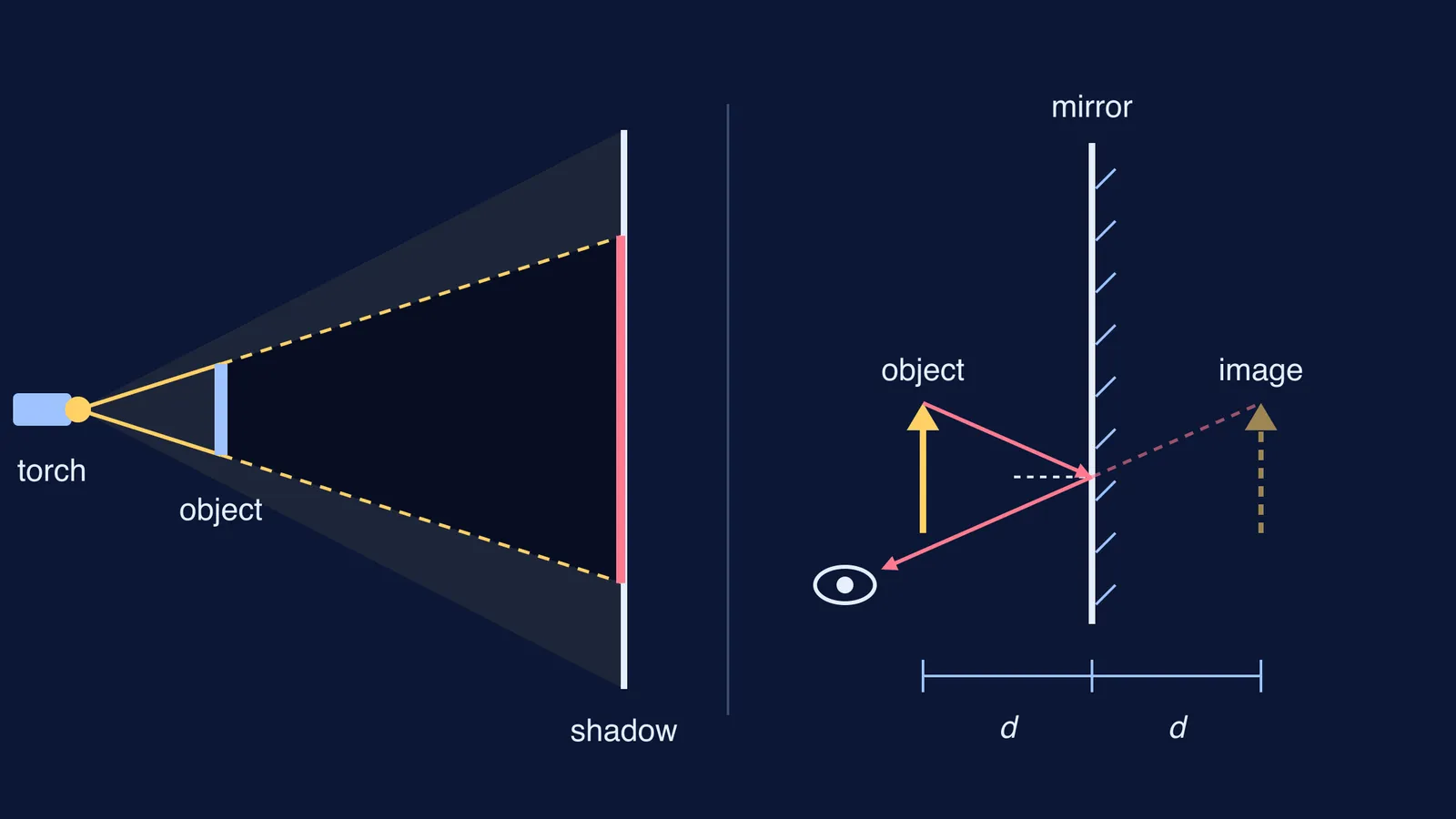
You need a torch (a phone torch works), a plain wall in a dark room, and a few small objects. The NCERT chapter defines a shadow as the dark patch where light does not reach because an object blocks it. To see one you need three things: a light source, an opaque object and a screen.
Near and far. Hold a toy between the torch and the wall. Move it towards the torch, then towards the wall. NCERT says the shape, size and sharpness of a shadow depend on where the object is relative to the light and the screen. You should see the shadow grow as the toy gets closer to the torch.
Colour swap. Swap in a same-shaped object of another colour. NCERT notes that changing the colour of an opaque object does not change the colour of its shadow.
Material test. Try cardboard, tracing paper and a glass. NCERT says opaque objects form darker shadows, translucent ones make lighter shadows, and even some transparent objects can make faint ones.
Worked example: check the AI's maths
Ask: "My torch is 100 cm from the wall. A 10 cm toy stands 25 cm from the torch. How tall is its shadow?" A good answer uses similar triangles, treating the torch as a single point of light. The shadow is 10 × (100 ÷ 25) = 40 cm tall. Move the toy to 50 cm from the torch and the same rule gives 20 cm.
Now measure with a ruler. Expect to land close, not exact: a torch is not a perfect point, so the edges blur. If you get 20 cm when the AI said 40 cm, ask it why.
How do you check what an AI says about mirror images?
NCERT's summary says a plane-mirror image is the same size as the object, upright (erect), cannot be caught on a screen, and is laterally inverted, meaning left and right appear swapped. OpenStax adds that the image is as far behind the mirror as the object is in front, and that the angle of incidence equals the angle of reflection.
Distance. Stand close to a mirror, then step back. Ask the AI how far behind the mirror your image is. Your image should seem to move back as you do.
Left and right. Raise your left arm, then write your name on paper and hold it facing the mirror. Ask the AI why the word AMBULANCE is printed reversed on ambulances; NCERT uses this example.
The screen test. Hold a sheet of paper where the image seems to be. Nothing appears on it. Ask the AI why a pinhole camera can put an image on a screen but a plane mirror cannot.
What should you do when the AI and your result disagree?
Run this checklist before deciding who is right:
Repeat the test, changing only one thing at a time.
Check the setup: is the room dark enough, and is the object really opaque?
Tell the AI exactly what you saw, with distances, and ask which step fails.
Look up the same point in your textbook.
A chatbot that only hands over answers skips your guess. Fermi's AI tutor decides whether to explain, ask or show, and draws the figure as it teaches. For ideas that are easier to see than read, the Fermi Simulation Lab has interactive simulations.
Pick one activity tonight, write your prediction down, then switch on the torch.