

On this page
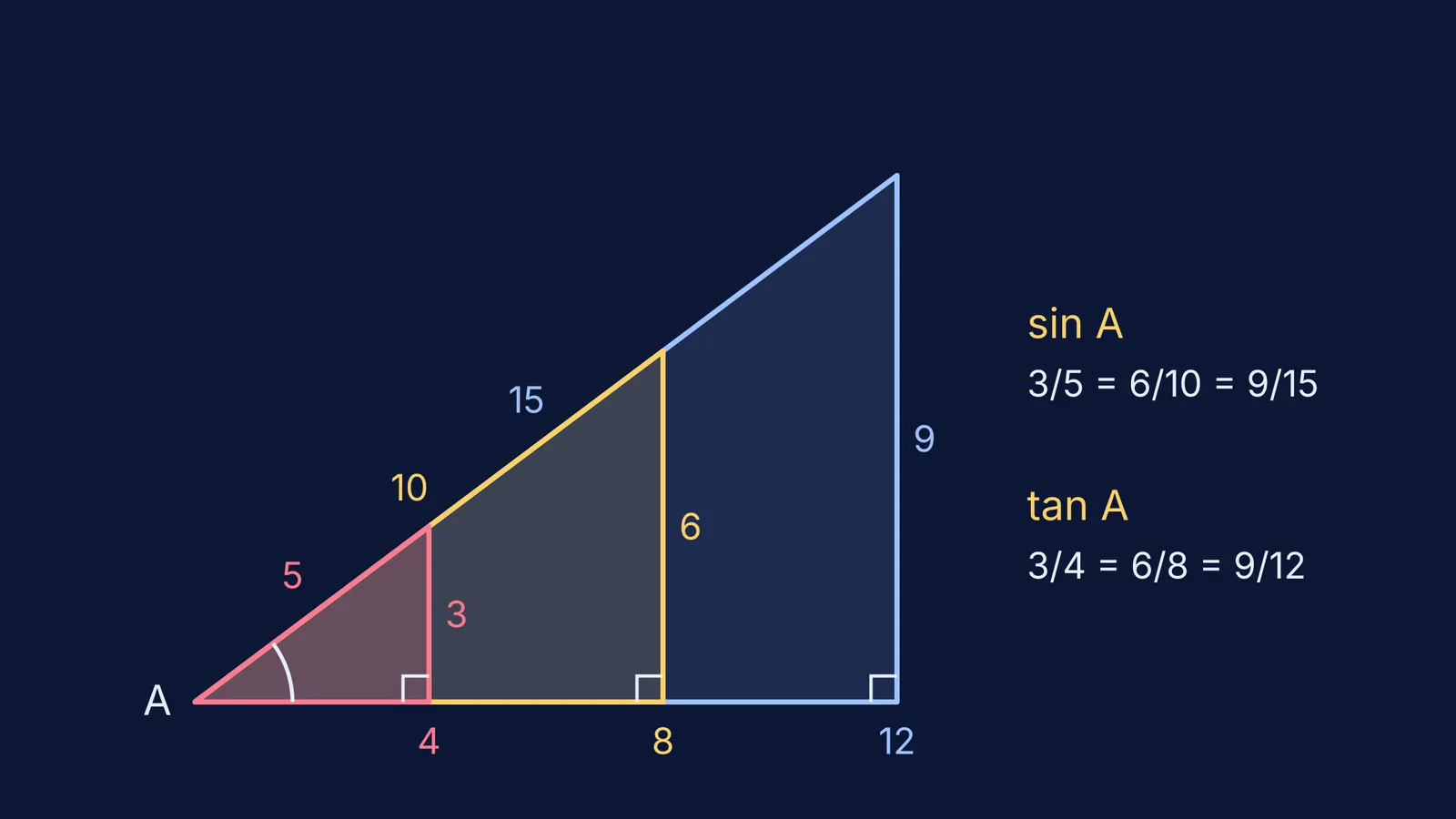
Draw a small right triangle with a 30° angle on one page and a huge one on the next. The second one has much longer sides, but sin 30° is still 1/2 in both. Students often learn this as a rule to memorise. It is really a short argument about similar triangles, and you can check it yourself.
Why do trigonometric ratios not depend on the size of the triangle?
The NCERT Class 10 chapter Introduction to Trigonometry defines sin A as the side opposite angle A divided by the hypotenuse, and tan A as the opposite side divided by the adjacent side.
The same chapter then takes a point P on the hypotenuse of a right triangle ABC, drops a perpendicular PM to the base, and asks whether angle A has different ratios in the smaller triangle PAM. Triangles PAM and CAB share angle A and both have a right angle, so they are similar by the AA criterion, and their corresponding sides are proportional.
From that, the textbook concludes that the values of the trigonometric ratios of an angle do not vary with the lengths of the sides of the triangle, if the angle remains the same (NCERT Class 10, Chapter 8).
The similarity rule comes from Chapter 6, Triangles. Its Theorem 6.3 says that if corresponding angles of two triangles are equal, their corresponding sides are in the same ratio, so the triangles are similar. In a right triangle the right angle is fixed and the three angles add to 180°, so choosing one acute angle fixes all three angles. We explain that angle sum in why the angles of a triangle add to 180 degrees.
What happens when you scale a 3-4-5 triangle?
NCERT's Example 1 uses a right triangle with tan A = 4/3, opposite side 4k, adjacent side 3k and hypotenuse 5k, where k is any positive number (NCERT Class 10, Chapter 8). Here is the same idea, turned so that angle A faces the 3, with three values of k. Before you read the answers, write down your own predictions for sin A and tan A in each row.
k = 1: opposite 3, adjacent 4, hypotenuse 5, so sin A = 3/5 = 0.6 and tan A = 3/4 = 0.75
k = 2: opposite 6, adjacent 8, hypotenuse 10, so sin A = 6/10 = 0.6 and tan A = 6/8 = 0.75
k = 10: opposite 30, adjacent 40, hypotenuse 50, so sin A = 30/50 = 0.6 and tan A = 30/40 = 0.75
Area and perimeter change, but the two ratios do not: sin A = 3k/5k, and the k cancels. Area behaves differently: it grows with k², which we show in the area ratio of similar triangles.
How can you test this yourself with an interactive?
A prediction you commit to before you look shows you what you actually believed. Use this sequence with a ruler and protractor, or with any interactive geometry tool that lets you drag a vertex.
Fix angle A at 30° and make the hypotenuse 4 cm. Predict the opposite side, then measure it. NCERT Chapter 8 gives sin 30° = 1/2, so expect 2 cm.
Double the hypotenuse to 8 cm without touching the angle. Predict the opposite side and sin A before you measure.
Now keep the hypotenuse at 8 cm and widen the angle to 60°. Predict whether sin A goes up or down. NCERT gives sin 60° = √3/2, about 0.87.
Switch to tan A. Predict whether it can ever be bigger than 1. NCERT lists tan 60° = √3, so yes.
Write one sentence explaining each surprise in your own words.
Step 3 is the key contrast: changing the size did nothing, but changing the angle changed everything. To see more ideas like this move on screen, the Fermi Simulation Lab has interactive simulations for ideas that are easier to see than to read.
Which mistakes come from forgetting this?
Measuring the wrong angle. The opposite and adjacent sides swap when you switch from angle A to angle C, as Fig. 8.5 in NCERT Chapter 8 shows, so the ratios change too.
Expecting sin A above 1. The hypotenuse is the longest side, so NCERT notes that sin A and cos A are always less than or equal to 1. Tan has no such limit.
Reading sin A as a product. NCERT points out that sin A means the sine of angle A, not sin times A.
This idea is why heights and distances work. You never climb the tower, because a small triangle you can measure has the same ratios as the large one you cannot. See it step by step in heights and distances visualised. If one definition still feels shaky, the Fermi Concept Library gives every mathematics concept its own lesson.


