

On this page
A transformer is two coils of wire wound on one iron core, and it changes an alternating voltage to a larger or smaller value using mutual induction, as NCERT's Class 12 Physics chapter on alternating current explains in section 7.8. In a simulation you set the primary and secondary turns, so you can predict the result before moving a slider.
How does the turns ratio change voltage and current?
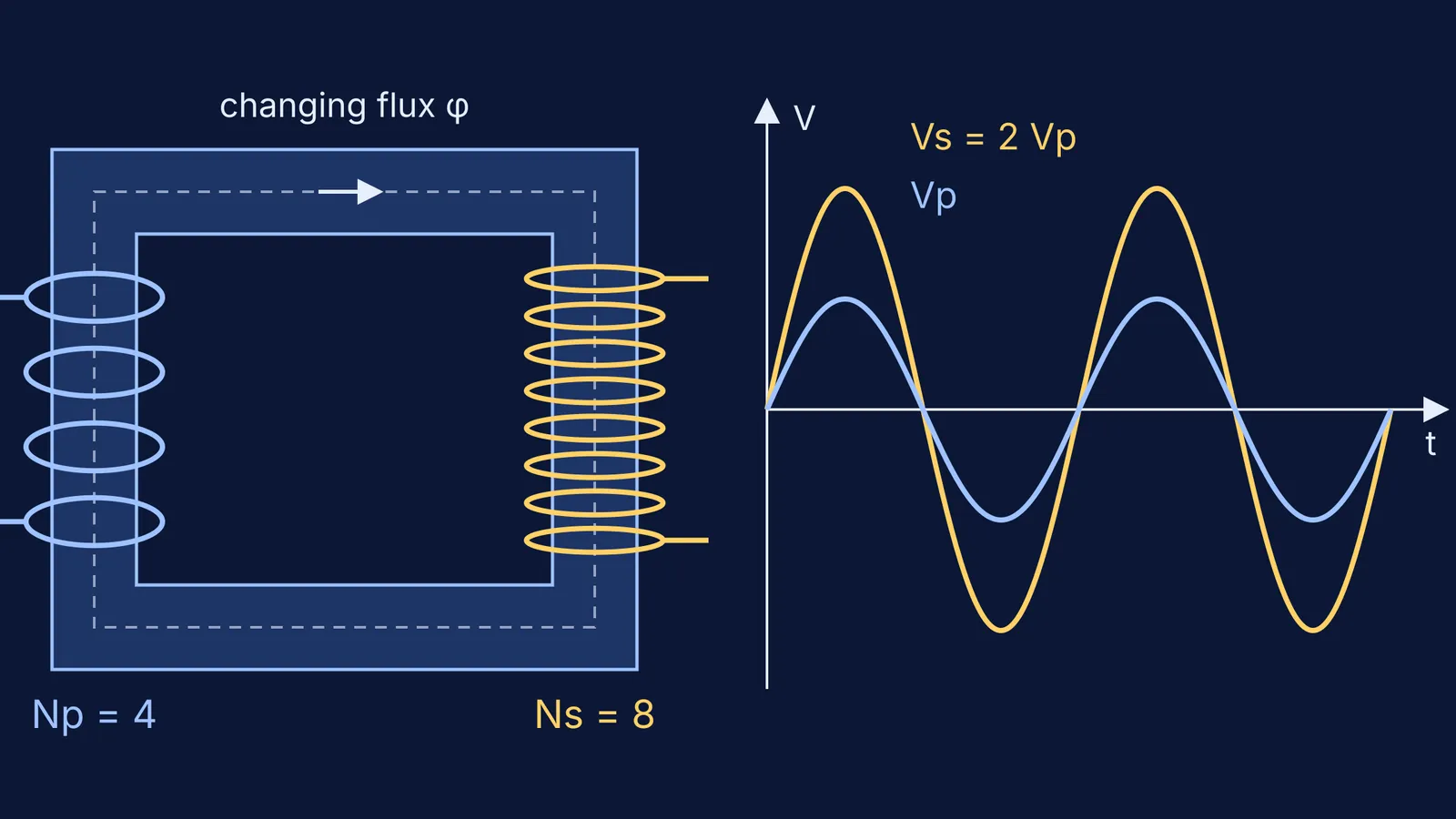
For an ideal transformer, the voltage ratio equals the turns ratio: Vs/Vp = Ns/Np (NCERT Class 12 Physics, equation 7.33).
Current goes the other way: Is = (Np/Ns) Ip, because an ideal transformer gives out the same power it takes in, so Vp Ip = Vs Is (NCERT, equations 7.34 to 7.36).
NCERT's own example: with 100 turns on the primary and 200 on the secondary, a 220 V input at 10 A becomes 440 V at 5.0 A.
More turns on the secondary (Ns > Np) gives a step-up transformer: voltage rises, current falls.
Fewer turns on the secondary (Ns < Np) gives a step-down transformer: voltage falls, current rises.
Stepping up the voltage does not create energy. As OpenStax College Physics puts it, "So if voltage increases, current decreases."
What should you predict before you move the sliders?
Use this routine for every change:
Write the turns ratio Ns/Np as a fraction before you touch anything.
Predict Vs by multiplying Vp by that fraction.
Predict Is from the power balance: Is = Vp Ip / Vs.
Move one slider only, then compare. If the numbers differ, decide whether it is rounding, losses or a flipped ratio.
How do you step 240 V down to 12 V?
NCERT notes that a supply of 240 V reaches our homes. Suppose the primary has 1,200 turns and the secondary has 60.
Ratio: Ns/Np = 60/1,200 = 1/20.
Voltage: Vs = 240 V / 20 = 12 V.
If the load draws 2 A from the secondary, the ideal primary current is Ip = (60/1,200) x 2 A = 0.1 A.
Check the power: 240 V x 0.1 A = 24 W on the input, and 12 V x 2 A = 24 W on the output.
Now make it real. NCERT says a well-designed transformer may have an efficiency of more than 95%. At 95%, the input must be 24 W / 0.95, about 25.3 W, so the primary current is about 0.105 A instead of 0.1 A.
The Fermi Simulation Lab has interactive simulations for ideas that are easier to see than to read; the same predict-then-check habit works in all of them.
Why does a transformer not work on DC?
The secondary voltage comes from Faraday's law: vs = -Ns dφ/dt, where φ is the magnetic flux in the core (NCERT, equation 7.31). A steady DC current makes a steady flux, so dφ/dt is zero and the secondary gets no voltage. OpenStax says that transformers being based on Faraday's law of induction "makes it clear why we cannot use transformers to change DC voltages."
In a simulation, switch the source to DC and watch the secondary: it can show a voltage only while the current changes, as you connect or disconnect, then it reads zero.
There is a second problem. On AC, the changing flux also induces a back emf in the primary that balances the applied voltage; NCERT points out that otherwise the primary current of its ideal, zero-resistance coil would be infinite. On DC there is no back emf, so only the winding's small resistance limits the current, and a real primary heats up while delivering nothing to the secondary.
For the history behind this, read how Michael Faraday discovered electromagnetic induction in 1831, and for the grid side, why India uses 50 Hz AC power.
Where do the energy losses in a transformer come from?
NCERT lists four reasons real transformers lose energy, each with its fix:
Flux leakage: not all the flux from the primary passes through the secondary. Winding one coil over the other reduces it.
Resistance of the windings: the wire heats up (I squared R loss). Thick wire in the high-current, low-voltage winding keeps this down.
Eddy currents: the changing flux induces currents in the iron core itself, which heat it. A laminated core reduces them.
Hysteresis: the core's magnetisation reverses every cycle, and that energy appears as heat. A core material with low hysteresis loss keeps it small.
These losses are small. NCERT says a well-designed transformer may have an efficiency of more than 95%, and OpenStax says transformer efficiency often exceeds 99%. If you have heard one buzz, our explainer on why electric transformers hum picks up what the alternating field does to the core.
If your answers keep coming out wrong, the Fermi Problem Library has worked problems with a step-by-step solver that explains the reasoning rather than printing an answer.


