

On this page
Look at a corner of your room: two walls and the floor, three flat surfaces meeting at one point. That is the whole idea behind three equations in three unknowns.
What do three equations in three variables mean geometrically?
The points satisfying x + y + z = 6 form a flat plane in space. MIT's linear algebra course calls this the row picture, and its notes say: "The solution to a three dimensional system of equations is the common point of intersection of three planes (if there is one)" (MIT OpenCourseWare 18.06SC, The geometry of linear equations).
So "how many solutions?" becomes "how can three planes meet?"
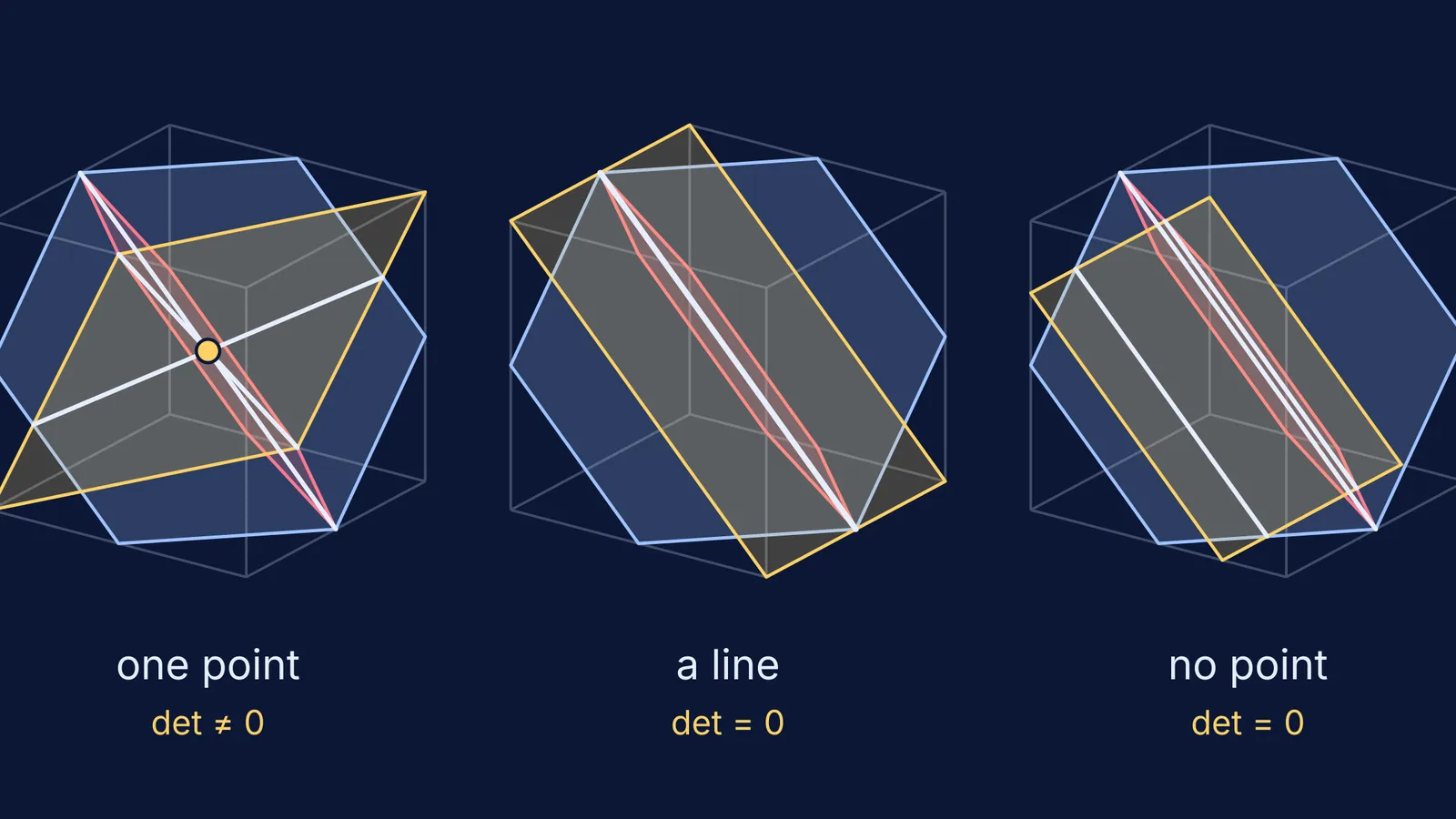
One point, like the corner of a room: one solution.
A line, like pages of an open book around the spine: infinitely many solutions. (Three copies of the same plane also give infinitely many.)
Nowhere: two planes are parallel, or the three pairwise lines run side by side like the edges of a triangular prism. No solution.
How does the determinant decide the number of solutions?
Write the system as AX = B, with A the matrix of coefficients. The NCERT Class 12 Mathematics textbook (Chapter 4, Section 4.6) calls a system consistent if one or more solutions exist and inconsistent if none does, and sets out the cases (NCERT Class 12 Mathematics, Chapter 4):
If |A| ≠ 0, X = A⁻¹B is the unique solution.
If |A| = 0 and (adj A)B ≠ O, there is no solution.
If |A| = 0 and (adj A)B = O, there may be infinitely many solutions or none.
Why? Each row of A is the normal of one plane, the arrow that fixes its tilt. MIT's course notes that "the absolute value of the determinant gives the volume of a box" (MIT OpenCourseWare, Cramer's rule, inverse matrix and volume). Build that box from the three normals. If |A| = 0 the box is flat, so some direction runs parallel to all three planes. Planes sharing a direction cannot pin down one point: they share a line or plane, or never all meet.
Worked example: move one plane, watch the answer change
Keep two planes fixed: P1 is x + y + z = 6 and P2 is x − y + z = 2. Subtracting gives y = 2, and then x + z = 4. That is the line where P1 and P2 meet. Now pick the third plane.
Case 1: 2x + y − z = 1. |A| = 1(1 − 1) − 1(−1 − 2) + 1(1 + 2) = 6. Substituting y = 2 and z = 4 − x gives 3x − 2 = 1, so x = 1, z = 3. One solution: (1, 2, 3).
Case 2: 2x + 2z = 8. This is P1 + P2, so it contains their line. |A| = 1(−2) − 1(0) + 1(2) = 0. The adjoint has rows (−2, −2, 2), (0, 0, 0), (2, 2, −2), so (adj A)B = (0, 0, 0). Every point (t, 2, 4 − t) works: infinitely many solutions.
Case 3: 2x + 2z = 5. Same tilt, shifted. |A| is still 0, but (adj A)B = (−6, 0, 6). On the line of P1 and P2, 2x + 2z is always 8, never 5. No solution: the prism.
Cases 2 and 3 share A and its determinant; only B changed. So "find k for which the system has no solution" takes two steps: set |A| = 0 to get candidate values of k, then test B.
A four-step check for exam questions
Find |A|. Non-zero means one solution; get it from A⁻¹B or Cramer's rule.
If |A| = 0, compute (adj A)B. Non-zero means no solution.
If (adj A)B = O, eliminate a variable. A false line like 0 = 3 means no solution; 0 = 0 means infinitely many.
Name the picture: a point, a line (or plane), or no common point.
Step 3 matters. For the parallel planes x + y + z = 1, 2 and 3, adj A is the zero matrix, so (adj A)B = O, yet no point lies on all three. This is the case NCERT's "may be either consistent or inconsistent" warns about.
If the arithmetic slows you down, see our guide to evaluating determinants with row operations, or using Cayley–Hamilton to find a matrix inverse for another route to A⁻¹.
Why move the planes yourself?
A textbook figure freezes one case. Sliding a plane and watching the meeting point stretch into a line or vanish makes the cases stick. Predict before each move whether |A| changes. Simulations have limits, which our piece on what simulations can and cannot teach covers.
The Fermi Simulation Lab has interactive simulations for ideas that are easier to see than to read. When a "find k" question keeps going wrong, the Fermi Problem Library has worked problems with a step-by-step solver that explains the reasoning rather than printing an answer.
Next time, find |A| first, then picture the corner of the room.


