On this page
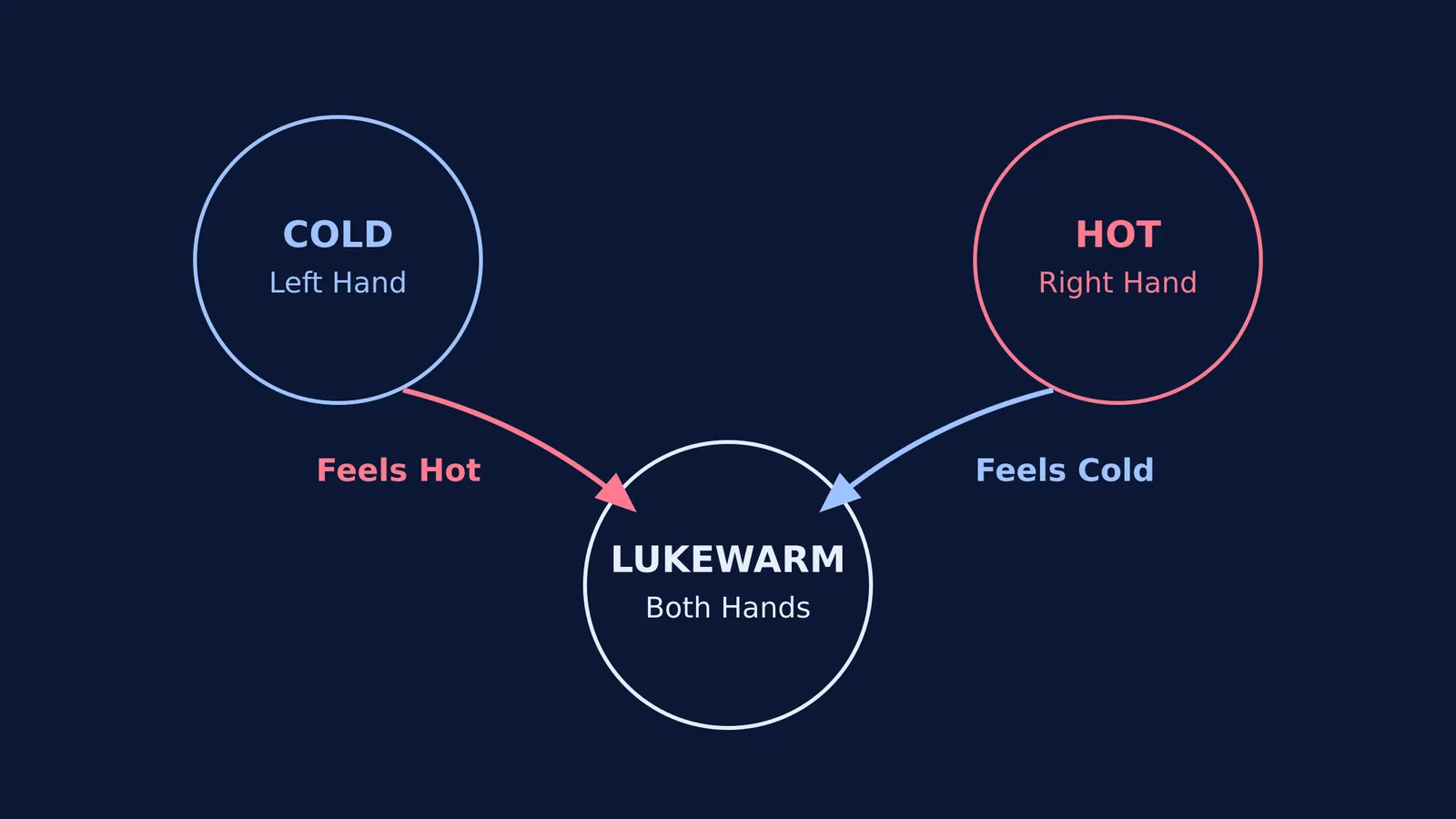
In 1690, the philosopher John Locke described a simple setup in his book An Essay Concerning Human Understanding. He proposed placing one hand in hot water and the other in cold water, then moving both into a single basin of lukewarm water.
Locke argued that if heat were an objective property—what he called a "primary quality" like size or shape—it would be impossible for the exact same water to be both hot and cold simultaneously. Therefore, he concluded that temperature is a "secondary quality," meaning it is a perception created in the mind rather than a physical property of the object itself. While modern physics defines temperature objectively as average kinetic energy, Locke was entirely correct about how our biology perceives it. Modern science has since explained exactly why this sensory illusion works.
How to test the three bowls experiment: hot, cold, lukewarm water?
You can test Locke's premise at home to see how your skin adapts.
Fill Bowl A with cold water (add ice to drop the temperature).
Fill Bowl B with hot water (warm enough to feel hot, but safe to touch).
Fill Bowl C with lukewarm water (room temperature).
Submerge your left hand in Bowl A and your right hand in Bowl B for 60 seconds.
Move both hands into Bowl C simultaneously.
Your left hand will immediately feel that the lukewarm water is hot. Your right hand will feel the exact same water as freezing cold.
Why does the same lukewarm water feel hot and cold?
Our skin is not a thermometer. Instead of measuring absolute temperature, our sensory nerves act as differential sensors that detect relative changes.
In 2021, the Nobel Prize in Physiology or Medicine was awarded to David Julius and Ardem Patapoutian for discovering the specific receptors responsible for this sensation. Before their work, scientists knew that sensory nerves reacted to heat, but they did not know how physical temperature was converted into electrical signals in the nervous system.
David Julius used capsaicin, the pungent compound in chilli peppers, to identify TRPV1, an ion channel that detects painful heat above 43 °C. His team and Patapoutian's team independently used menthol to identify TRPM8, a receptor that fires in cold temperatures. These discoveries proved that we have specific molecular thermometers built into our nerve endings.
When you hold your right hand in hot water, your TRPV1 heat receptors adapt and become desensitised to the constant heat. This biological process slows the channel's firing rate, effectively raising your skin's definition of "normal" temperature. As soon as you plunge that hand into lukewarm water, the temperature drops sharply relative to what the skin has adapted to. This sudden drop causes your cold receptors to fire vigorously, while your heat receptors remain silent, making the water feel freezing.
The opposite happens to your left hand. After adapting to the cold, its TRPM8 receptors desensitise. Plunging it into lukewarm water causes a relative surge in heat, firing the warm receptors and sending a strong "hot" signal to your brain.
Why does skin measure relative temperature change?
Sensory adaptation is an evolutionary advantage. If our nervous system constantly fired at full strength to report the ambient temperature, we would be overwhelmed by harmless background noise. By adapting to a constant baseline, our skin remains highly sensitive to sudden changes. A sudden change is much more likely to signal a threat, such as touching a burning surface or stepping into freezing water.
You can observe similar relativity when metal feels colder than wood at the same temperature. The metal draws heat away from the skin faster, creating a sharper temperature drop that triggers the cold receptors more intensely. For another sensory trick, consider why mint feels cold in your mouth: the menthol physically binds to the TRPM8 cold receptors, tricking your brain into feeling a temperature drop without any physical cooling.
This reliance on perception rather than absolute measurement is also why students often experience heat energy vs temperature confusion when first learning thermodynamics.
How can you explain the experiment to a child?
If you are doing this experiment with a teenager or a younger child, you can guide them to the right conclusion without giving away the answer.
Use this script to prompt their reasoning:
Before the transfer: "How does the water in the left bowl feel compared to the right bowl?"
During the transfer: "When you put both hands in the middle bowl, what does your left hand feel? What does your right hand feel?"
The contradiction: "Are both of your hands in the exact same water? How can the same water be both hot and cold at the same time?"
The revelation: "What if your skin isn't measuring the water at all, but only measuring the *difference* between the last bowl and this one?"
Predict and test with Fermi
Testing physical properties before reading the theory builds much stronger intuition. Before you try an experiment, predict the outcome. Predicting the result helps you notice when your mental model is incomplete.
For the ideas that are easier to see than to read, you can use the Fermi Simulation Lab. When you tackle a new scientific mechanism, Fermi's AI tutor works out what you already know, builds a plan for the session, and teaches through it—checking your understanding as it goes.