

On this page
If you have ever eaten a strong mint and then taken a sip of water, you know the sensation: the water feels freezing cold, almost painfully icy. But if you were to measure the temperature of your mouth, you would find it hasn't changed at all. The cooling effect of mint is not physical; it is a biological trick played on your nervous system. The secret lies in a molecular mimic called menthol and how it interacts with the nerve endings that sense temperature.
How does your body sense cold?
Your skin and mouth are lined with sensory neurons that detect temperature. Embedded in the membranes of these neurons is a specialized protein called TRPM8 (Transient Receptor Potential Melastatin 8). It was identified as a cold and menthol receptor in 2002 by researchers in the lab of David Julius, who later won a Nobel Prize for his work on temperature sensation.
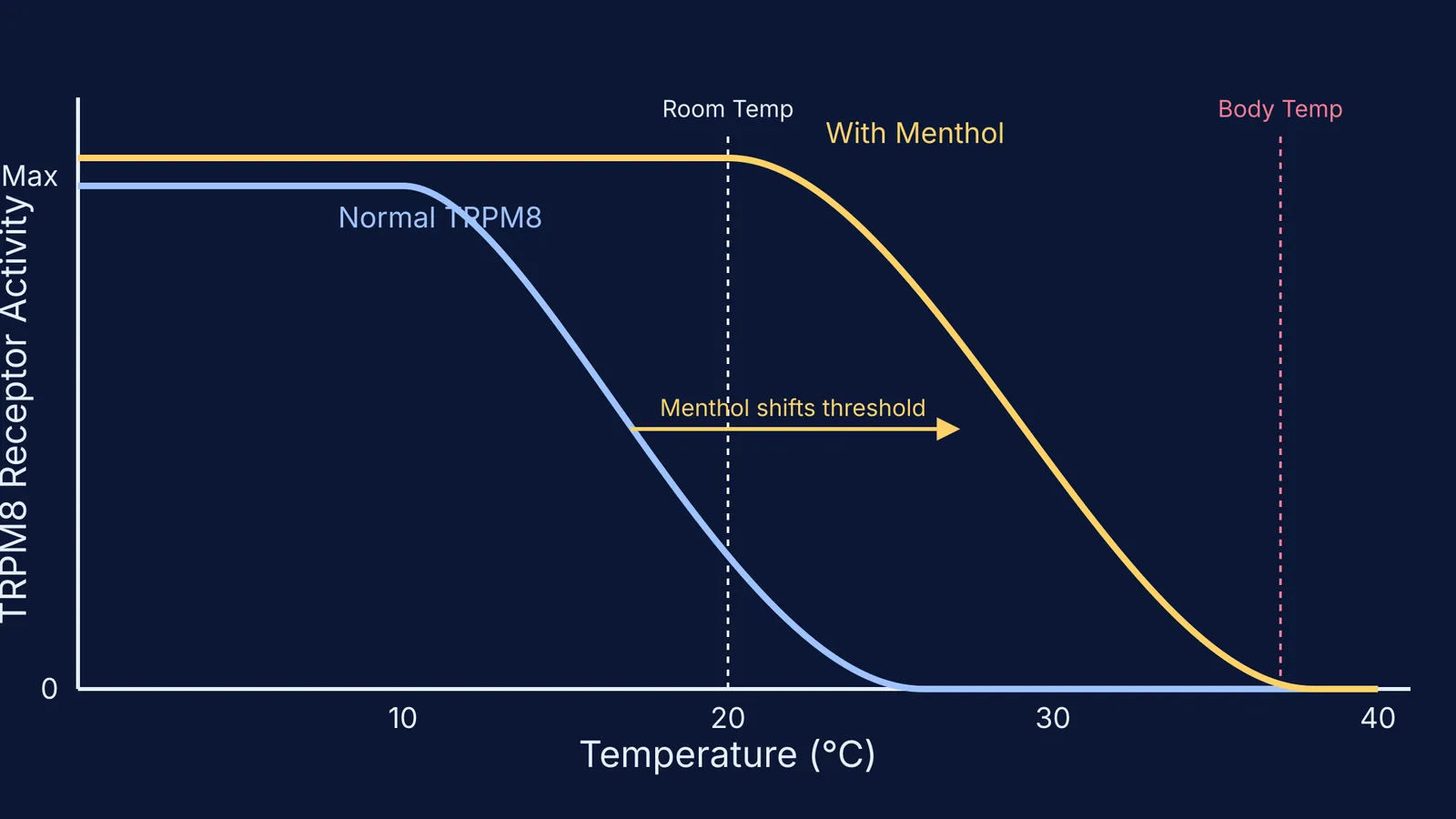
TRPM8 acts as a microscopic thermometer. Under normal conditions, this membrane receptor is activated when the temperature drops into the range of 8 °C to 26 °C. When the surrounding tissue gets cold, the TRPM8 channel undergoes a physical change in shape. It opens its pore, allowing positively charged ions like calcium and sodium to rush into the nerve cell. This sudden flow of ions alters the electrical charge across the cell membrane, firing an action potential. This electrical signal travels to your brain, which interprets the incoming message as a feeling of "cold".
What does the menthol trick do?
Mint plants naturally produce menthol, a small organic molecule that serves as a defence mechanism against herbivores. In humans, however, menthol happens to fit perfectly into a specific binding pocket on the TRPM8 receptor.
Menthol does not lower the temperature of your mouth. Instead, it acts as a molecular mimic. When it binds to the TRPM8 protein, it forces the ion channel to open, exactly as if the temperature had dropped. Because the channel is open, the neuron fires. Your brain receives a steady stream of "cold" signals and has no way to tell whether the channel was opened by a physical drop in temperature or by a chemical like menthol. The result is the familiar, freezing sensation of mint.
Why does water feel icy after mint?
This mechanism also explains why drinking a glass of room-temperature water immediately after eating a mint feels shockingly cold. Menthol does not just open the TRPM8 channel; it chemically sensitises it.
When menthol is present in your mouth, the receptor's activation threshold shifts. Normally, the receptor might require a temperature below 26 °C to activate. With menthol bound to it, the channel becomes much easier to open, even at higher temperatures. When you add a slight physical chill — such as a sip of water or even a breath of ambient air — to a mouth already primed by menthol, the sensitised receptors react with intense firing. The combined effect of the chemical and the slight temperature drop sends an exaggerated, powerful signal to the brain, turning a mild cooling sensation into an icy blast.
What this means for learning biology
For biology students, the menthol story is a perfect real-world example of how receptors and the nervous system work. It shows that sensory perception is not just a direct window to the physical world, but a highly specific biochemical process governed by how molecules bind to proteins.
If you struggle to picture how ions cross a membrane, how a receptor changes its shape, or how an action potential propagates down a neuron, the Fermi Simulation Lab lets you interact with cell membranes and see these mechanisms in action. Visualising these invisible processes often makes the difference between memorising a fact and truly understanding how a system works.
Try this yourself: The next time you revise sensory organs, take ten minutes to map out the complete pathway. Trace the signal starting from the TRPM8 receptor in the mouth, continuing along the sensory neuron, through the spinal cord, and all the way to the sensory cortex in the brain. Understanding the chemistry behind a common sensation is often the best way to make abstract biology stick in your memory.


