

On this page
You already have the notes. Text-to-speech, the read-aloud feature built into most phones and laptops, can turn them into audio for the bus, the auto or the walk to school. The real question is whether hearing your notes counts as revision, or only feels like it.
Can listening to notes with text-to-speech help revision?
Yes, the format itself is not the problem. In a 2016 experiment, 91 participants were randomly assigned to read a non-fiction chapter as e-text, hear it as an audiobook, or do both at once, and Rogowsky, Calhoun and Tallal found no significant difference in comprehension, either straight after or two weeks later.
Two other studies add a warning. When Daniel and Woody gave students a primary source as a podcast or as text, the podcast group scored lower on the quiz, and the students' early preference for podcasts changed straight after the quiz. And in a study by Varao Sousa, Carriere and Smilek, listening to a passage led to more mind wandering and poorer memory than reading it silently or aloud.
Put together: your ears can learn as well as your eyes, but attention drifts more easily when audio is just playing at you.
Why does listening to notes feel like learning when it is not?
Playing a recording again is rereading with headphones. A major review of ten study techniques by Dunlosky and colleagues rated rereading as low utility, and gave the highest ratings to practice testing and spreading study out over time.
The testing effect shows why. In Roediger and Karpicke's experiments, students who took recall tests on prose passages remembered substantially more after two days and a week than students who restudied, even though restudying made students more confident. We wrote about the same idea in a five-minute recall before each class.
How do you turn notes into audio that quizzes you?
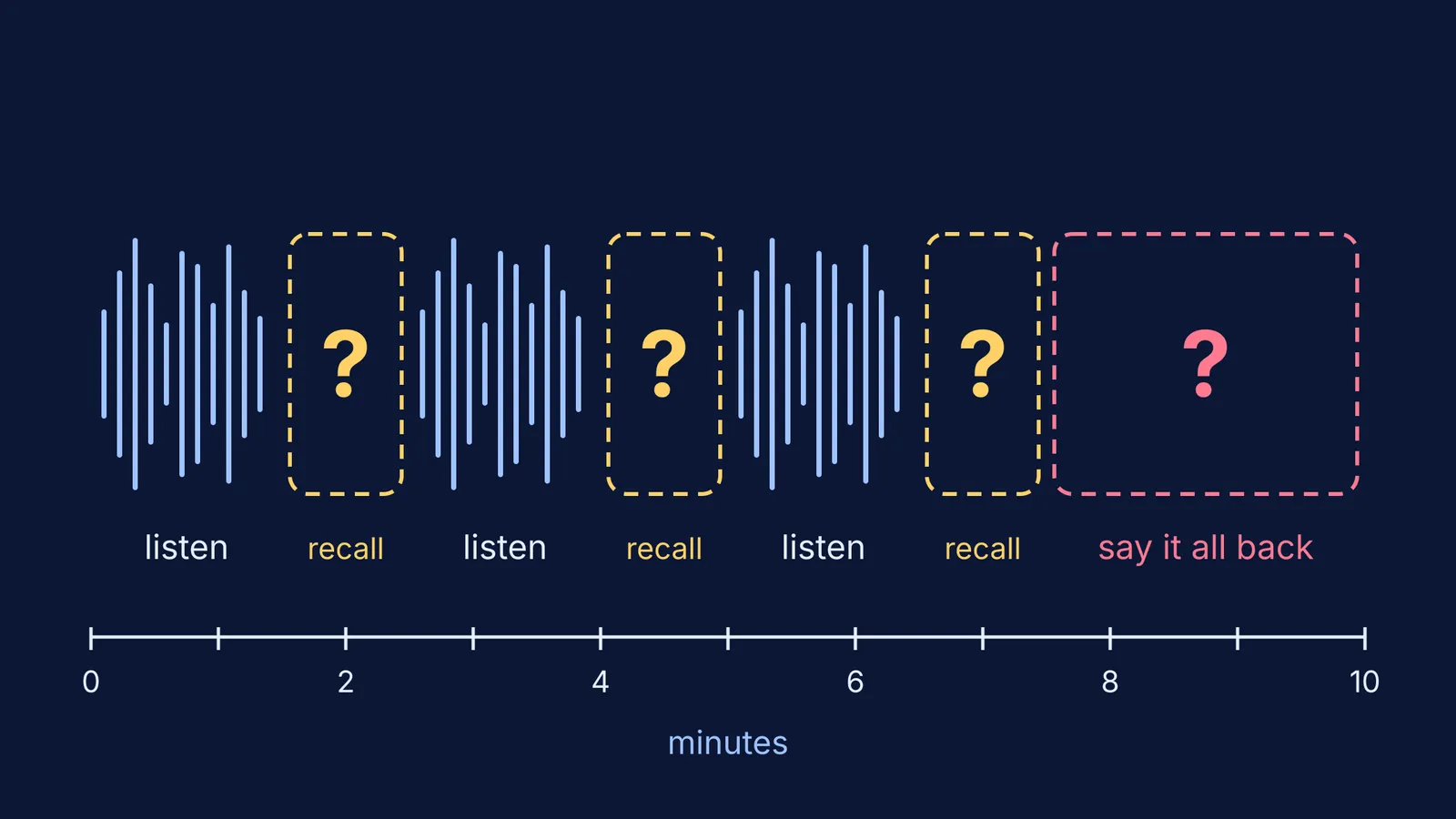
Rewrite one page of notes as questions and answers first, then make the audio.
Pick one topic and write a handful of questions from your notes, each with a short answer of one or two sentences.
Before each answer, write a cue such as "Pause and answer now." If your app does not leave a gap, keep a thumb on pause.
Paste the text into your phone's read-aloud or a text-to-speech app and save it as one short track per topic.
When you hear a question, pause and say the answer out loud or in your head before you let it play.
End every track with: "Now say everything you remember about this topic." Then check your notes when you get off the bus.
Here is a worked example from Class 11 chemistry:
"Question one. Why does ionisation energy generally increase across a period? Pause and answer now." Answer: nuclear charge rises while electrons go into the same shell, so the outer electrons are held more tightly and atoms get smaller.
"Question two. Why is the first ionisation energy of nitrogen higher than that of oxygen? Pause and answer now." Answer: nitrogen's half-filled 2p subshell is extra stable, while in oxygen one 2p orbital holds a pair of electrons whose repulsion makes one easier to remove.
Audio is only as good as the notes behind it, so check them first; our guide to asking AI to check your notes for mistakes walks through it.
Should you record your own voice instead of using text-to-speech?
It may help a little. In a memory experiment by Forrin and MacLeod, people remembered words they had recorded and then heard in their own voice better than words spoken by someone else, though less well than words they said aloud themselves. That study used word lists, not textbook chapters, so treat it as a nudge rather than a rule.
A practical split: text-to-speech for long notes, your own recording for topics you keep forgetting. Either way, saying the answer before the audio does is what matters.
How do you fit audio revision into a busy week?
Make tracks on Sunday for the topics you studied that week.
Play one or two tracks on each commute; our post on studying during a long college commute has more ideas for that time.
Mark the questions you missed and move them into the next day's track.
Keep problem-solving for the desk. Audio suits definitions, reasons and sequences, not long numericals.
Parents can help by asking one question from the track at dinner, rather than asking whether it was played.
If a question keeps coming back wrong, the Fermi Concept Library has a lesson for every concept in physics, chemistry, biology, mathematics and computing. And if you are not sure where to start, Fermi's AI tutor works out what you already know and builds a plan for the session.
Tonight, turn one page of notes into questions and listen to it on tomorrow's ride.


