

On this page
A long trip to college is more than just an inconvenience. It is time that you are not studying, resting or sleeping.
When you add up the hours spent waiting for trains, sitting on buses or walking to campus, the weekly total often rivals a part-time job. But if you plan ahead, you can turn this "dead" time into one of the most productive parts of your day.
Does a long commute affect your grades?
Research shows a clear link between travel time and academic performance, primarily because commuting crowds out other essential activities. A massive StudentMoveTO survey reported that 30% of postsecondary students in the Greater Toronto Area commute for more than two hours round-trip daily (source). When students lose over ten hours a week to transit, the gap in available study time often leads directly to lower grades and increased academic stress. Many commuters find that by the time they reach home, fatigue prevents them from completing complex assignments.
The challenge is structural rather than a lack of motivation. You cannot easily open a textbook, solve a calculus problem, or write an essay while standing on a crowded train or waiting at a bus stop.
What should you study on the bus or train?
To reclaim this lost time, you must adapt your study habits to the environment. The trick is to match the cognitive load of the task to the stability of your commute.
Psychologist William James noted early on that habits define our daily productivity. If you build a specific habit for your commute, your brain will switch into study mode as soon as you board the bus.
0–10 minutes (Walking or waiting): Avoid screens entirely. Use this time for mental recall. Pick one concept from yesterday's lecture and try to explain it silently to yourself. Alternatively, listen to an educational podcast.
10–30 minutes (Standing or short rides): Do rapid, high-yield tasks. This is the perfect window for digital flashcards. You do not need a desk or a pen to flip through a deck on your phone.
30+ minutes (Seated on a long haul): If you are seated and have a stable ride, you can engage your working memory more deeply. Read new material or review complex diagrams. If you are stuck on a difficult topic, you can read the Fermi Concept Library to see how it works.
Why does spaced repetition work on a commute?
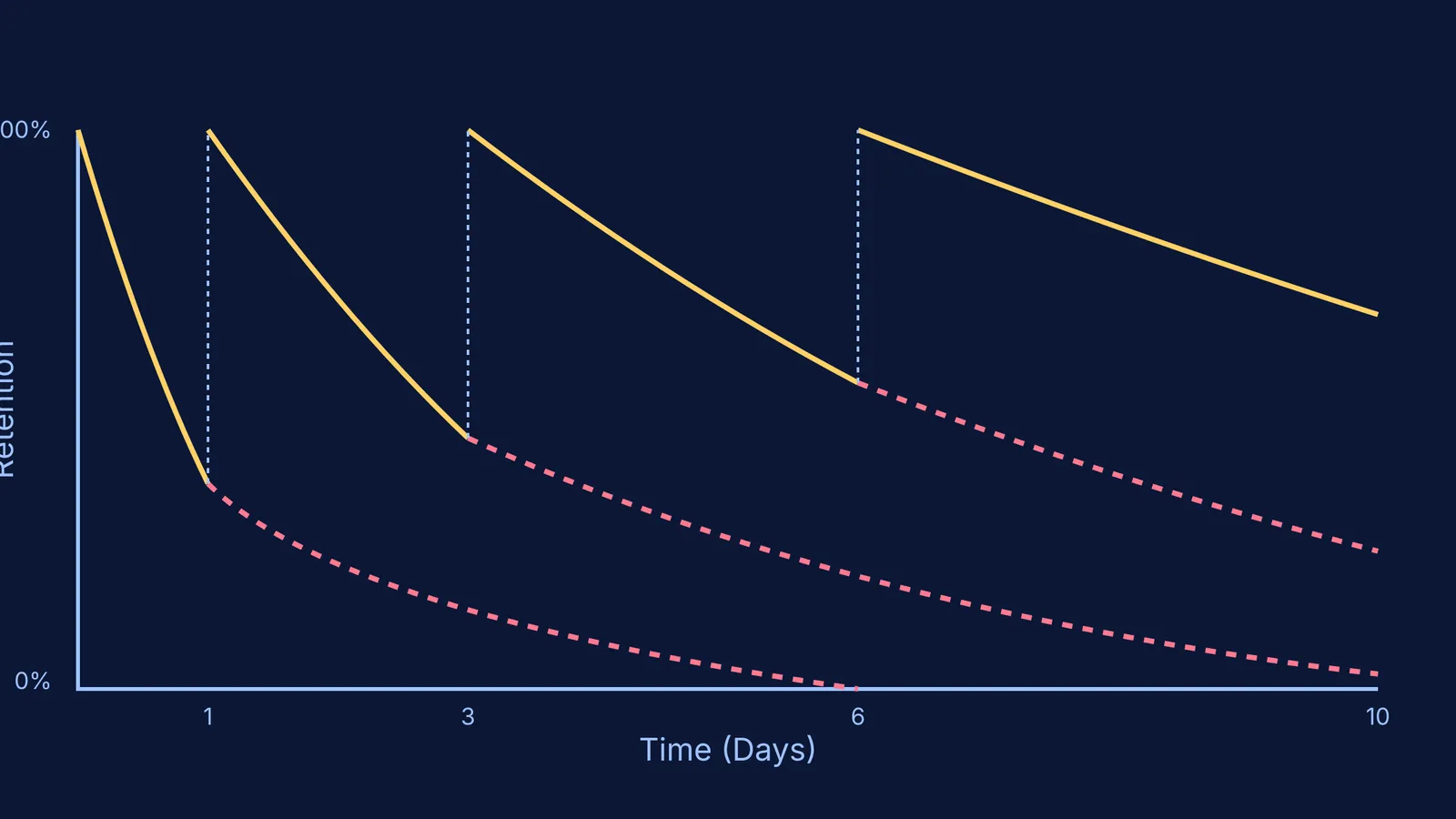
German psychologist Hermann Ebbinghaus discovered that memory decays exponentially if left alone. Immediately after a lecture, your retention drops sharply. However, every time you actively recall the information, you reset the curve and decrease the rate of forgetting.
A daily commute provides the perfect natural rhythm for this "spacing effect." If you have a one-hour journey every morning and evening, you have built-in windows for review. Instead of cramming for four hours on a Sunday, spending just 20 minutes on the bus each day produces far stronger memories. The famous Dunlosky review of study techniques rated active recall (testing yourself) and distributed practice (spacing out your study) as the most effective methods for long-term retention.
This is where mobile apps excel. Spaced-repetition software automates the schedule. The algorithm tracks which facts you struggle with and shows them to you just before you are likely to forget them. You only need one hand and a few minutes to clear your daily deck.
How to keep safety and focus in mind?
Safety must come first when studying outside the classroom. Never look at flashcards, read notes or stare at your phone while walking, crossing streets or driving. The risk of distraction is simply too high.
When you are in motion, stick strictly to audio-only materials or silent mental review. Save the visual tasks for when you are safely seated on a bus or train.
When you finally get home and sit down to work through your assignments, the concepts you reviewed on the train will be fresh in your mind. If you need help with the details, the Fermi Problem Library explains the reasoning behind each step. By splitting your work this way—memorising on the move and solving problems at your desk—you can commute for hours without falling behind.


