

On this page
Surface area is the amount of paper you would need to wrap a solid with no overlaps. The easiest way to see it is to unfold the solid flat. That flat pattern is called a net. Once the shape is flat, you only need areas you already know: squares, rectangles, circles and sectors.
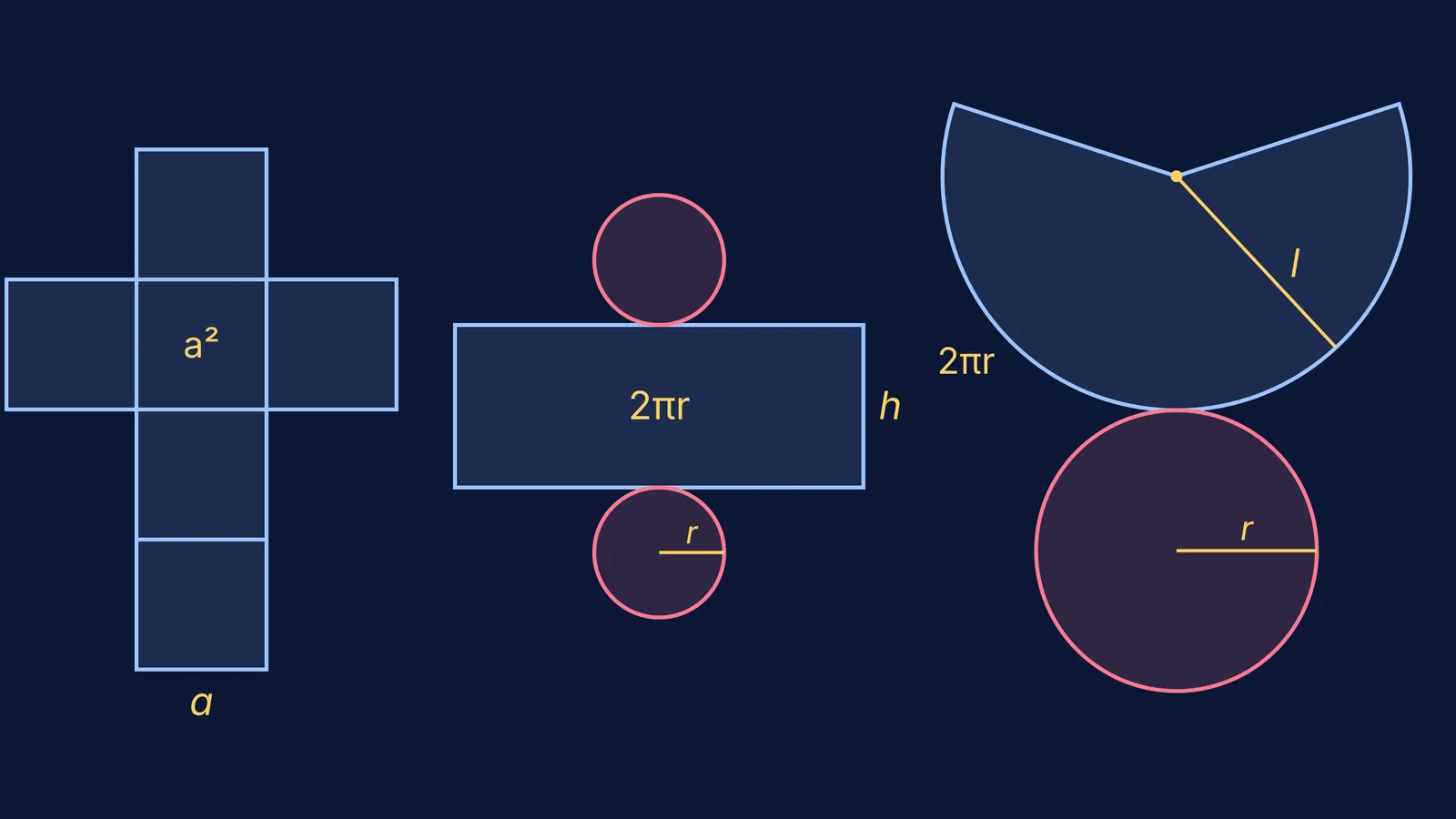
Below we unfold a cube, a cylinder and a cone. Guess each piece's area before working it out. The cone gets the most space.
What is a net, and why does it give the surface area?
A net is a 2D shape that folds up into a 3D solid with every face covered exactly once. Folding doesn't stretch the paper, so the total area of the net equals the surface area of the solid.
Not every pattern of six squares folds into a cube. We go through how to tell which ones work in which cube nets fold into a cube.
How do you find the surface area of a cube and a cylinder from their nets?
Cube. The net is six equal squares of side a, so the total is 6a². NCERT's Class 10 Surface Areas and Volumes chapter uses the same rule in its worked example: a cube of edge 5 cm has total surface area 6 × 5 × 5 = 150 cm².
Cylinder. Slit the curved side straight down and flatten it into a rectangle of height h and width 2πr, the circumference. So the curved surface is 2πrh. The two ends are circles of area πr² each, giving 2πrh + 2πr² for a closed cylinder. NCERT's toy-rocket example uses 2πrh plus just one base, because the other end is hidden under the cone.
For r = 1 cm and h = 2.5 cm, the rectangle is 2π × 2.5 = 5π ≈ 15.7 cm², and the two circles add 2π ≈ 6.3 cm², for a total of about 22.0 cm².
How do you find the surface area of a cone using its net?
Cut a cone from its rim straight up to the tip and flatten the curved part. It doesn't turn into a triangle. It turns into a sector, a slice of a circle. Two facts about that sector give you the whole formula:
Its radius is the slant height l, because every line from the tip to the rim has length l.
Its arc is the rim of the base, so the arc length is 2πr.
The Wikipedia article on the cone describes this sector: it has radius √(r² + h²), arc length 2πr and central angle 2πr/l in radians, which works out to 360° × r/l.
The area of a sector is ½ × radius × arc length, just as a triangle's area is ½ × base × height. So the curved surface area is ½ × l × 2πr = πrl. Add the base circle and the total surface area is πrl + πr² = πr(l + r). Wolfram MathWorld's cone entry gives the same lateral area, with the slant height l = √(r² + h²).
What is the surface area of a 3-4-5 cone?
Take a cone with base radius r = 3 cm and height h = 4 cm, and use the slant height and sector angle from the cone article above.
Slant height: l = √(3² + 4²) = 5 cm.
Predict the sector angle: 360° × 3/5 = 216°. That's more than a semicircle but less than a full circle.
Area of the sector: (216/360) × π × 5² = 15π ≈ 47.1 cm².
Check with the formula: πrl = π × 3 × 5 = 15π. The two answers match.
Base: π × 3² = 9π ≈ 28.3 cm².
Total: 24π ≈ 75.4 cm².
Mixing up l and h is a common slip on cone questions. We explain it in cone slant height vs height. The difference between "curved" and "total" is covered in curved vs total surface area.
How can you check the cone formula with paper?
You need a compass, a protractor, scissors and tape. The numbers below follow the sector rule from the Wikipedia cone article.
Draw a circle of radius 5 cm.
Mark a 216° sector and cut it out.
Tape the two straight edges together. The rim should be about 2π × 3 ≈ 18.8 cm, a base radius of 3 cm, and the height close to 4 cm.
Roll the leftover 144° piece. Predict first: 5 × 144/360 gives a base radius of 2 cm, and √(5² − 2²) ≈ 4.6 cm gives the height.
The two curved areas add up to the full circle: 15π + 10π = 25π.
If folding is hard to picture without paper, the Fermi Simulation Lab has interactive simulations for ideas that are easier to see than to read. For a mixed question such as a cone on a hemisphere, the Fermi Problem Library has a step-by-step solver that explains the reasoning rather than printing an answer.
Next time you meet a new solid, ask yourself what shape each face becomes when it lies flat.


