

On this page
A net is a flattened 2D pattern that folds up to make a solid 3D shape. Since a cube has six identical square faces, any net of a cube) must be made of exactly six squares joined at their edges.
If you cut six squares out of paper and try joining them in different ways, you will find 35 distinct arrangements (known mathematically as hexominoes). Of these, exactly 11 distinct patterns can successfully fold into a closed cube. Memorising all 11 is unnecessary if you know how to group them into families and how to spot the shapes that break the rules.
How many nets fold into a cube?
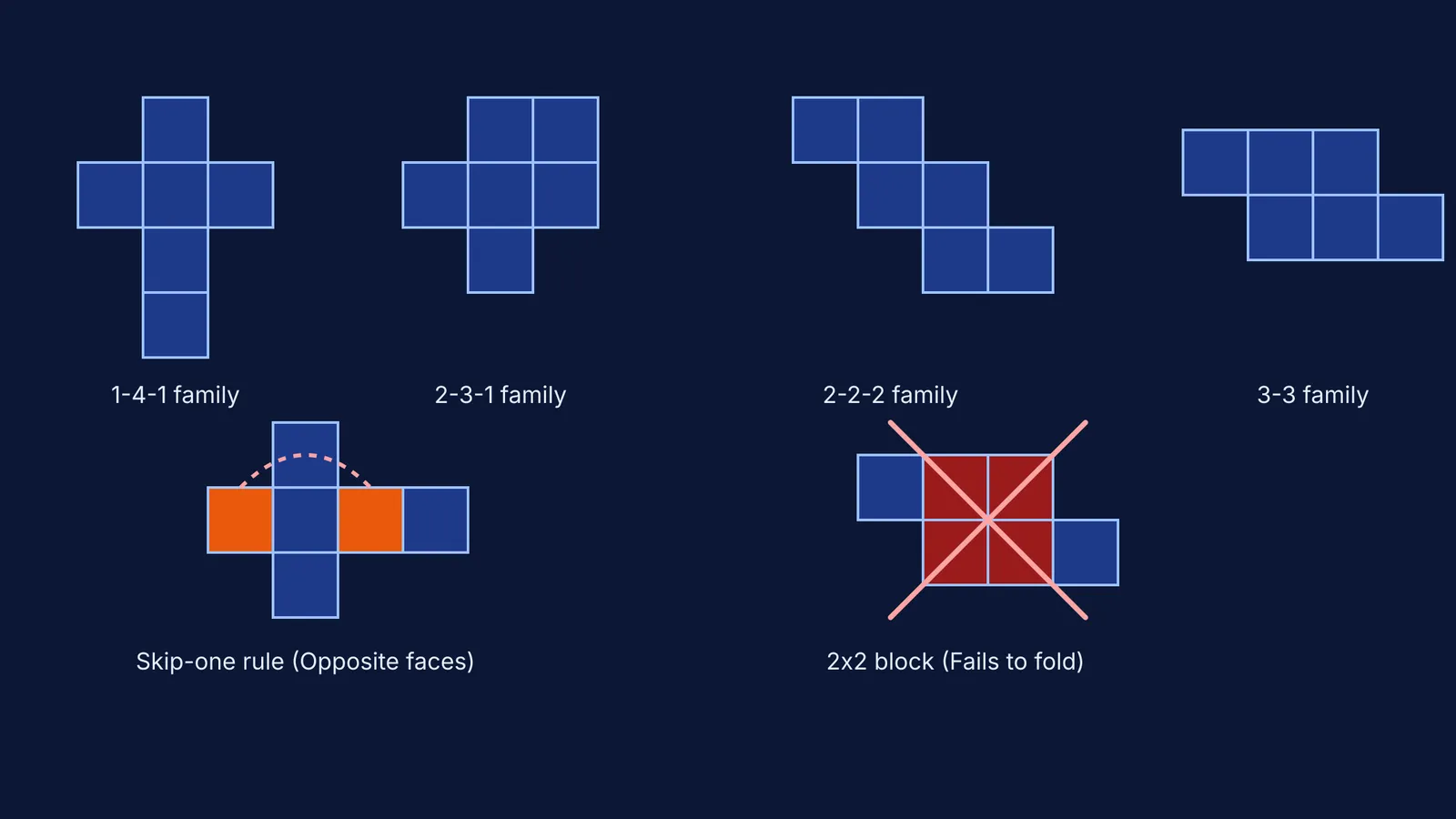
The easiest way to identify the 11 valid nets is to look at their longest straight row of squares. As detailed in the mathematical catalog of hexominoes, this sorts them into four distinct families:
The 1-4-1 family (6 nets): This is the largest group. These nets have a central "spine" of four squares in a row, which will become the four sides of the cube (front, back, left and right) when folded into a box. The two remaining squares are attached to either side of the spine; these will form the top and bottom lids of the cube. The classic cross or "T" shape belongs to this family. As long as the two single squares are on opposite sides of the spine, the shape will fold into a cube. If both squares are on the same side, the top and bottom will overlap and leave one end open.
The 2-3-1 family (3 nets): These nets feature a central row of three squares. A block of two squares is attached to one side of the row, and a single square is attached to the other side. When you fold this net, the row of three bends to form three of the vertical walls, while the block of two swings around to provide the top and the final wall.
The 2-2-2 family (1 net): There is only one net in this group, often called the "staircase". It consists of three pairs of squares, with each pair shifted one step diagonally from the last. Because it has no central axis to wrap around, folding the staircase requires rolling the shape diagonally until all the edges meet.
The 3-3 family (1 net): The final net is made of two rows of three squares. The two rows are staggered by exactly one square, looking like two "L" shapes joined together. Like the staircase, it lacks a long spine, but rolling it up creates a perfect cube.
Quick tests: which shapes fail to fold?
In an exam, you are often asked to pick the valid net out of four options. Instead of trying to fold each one in your head, look for these two impossible structures.
The 2x2 rule Because a hexomino cannot fold into a cube if it contains an O-tetromino, any shape with four squares arranged in a 2x2 block is instantly disqualified. When you try to fold a 2x2 block, three of the squares will meet at the same corner. They will immediately clash and overlap each other, leaving gaps elsewhere on the cube. Any valid net can only have squares joined in lines or staggered steps, never clustered together around a single central point.
The 5-in-a-row rule A cube has four sides wrapped around a central vertical axis, plus a top lid and a bottom base. Because the central "belt" of a cube is exactly four faces long, a net can never have five or six squares arranged in a single straight line. If you fold a row of five squares, the fifth square will wrap all the way around the shape and land directly on top of the first square, leaving the cube without a top or a bottom.
How do you find the opposite faces of a cube net?
Questions on cubes and cube roots in Class 8 or reasoning puzzles often label the faces of a net and ask which two will be opposite each other when folded. Two reliable rules solve these without mental gymnastics:
The skip-one rule In any straight line of three or four squares, the faces separated by exactly one square will always end up opposite each other. Think of the middle square as a hinge or a wall connecting the two outer squares. When folded, that middle square stands upright, forcing the two outer squares to face each other across the gap. If you number a row 1, 2, 3 and 4, face 1 will be opposite face 3, and face 2 will be opposite face 4.
The touching rule If two squares share an edge in the flat 2D net, they will share an edge on the folded 3D cube. They can never be opposite each other. If a multiple-choice drawing shows a finished cube where two faces that touched in the net are now on opposite sides, that drawing is mathematically impossible.
The Z-rule For nets without a long straight line (like the staircase or the 3-3 net), you cannot use the skip-one rule directly. Instead, trace a path through the squares. If you move two squares in one direction, turn a right angle, and move one square further (tracing a short "Z" shape), the square at the start of your path and the square at the end will sit opposite each other on the finished cube.
If a spatial puzzle has you stuck, Fermi's AI tutor works out what you already know and draws the figure on a board to help you build the geometry. Like learning the axioms of an introduction to Euclid's geometry in Class 9, breaking a 3D shape down into a few reliable rules turns a confusing diagram into a solvable problem.


