

On this page
Shops often stack 20% off the tag with an extra 20% at checkout. It sounds like 40% off, but percentage changes do not add up, and a simple bar shows why.
Why is 20 percent off twice not 40 percent off?
Successive percentage changes multiply; they do not add, because each change is measured against a different base, as Wikipedia's article on percentage explains.
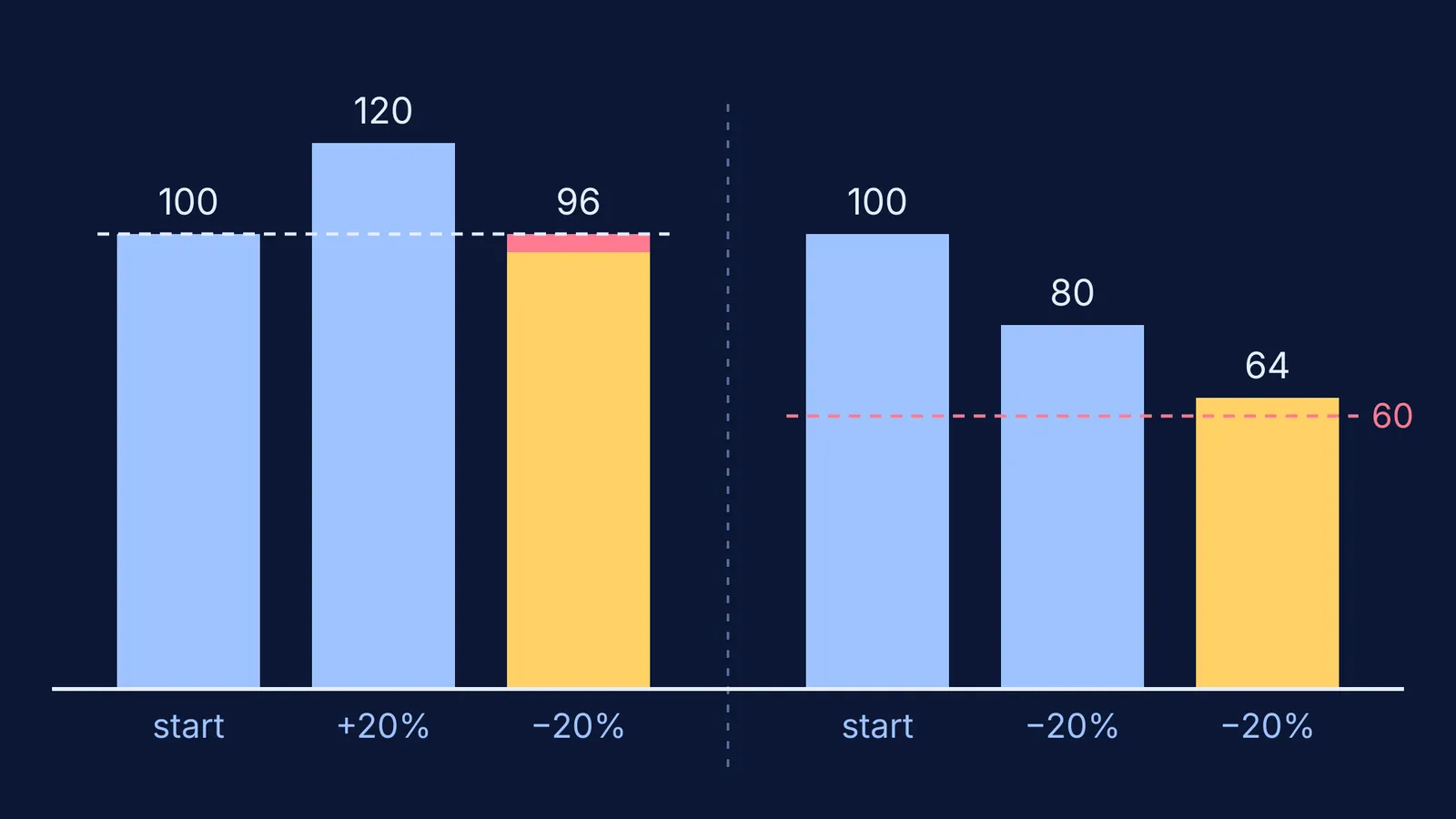
Take a ₹1,000 kurta. The first 20% takes ₹200, leaving ₹800. The second 20% is worked out on ₹800, not on ₹1,000, so it takes only ₹160. You pay ₹640.
A flat 40% discount would have left ₹600. The second discount never touches the ₹200 already gone.
Why does a rise then an equal fall leave you below where you started?
Now push the same ₹1,000 up by 20% to ₹1,200, then down by 20%. The fall takes 20% of ₹1,200, which is ₹240, so you land at ₹960. That is 4% below the start, the effect the same Wikipedia article describes.
The article gives the general result: a rise of x% followed by a fall of x% turns a price p into p(1 + 0.01x)(1 − 0.01x), which equals p(1 − (0.01x)²). Its own example: $200 rises 10% to $220, falls 10% to $198, and ends 1% down.
So the loss is the rate squared: a 10% swing each way costs 1%, a 20% swing costs 4%, a 50% swing costs 25%. Order does not matter; a fall then a rise also ends at ₹960. Recovering from a fall needs a bigger rise, as we show in why a percentage drop needs a bigger rise to recover.
How do you predict the final value in one line?
Use multipliers, the method behind the formula in Wikipedia's percentage article:
Turn each change into a multiplier: a rise of r% becomes 1 + r/100, a fall of r% becomes 1 − r/100.
Multiply the multipliers together.
Subtract 1 and read the result as a percentage change.
Four examples to check yourself:
20% off twice: 0.8 × 0.8 = 0.64, so 36% off in total.
20% up, then 20% down: 1.2 × 0.8 = 0.96, so 4% down.
25% up, then 20% down: 1.25 × 0.8 = 1.00, so exactly back to the start.
50% up, then 50% down: 1.5 × 0.5 = 0.75, so 25% down.
In the third, the fall works on a base of 125, so it removes exactly the 25 the rise added. Always ask "percent of what?", a habit we explain in percentage vs percentage points.
How do you check your prediction on a bar?
Picture a bar 100 units tall, or draw one on squared paper, and predict before you look; the runs follow the multiplier rule from Wikipedia's percentage article.
Predict: write down the final height before touching anything.
Apply the first change and look at the new bar. Say out loud: this is the new 100%.
Predict the second step from the new bar, then apply it.
Explain any gap in one sentence, such as "the fall worked on a taller bar, so it took more".
Try these four runs: 20% up then 20% down; 20% down then 20% up; 25% up then 20% down; and 10% up five times. The last gives 1.1 to the power 5, about 1.61: 61% up, not 50%. That growth on growth is the idea behind compound interest and the number e.
The Fermi Simulation Lab has interactive simulations for the ideas that are easier to see than to read, and the same predict, run, explain habit works there.
Why do so many people get successive percentages wrong?
In a 2007 Journal of Consumer Research paper, Haipeng Chen and Akshay Rao predicted that shoppers may use a "whole number" strategy that yields a systematic error when judging the net effect of a series of percentage changes. In a real-world retail setting, they found that sequential percentage discounts generated more purchasers, sales, revenue and profit than the economically equivalent single discount (abstract on RePEc).
Teachers find it hard too. Sarah Bansilal studied the written answers of 406 in-service Mathematical Literacy teachers in South Africa to a question needing two successive percentage changes for inflation (Pythagoras, 2017). Of those, 260 (65%) could not take account of all the contextual constraints, and 108 reduced it to a one-step calculation.
Whatever the problem, take the second change from what the first left behind, not from the original amount.
If word problems keep tripping you on which base to use, the Fermi Problem Library has worked problems with a step-by-step solver that explains the reasoning rather than printing an answer.
Next time you see two percentages in a row, multiply, then check it on a bar.


