

On this page
Results-day reports said CBSE's Class 12 pass rate went up 0.41 percentage points in 2025. Write "up 0.41 per cent" instead and you describe a different, smaller change. On a small starting number, the two tell very different stories. Below are five worked examples, four from Indian exam and survey data and one with made-up numbers, then a self-test.
What is the difference between percentage and percentage points?
A percentage point is the arithmetic difference between two percentages, so moving from 40% to 44% is a rise of 4 percentage points, even though it is a 10% increase in the quantity itself (Wikipedia: Percentage point).
So there are two calculations:
Percentage-point change = new percentage − old percentage
Percentage change = (new − old) ÷ old × 100
How do you calculate percentage points and percent change?
Example 1, a board-exam pass rate. In 2025, 88.39% of CBSE Class 12 candidates passed, which All India Radio News reported as an increase of 0.41 percentage points over the previous year (All India Radio News). That puts 2024 at 87.98%, the figure Careers360 also gives (Careers360).
Points: 88.39 − 87.98 = 0.41 percentage points
Percent: 0.41 ÷ 87.98 × 100 ≈ 0.47%
Both readings say the change is tiny. That is not always so.
Example 2, a gap between two groups. The same report says girls outperformed boys by 5.94 percentage points (All India Radio News). A gap between two rates is a subtraction, so it is in points. Saying girls' pass rate was "X% higher" would need the gap divided by the boys' pass rate.
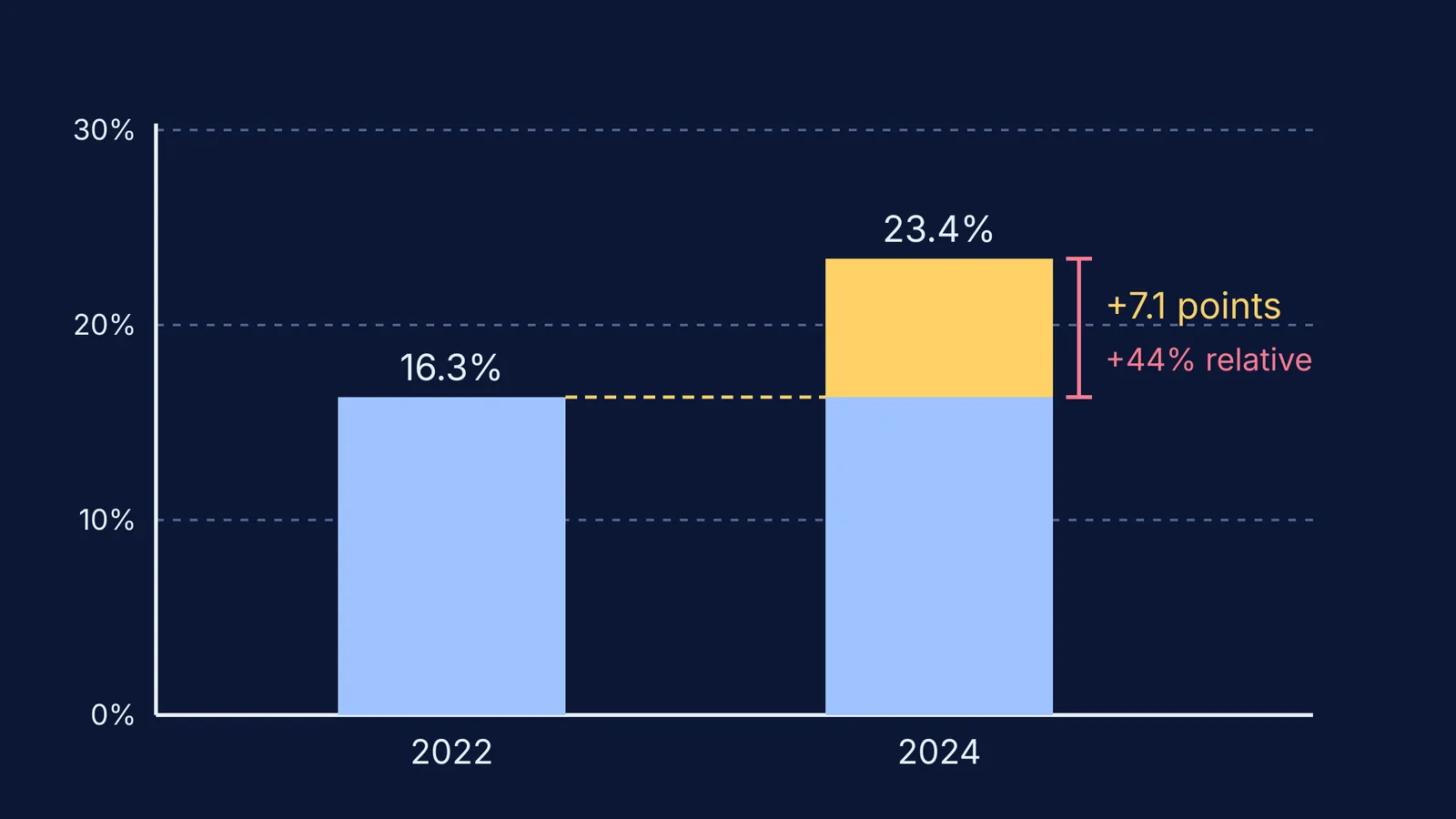
Example 3, a survey that recovered from a low base. ASER 2024, a survey of rural India, found that the share of Std III children in government schools who could read at least a Std II level text was 16.3% in 2022 and 23.4% in 2024 (ASER 2024 national findings).
Points: 23.4 − 16.3 = 7.1 percentage points
Percent: 7.1 ÷ 16.3 × 100 ≈ 44%
"Up 44%" sounds dramatic; "up 7 points" reminds you that about three in four of these children still could not read that text.
Example 4, a cut-off that moves (made-up numbers). Suppose a qualifying cut-off rises from 40% of marks to 50%.
Points: 50 − 40 = 10 percentage points
Percent: 10 ÷ 40 × 100 = 25%
On a 300-mark paper that is 120 to 150 marks, also 25% more. A percentage of marks is not a percentile; our explainer on how JEE Main percentile scores and shift normalisation work covers that difference.
Example 5, a fall, and why the way back looks bigger. The same ASER report says the share of 15-16-year-olds not enrolled in school dropped from 13.1% in 2018 to 7.5% in 2022, and stood at 7.9% in 2024 (ASER 2024 national findings).
Points: 7.5 − 13.1 = −5.6 percentage points
Percent: −5.6 ÷ 13.1 × 100 ≈ −43%
If the figure climbed from 7.5% back to 13.1%, that would be the same 5.6 points but a rise of about 75%, because you now divide by 7.5. Percentage changes are not symmetric; percentage points are.
If you keep dividing by the wrong base in word problems, the Fermi Problem Library has worked problems with a step-by-step solver that explains the reasoning rather than printing an answer.
How can you spot the mix-up in news reports?
Run these checks whenever a headline reports a change in a rate such as a pass rate or turnout:
Find both the old and the new value.
If a story says "up X%" about something that is already a percentage, treat it as ambiguous until you check.
Look at the base. The smaller the starting value, the bigger the percent change for the same number of points.
Gaps between groups (girls and boys, two states, two years) are in points.
Sanity check: on a 0 to 100 scale, a change in points can never exceed 100, but a percent change can.
When someone quotes a big jump, one question settles it: "From what to what?" For the basics, see our guide to percentages, discounts and interest in Class 8, and for the full survey behind examples 3 and 5, read what ASER 2024 found about reading and maths in rural India.
When a maths or science idea is easier to see than to read, the Fermi Simulation Lab has interactive simulations you can explore.
Quick self-test: can you tell them apart?
Voter turnout goes from 60% to 66%.
A school's pass rate falls from 80% to 72%.
A loan rate of 5% is reported as "up 2%".
A rate goes from 3% to 6%.
Group A passes at 70%, group B at 63%.
Answers:
Up 6 percentage points, a 10% rise.
Down 8 percentage points, a 10% fall.
Ambiguous: 7% if it means 2 points, or 5.1% if it means a 2% relative rise.
Up 3 percentage points, a 100% rise, because the rate doubled.
A gap of 7 percentage points; A's rate is about 11% higher than B's (7 ÷ 63).


