

On this page
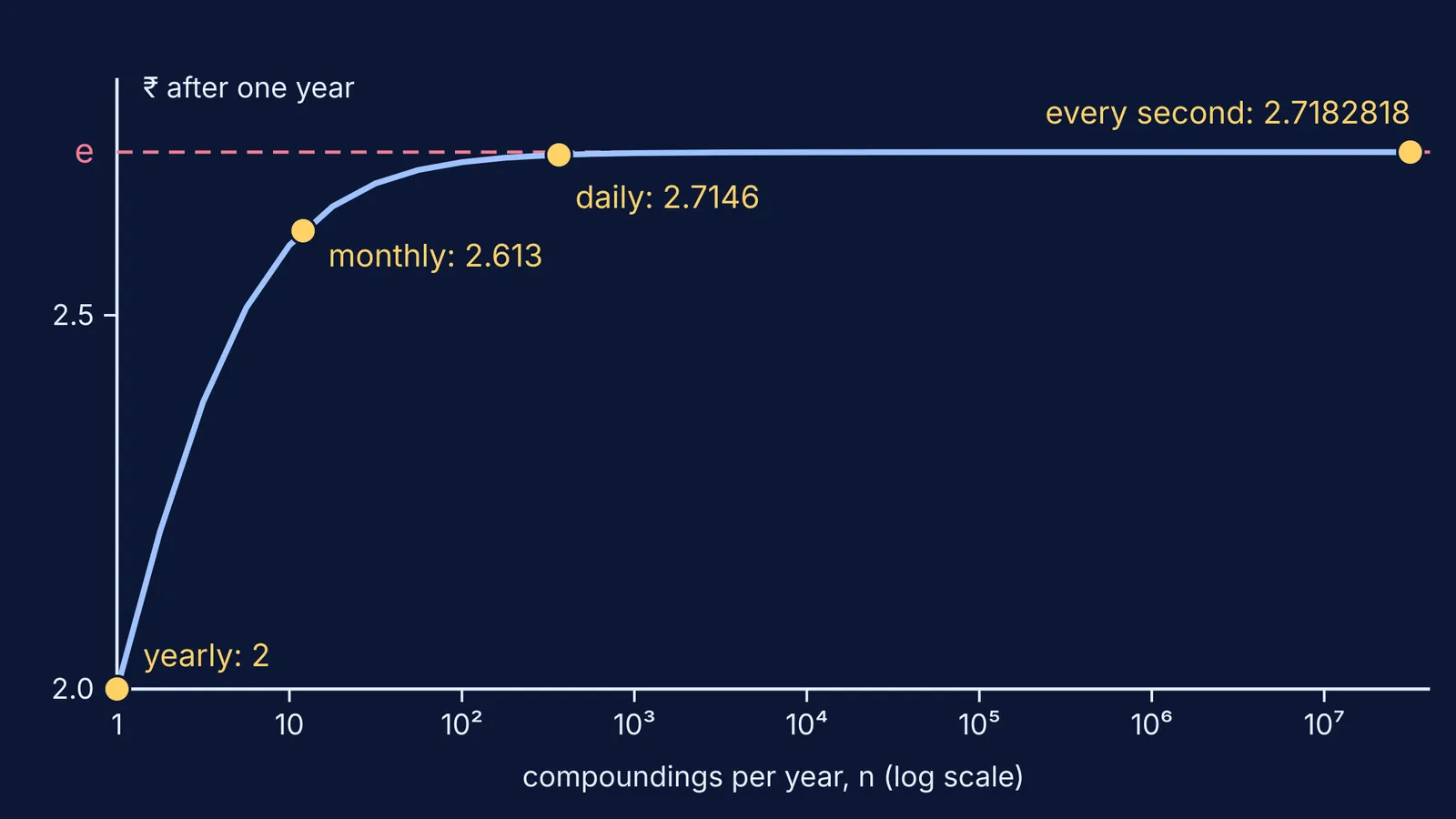
Imagine a bank that pays 100% interest a year on one rupee. Paid once, at year end, you get ₹2. Now ask the bank to split that interest into smaller pieces and add each piece as soon as it is earned. Does your rupee grow without limit? It does not, and the number it creeps towards is e.
Where does the number e come from?
It comes from exactly this banking puzzle. According to the MacTutor history of e at the University of St Andrews, in 1683 Jacob Bernoulli studied continuous compound interest and tried to find the limit of (1 + 1/n)^n as n tends to infinity.
The same MacTutor page says the letter e first appeared in a letter Leonhard Euler wrote to Goldbach in 1731, and that Euler gave a full treatment of e in his 1748 book Introductio in Analysin infinitorum. You can read more about the man in our post on Leonhard Euler and the notation you use every day.
The value of e is 2.71828 18284 59045..., as listed in the NIST Digital Library of Mathematical Functions, equation 4.2.11 and the OEIS entry A001113.
What happens if you compound ₹1 more often?
If the bank adds interest n times a year, each period pays 1/n of the yearly 100% rate, so ₹1 becomes (1 + 1/n)^n after a year. That is Bernoulli's expression from the MacTutor history.
Here are the totals, which we worked out from the formula:
Yearly (n = 1): ₹2.00
Every six months (n = 2): 1.5 squared = ₹2.25
Quarterly (n = 4): 1.25 to the power 4 = ₹2.4414
Monthly (n = 12): about ₹2.6130
Weekly (n = 52): about ₹2.6926
Daily (n = 365): about ₹2.7146
Hourly (n = 8,760): about ₹2.7181
Every second (n = 31,536,000): about ₹2.7182818
Going from yearly to monthly adds 61 paise. Going from daily to every second, a jump to 86,400 times as many compoundings, adds less than half a paisa.
Why does the total stop near 2.718?
Two things pull against each other. More compoundings means more times your money grows. But each growth step gets smaller, because the rate per period is 1/n. As n grows, these two effects balance and the total settles at e.
You can check how close you are with a short calculation. Using the series ln(1 + x) = x − x²/2 + ..., given as equation 4.6.1 in the NIST DLMF, n × ln(1 + 1/n) is about 1 − 1/(2n), so the shortfall from e is roughly e/(2n). For daily compounding that is 2.718/730, about 0.0037, which matches the gap between 2.7146 and 2.7183. Double the number of compoundings and you roughly halve the gap; you never cross it.
This is the same idea behind the 1^∞ limits in JEE. The base heads to 1, the power heads to infinity, and the answer is a power of e. Our post on limits of the form 1^∞ and the e-power shortcut shows how to use it in exam questions.
Does continuous compounding matter for a real deposit?
The general version of Bernoulli's limit is that (1 + z/n)^n tends to e^z as n tends to infinity, given as equation 4.4.17 in the NIST DLMF. Real banks compound at fixed intervals; for example, SBI's Special Term Deposit page says interest is compounded quarterly and paid at the end of the term.
Take ₹1,00,000 at an illustrative 8% a year for one year:
Compounded yearly: interest of ₹8,000.
Compounded quarterly, (1.02)^4: interest of about ₹8,243.
Compounded continuously, e^0.08: interest of about ₹8,329.
So for a sensible rate, the jump from quarterly to continuous is under ₹90 on a lakh. In this example, the rate and how long the money stays in make a much bigger difference than how often interest is added. The same e^kt curve also models population growth and cooling, which we work through in exponential models from dy/dt = ky.
How can you see the limit for yourself?
A ten-minute plan using only a calculator or a spreadsheet, starting from Bernoulli's (1 + 1/n)^n in the MacTutor history:
Write your guess for n = 1,000,000 on paper.
Put 1, 2, 4, 12, 52, 365, 8760, 1000000 and 31536000 down column A of a spreadsheet.
In column B type =(1+1/A1)^A1 and fill it down.
In column C type =EXP(1)-B1 to see the gap shrink.
Try n = 10^16. The answer comes out as 1, because the computer rounds 1 + 1/n to exactly 1. That is a rounding limit of the machine, not of the maths.
If you like learning by testing a prediction and watching what happens, the Fermi Simulation Lab has interactive simulations for the ideas that are easier to see than to read, so you do not have to take the textbook's word for it.


