On this page
It is late, you are studying for an upcoming physics exam, and you get stuck on a difficult homework problem. You paste the question into a general-purpose AI chat. In seconds, the screen fills with a perfect, step-by-step solution. You read through the logic and feel like you understand it completely.
But the next day in the exam hall, facing a similar question, the page stays blank.
The problem with general-purpose AI tools is that they are designed to be helpful assistants, not effective teachers. When an AI simply hands you the final answer, you skip the cognitive struggle required to build new neural pathways. To actually learn the material, you need the AI to withhold the answer and guide you instead.
Why do answers feel good but hints work better?
Reading a clear, well-written solution creates a powerful illusion of competence. Because the logic is so easy to follow when someone else writes it down, you mistakenly believe that recognising the correct answer is the same as being able to produce it yourself from scratch.
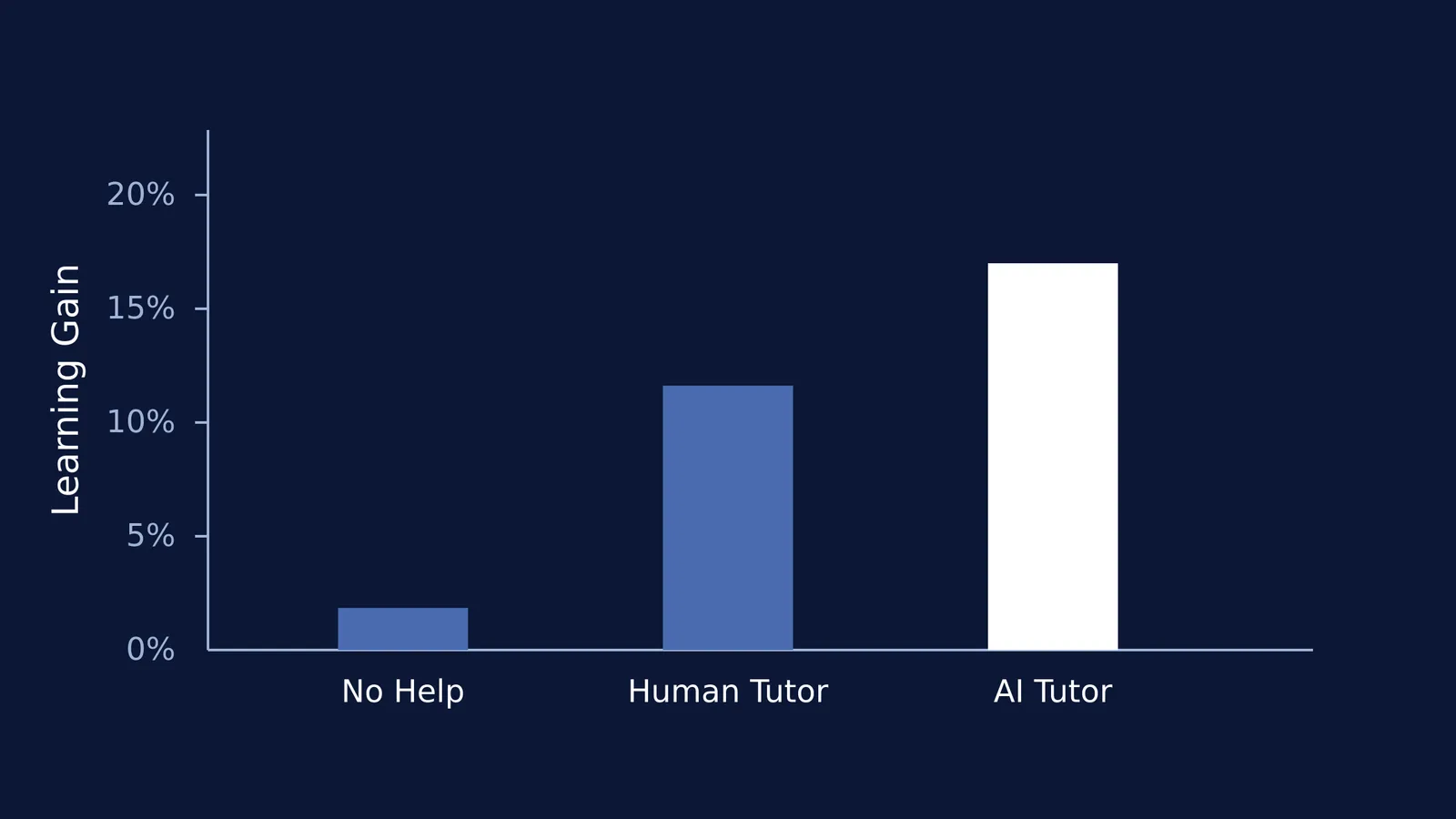
True learning requires you to do the heavy lifting. A 2024 study tested this exact dynamic by comparing students who received step-by-step hints to those who received no help at all. The researchers found that students using verified, AI-generated hints saw a 17% learning gain, matching the 11.6% gain from human-authored hints, while a control group improved by less than 2% in PLOS ONE.
This phenomenon is why educators often debate Hints or answers? What tutoring research says about the right help. When you are forced to retrieve information from your own memory and assemble the logic yourself, the resulting memory trace becomes significantly stronger. Psychologists call this a "desirable difficulty"—a short-term struggle that leads to long-term retention.
What is the Socratic method in tutoring?
The Socratic method is a form of dialogue where the teacher asks a carefully sequenced series of questions to help the student discover the answer for themselves. Instead of handing you a formula, a Socratic tutor asks what variables you know and what you are trying to find.
This approach is a foundational element of active learning. A 2014 meta-analysis found that the average failure rate was 21.8% for active learning versus 33.8% for traditional lecturing in the Proceedings of the National Academy of Sciences. Active learning significantly reduces failure rates by forcing students to participate in reasoning.
It is also the mechanism that makes one-to-one teaching so highly effective. In 1984, educational psychologist Benjamin Bloom published his famous 2 Sigma Problem paper. Bloom found that students tutored one-on-one performed two standard deviations better than those in a conventional classroom in his original study. The constant back-and-forth questioning prevents the student from tuning out and ensures they are always thinking one step ahead.
How to make an AI tutor ask me questions in Socratic mode?
To stop a generic AI from ruining your practice session by blurting out the answer, you must give it strict, explicit instructions before you paste your question. You need to change its default behaviour from an answering machine to a guiding coach.
This prompt works because it sets boundaries. Telling the AI to ask "one question at a time" prevents it from overwhelming you, and telling it to "not list the steps" stops it from giving away the solution outline.
Here is how that conversation might play out if you are stuck on a projectile motion problem:
You paste the Socratic prompt alongside the difficult physics problem.
The AI asks what happens to the vertical velocity when it reaches maximum height.
You think about it and reply that the vertical velocity becomes zero.
The AI confirms, then asks which kinematic equation connects your knowns and unknowns.
By engaging in this dialogue, you actively practice Bloom's taxonomy: using levels of thinking to test yourself. You move past simply remembering a formula to actually applying, analysing, and evaluating the physical situation.
When should you use Socratic questioning?
Socratic questioning works best when you already have some foundational knowledge about a topic but cannot see how to apply it to a new problem. It acts as a bridge between knowing the theory and executing the solution.
If you have no idea what the technical terms mean, Socratic tutoring only causes frustration. You cannot guess a concept you have never been taught. In those completely novel cases, you need direct instruction first, followed by an opportunity to Ask 'why is this true?' while studying: elaborative interrogation.
If you find that copying and pasting these restrictive prompts is tedious, a dedicated educational platform can manage the pedagogy for you automatically. Fermi's AI tutor teaches rather than answers: it holds a line of reasoning across a session, notices where a student is stuck, and decides whether to explain, ask, or show.
The next time you are stuck on a tough assignment, resist the temptation to ask the internet for a quick solution. Ask it for a difficult question instead.