

On this page
A refraction simulation is easy to play with. You drag a laser, the ray bends, and it looks right. But watching tells you very little. You learn more if you commit to a prediction first: which way the ray bends, by roughly how many degrees, and at what angle it stops coming out. This guide gives you the numbers, worked answers for air, water and glass, and a 15-minute plan for your next session.
What does Snell's law say about refraction?
Refraction is the bending of light as it crosses from one medium into another. OpenStax University Physics gives the law as n1 sin θ1 = n2 sin θ2, where both angles are measured from the normal, the line perpendicular to the surface.
The refractive index n tells you how much light slows down in a medium: n = c/v, where c is the speed of light in vacuum and v is its speed in the medium (OpenStax).
The three media in most simulations have these indices for light of wavelength 589 nm, according to OpenStax Table 1.1:
Air: 1.000293, which you can safely round to 1.00
Fresh water: 1.333
Crown glass: 1.52
Which way will the ray bend?
You can predict this without a calculator. A ray entering a medium with a higher index moves closer to the normal, and a ray entering a lower index moves away from it (OpenStax). So air to water or glass bends towards the normal, and glass or water to air bends away.
In a 2004 study in the American Journal of Physics, Crouch, Fagen, Callan and Mazur found that students who passively watched a classroom demonstration understood the underlying concepts no better than students who did not see it at all. Students who predicted the outcome before seeing it showed significantly greater understanding.
That study looked at live classroom demonstrations, not simulations, but the habit is easy to carry over. If you want a ray you can drag yourself, the Fermi Simulation Lab has interactive simulations for ideas that are easier to see than to read. Write your prediction down before you move anything.
How do you predict the angle of refraction?
Rearrange Snell's law: sin θ2 = (n1/n2) sin θ1. These answers use the OpenStax indices above, rounded to one decimal place.
Air to water at 30°: sin θ2 = 0.500/1.333 = 0.375, so θ2 = 22.0°. OpenStax's Example 1.2 runs this backwards: a ray at 30.0° that refracts to 22.0° gives n = 1.33 for water.
Air to glass at 30°: sin θ2 = 0.500/1.52 = 0.329, so θ2 = 19.2°. Glass has the higher index, so it bends the ray more.
Air to water at 60°: θ2 = 40.5°. Air to glass at 60°: θ2 = 34.7°.
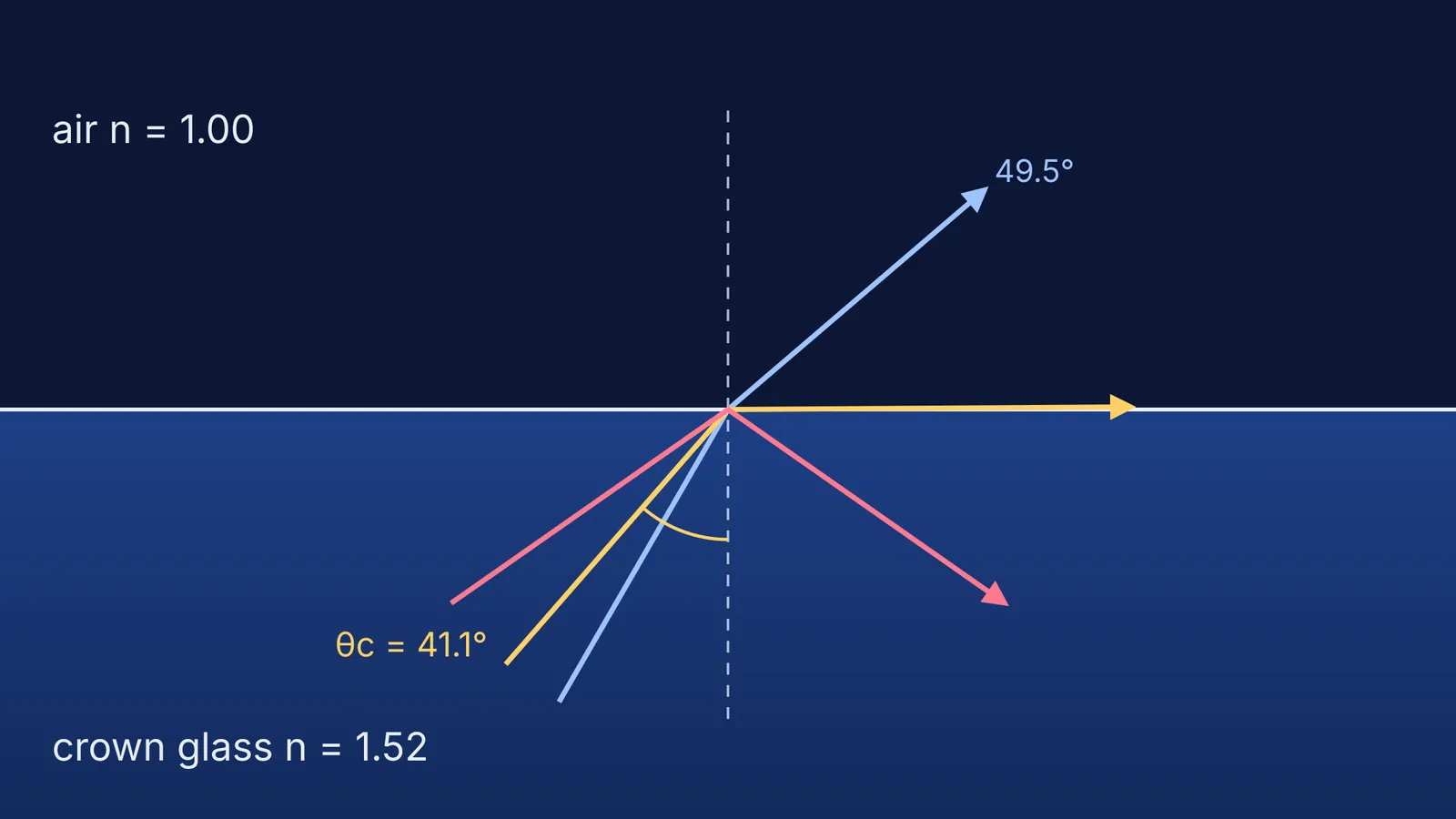
Glass to air at 30°: sin θ2 = 1.52 × 0.500 = 0.760, so θ2 = 49.5°. The ray now bends away from the normal.
The pattern to notice: doubling the incident angle from 30° to 60° does not double the refracted angle. Snell's law links sines, not angles. That is a common trap in assertion-reason questions, and our post on ray optics assertion-reason traps collects more of them.
At what angle does the ray stop leaving the glass?
Put the laser inside the glass and aim it up at the surface. As you tilt it, the ray in the air swings further from the normal until it skims along the surface. The critical angle is the incident angle that produces a refraction angle of 90°, and it exists only when the second medium has a lower index than the first (OpenStax). The formula is θc = sin⁻¹(n2/n1).
Crown glass to air: θc = sin⁻¹(1/1.52) = 41.1°
Water to air: 48.6°, the value OpenStax gives
Crown glass to water: θc = sin⁻¹(1.333/1.52) = 61.3°
Beyond the critical angle, all of the light reflects back into the glass. Going the other way, from air into glass, no angle will make the ray stop.
The same idea carries light down a cable, as our walk-through of an optical fibre total internal reflection simulation shows.
A 15-minute plan for your next refraction session
Minutes 0-3: write down the three indices and the two rules for which way the ray bends.
Minutes 3-8: for air to water and air to glass at 30° and 60°, predict the direction first, then the angle. Then check in the simulation.
Minutes 8-12: move the source into the glass and predict the angle where the ray stops leaving. Tilt slowly and note where it happens.
Minutes 12-15: wherever you were off by more than a degree or two, redo the sine calculation. Check that you measured the angle from the normal, not from the surface.
If you get stuck on why the bend happens at all, Fermi's AI tutor can run the simulation, draw the figure and check your understanding as it goes. Next, try predicting how deep a pool looks in apparent depth and viewing angle.


