

On this page
Have you ever stood at the edge of a swimming pool and thought the bottom looked surprisingly close, only to jump in and find the water reaching your chest? This is a classic optical illusion caused by refraction, a fundamental property of light that alters how we perceive objects submerged in transparent liquids.
Why does a pool look shallower than it is?
When light travels from a denser medium like water into a rarer medium like air, it speeds up and bends away from the normal (the imaginary line perpendicular to the surface). The refractive index of water is 1.33, meaning light travels 1.33 times faster in a vacuum than in water.
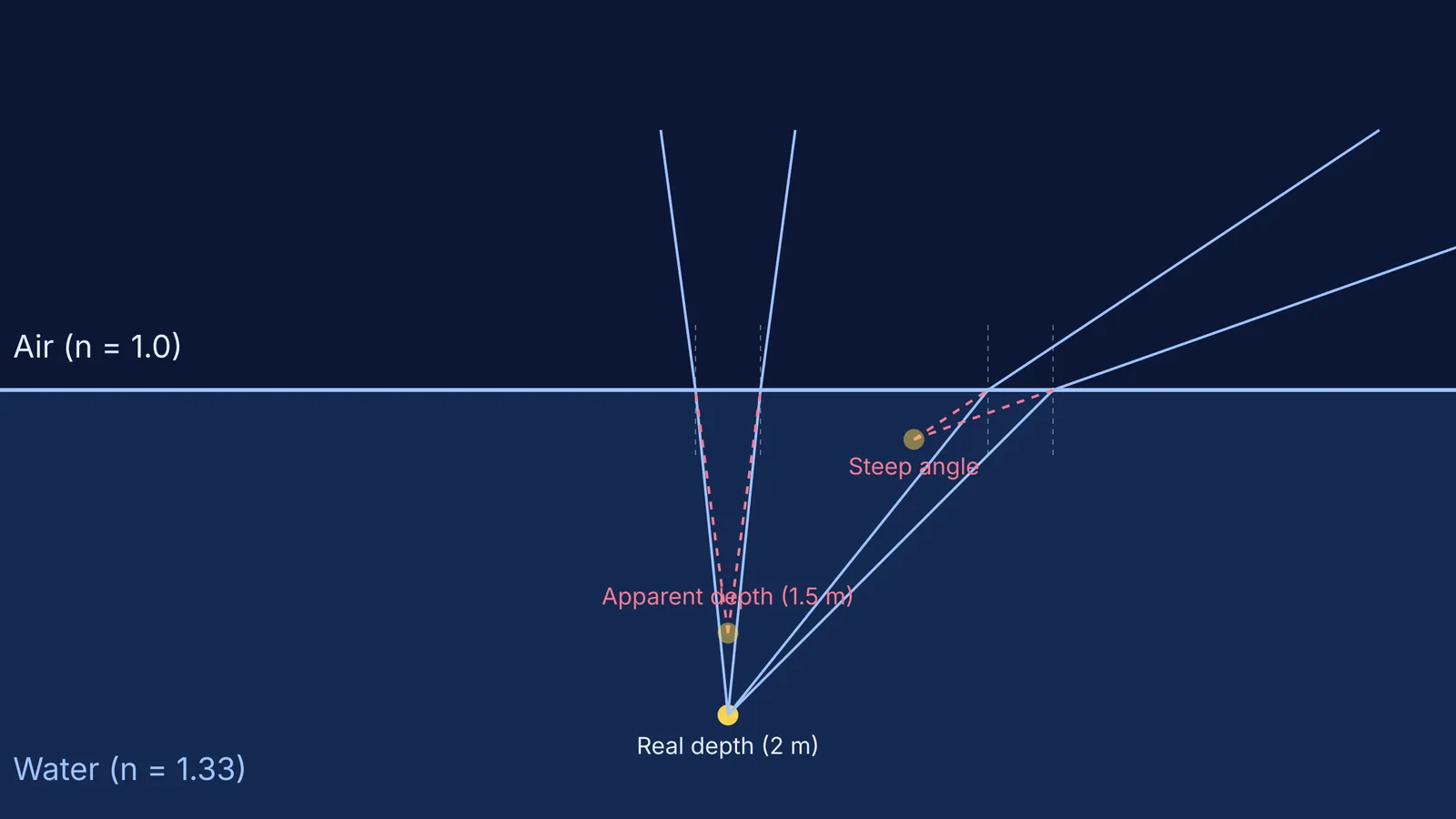
Your brain, however, always assumes that light travels in straight lines. It cannot instinctively account for the bending of light at the surface. When your eyes receive these bent rays emerging from the water, they trace them back in a straight geometric line. This mental projection creates a "virtual image" of the pool floor that is positioned significantly higher than the actual physical floor.
How deep does a 2 m pool look from straight above?
If you are looking almost straight down at the water, there is a simple formula to find the apparent depth: you divide the real physical depth by the liquid's refractive index.
For a pool with a real depth of 2 metres, viewed from directly above: Apparent depth = 2 m / 1.33 ≈ 1.5 metres.
This means the bottom appears half a metre closer to you. The difference between the real depth and the apparent depth is called the normal shift. In this case, the normal shift is exactly 0.5 metres. If you drop a heavy object into the deep end of a pool, this half-metre illusion might lead you to severely underestimate how far you must dive to retrieve it. These normal shift calculations are a staple of apparent depth and refraction problems for physics exams.
Why does it look even shallower from an angle?
As you walk away from the edge and view the pool at a slanted angle, the light rays must bend even more to reach your eyes. According to Snell's law, which mathematically relates the angles of incidence and refraction to the optical density of the materials, a larger angle of incidence inside the water leads to an aggressively larger angle of refraction in the air.
This increased bending pushes the virtual image further up towards the surface and shifts it laterally away from the object's true position. If you view the same 2-metre pool from a steep angle, standing far back from the edge, it might look barely a metre deep. The rays emerging at these extreme angles are bent so severely that the floor of the pool appears to slope upwards.
Why does a straight stick look bent in water?
If you place a straight stick into the pool at an angle, the submerged part appears to bend upwards. This happens because every point on the underwater stick has its apparent depth shifted towards the surface. The deeper the point, the greater the absolute vertical shift. When your brain pieces together the complete image, the underwater section seems to hinge abruptly at the water's surface.
This same optical effect explains why spearfishing requires you to aim below where a fish appears to be. A fish swimming near the bottom will appear much closer to the surface than its true physical location. If you aim directly at the virtual image, your spear will pass harmlessly above the fish.
How can you test apparent depth at home?
Reading about refraction is one thing, but seeing it builds stronger intuition. Here is a simple active learning exercise to test this at home:
Fill a transparent glass or rectangular container with water.
Drop a heavy coin to the bottom so it sits flat.
Look at the coin from straight above and estimate its depth.
Slowly lower your head to view the coin from the side, and watch the coin appear to rise towards the surface.
If you find these ideas hard to picture, the Fermi Simulation Lab has interactive simulations for the ideas that are easier to see than to read. You can change the viewing angle, swap water for glass or oil, and watch the virtual image shift in real time, making the physics tangible.


