

On this page
Two lines in space can meet, run parallel, or do neither. The third case trips up students in Class 12 and JEE Main revision because a flat page shows it badly. Here we build the picture first, guess the answer, and only then use the formula.
What are skew lines?
Skew lines are lines in space that are neither parallel nor intersecting, so no single plane contains both. That is how Chapter 11, Three Dimensional Geometry, of the NCERT Class 12 Mathematics textbook defines them, using a room as its example: a diagonal across the ceiling and a diagonal down one wall never meet and are not parallel.
Try your own room: the top edge of the front wall and a vertical corner edge of the back wall never touch and are not parallel. Guess the shortest distance between them. (It is the depth of the room, measured along the ceiling from front to back.)
What does the common perpendicular look like?
The same NCERT chapter defines the shortest distance between two lines as the length of the shortest segment joining a point on one line to a point on the other, and notes that for skew lines this segment is perpendicular to both lines. That segment is called the common perpendicular, and there is exactly one for any pair of skew lines.
Two ways of turning the picture make it visible:
Look straight down one line. Rotate your view until the first line shrinks to a dot. The shortest distance is then the distance from that dot to the second line, which is 2D geometry you already know.
Put each line in its own plane. Place each line in a plane parallel to the other line. The gap between these two parallel planes is the shortest distance, and b₁ × b₂ points straight across it, which is why the cross product appears in the formula.
How do you predict the shortest distance before calculating?
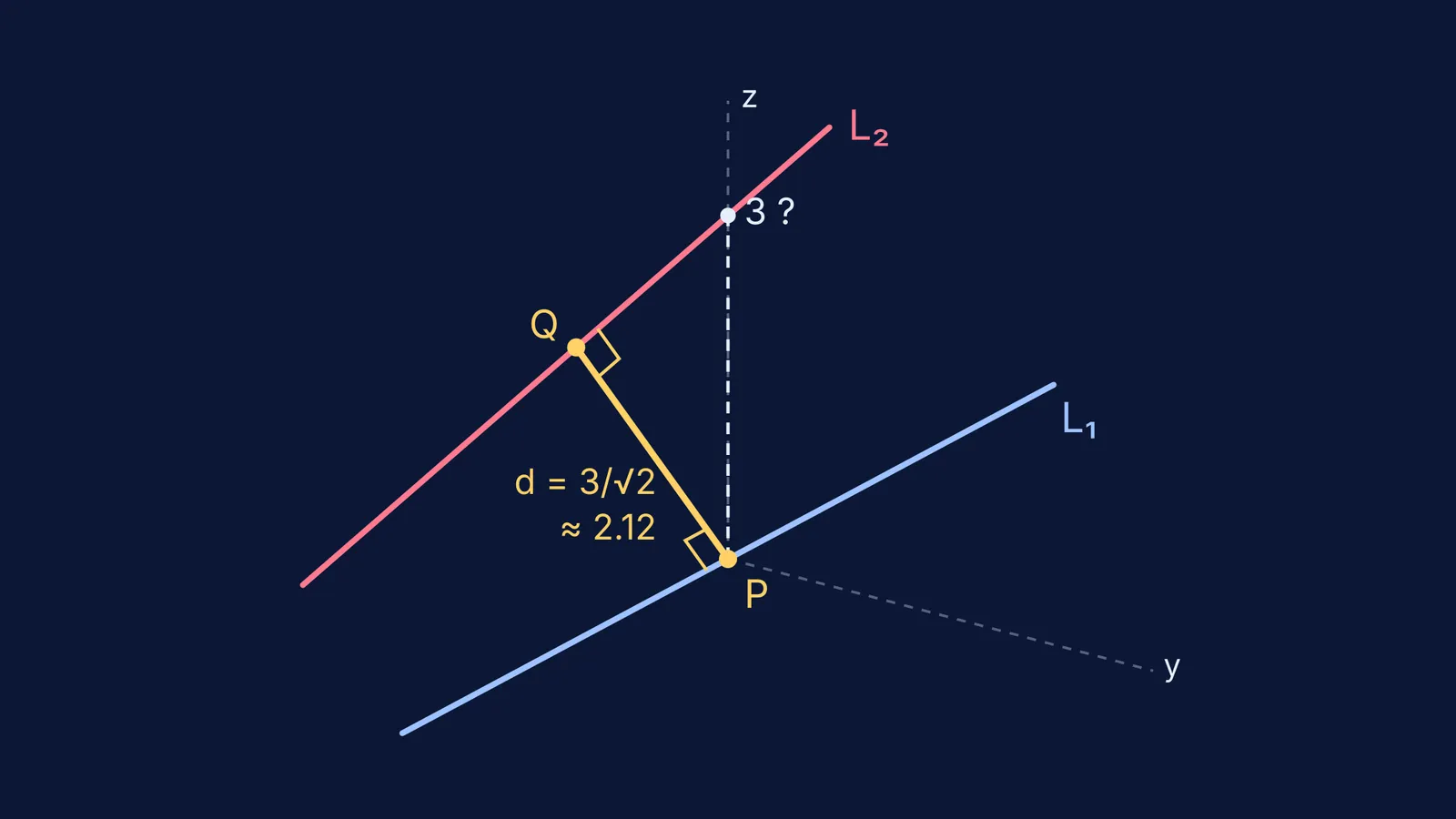
Here is a worked example in four steps. Line 1 is the x-axis, r = λi. Line 2 is r = 3k + μ(j + k).
Predict. Line 2 passes through (0, 0, 3), which is 3 units straight above the origin, a point on line 1. So the answer is at most 3. But line 2 slopes downwards as y decreases, so there may be a closer pair of points. A fair guess is "a bit less than 3".
Look down line 1. Viewed along the x-axis, line 1 is a dot at the origin and line 2 becomes the line z = y + 3 in the yz-plane. That line meets both axes 3 units from the origin, so its distance from the origin is 3/√2, about 2.12.
Compute. Here a₁ = 0, b₁ = i, a₂ = 3k and b₂ = j + k. Then b₁ × b₂ = k − j, with length √2, and (a₂ − a₁) · (b₁ × b₂) = 3. So d = 3/√2 ≈ 2.12, matching the picture.
Check the feet. The common perpendicular runs from P(0, 0, 0) on line 1 to Q(0, −1.5, 1.5) on line 2, at μ = −1.5. The vector PQ = (0, −1.5, 1.5) has zero dot product with both i and j + k, and its length is √4.5 ≈ 2.12.
Now try Example 9 in the NCERT chapter the same way: guess first, then compute. The book's answer is 10/√59, about 1.30.
Why guess before you use the formula?
In a study published in the American Journal of Physics in 2004, Catherine Crouch, Adam Fagen, J. Paul Callan and Eric Mazur found that students who only watched classroom demonstrations understood the ideas no better than students who did not see them at all. Students who predicted the outcome before watching showed significantly greater understanding. The study tested physics demonstrations, not geometry, but the habit is easy to borrow: commit to a number first.
If you struggle to picture 3D figures from a printed diagram, the Fermi Simulation Lab has interactive simulations for ideas that are easier to see than to read. For more on predicting before you look, see our post on predicting vector sums before running a simulation.
What if your answer and your guess disagree?
A mismatch usually means one of these:
You get d = 0. The lines intersect, or you copied a point wrongly.
b₁ × b₂ comes out as the zero vector. The lines are parallel, not skew. NCERT gives a separate formula for this case: d = |b × (a₂ − a₁)| / |b|.
Your answer is negative. You dropped the modulus.
Your answer is larger than the gap between a₁ and a₂. There is an arithmetic slip, usually a sign in the cross product.
If you keep landing on the wrong method, the Fermi Problem Library has worked problems with a step-by-step solver that explains the reasoning rather than printing an answer.
The see-first habit works in 2D too: try it on heights and distances in trigonometry, and read what simulations can and cannot teach you.


