

On this page
A siphon is a tube that carries liquid up over a rim and down to a lower point with no pump, as when you change aquarium water. Three ideas explain it: where the outlet sits, how far the water drops, and how high the tube climbs. Each comes below as a prediction to test.
How does a siphon work?
Once the tube is full, water in the long downhill leg falls and pulls the column after it. Pressure at the top of the tube drops below atmospheric, and the higher pressure on the source surface pushes more water up the short leg.
Physicists have argued over the description. A 2015 Scientific Reports paper by Boatwright, Hughes and Barry sets out two models: gravity plus atmospheric pressure, or gravity plus the cohesion between water molecules. Both give the same answers below, and both rest on Bernoulli's equation, p + ½ρv² + ρgh = constant. Our post on predicting speed and pressure in a narrowing pipe practises that equation in a simpler setting.
Why must the outlet sit below the water surface?
Prediction 1: raise the outlet until it is level with the water surface in the source bucket. What happens?
Source surface and outlet are both at atmospheric pressure, so only the height the water loses can speed it up. The speed depends only on how far the outlet sits below the surface of the upper reservoir (Wikipedia, Siphon).
So the flow stops when the outlet reaches the surface level, and reverses if you lift it higher. What counts is the outlet against the water surface, not the tube's length. It is also why a siphon slows as a tank empties: the drop shrinks.
How does the height difference set the flow speed?
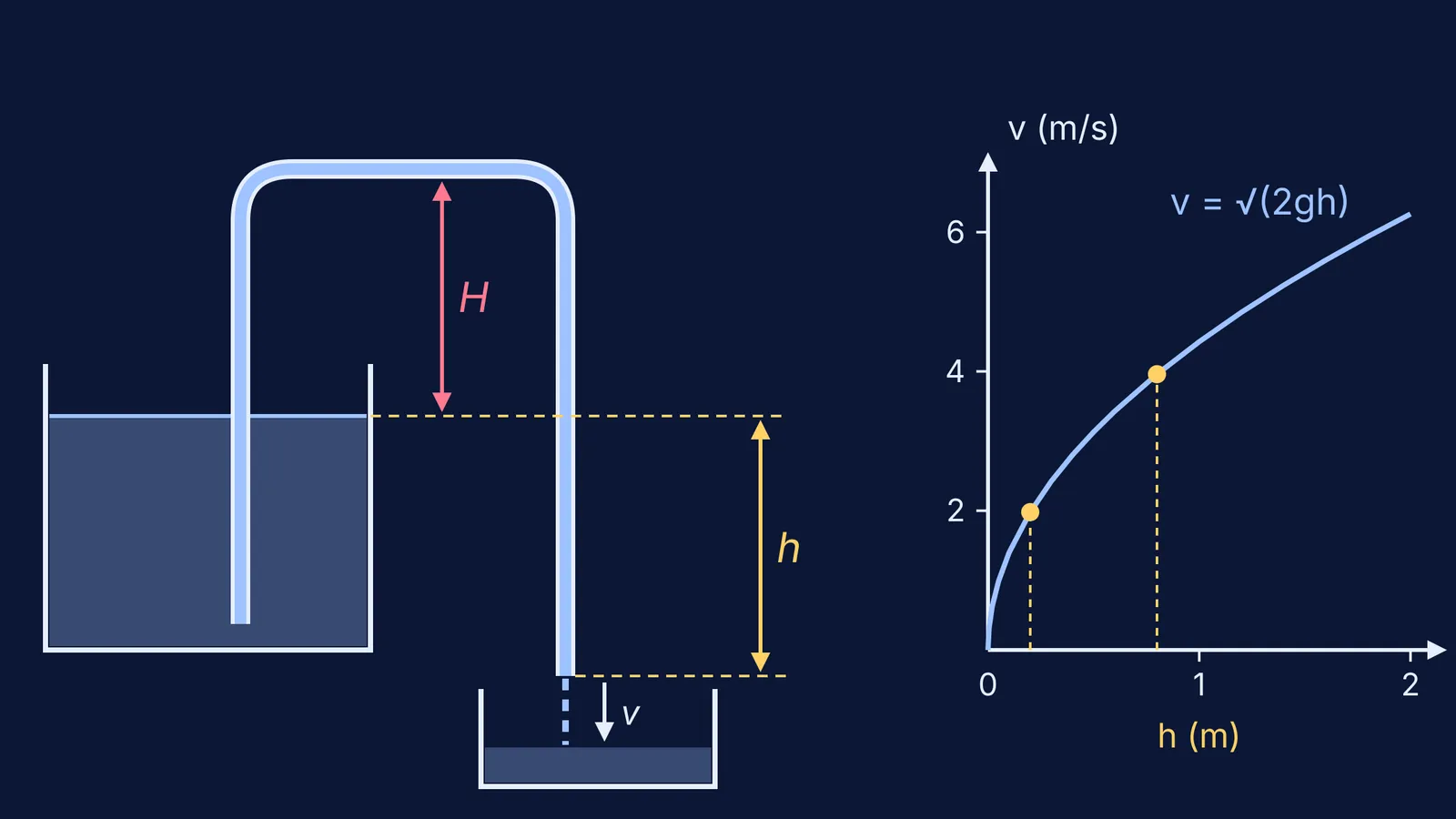
In the ideal, frictionless case, the outlet speed is v = √(2gh), where h is the drop from the source surface to the outlet (Wikipedia, Siphon). It is the same result as water leaving a hole in a tank, which our post on efflux speed from a pressurised tank extends.
A worked example with g = 9.8 m/s²:
h = 0.2 m gives v = √3.92 ≈ 1.98 m/s
h = 0.8 m gives v = √15.68 ≈ 3.96 m/s
h = 2.0 m gives v = √39.2 ≈ 6.26 m/s
Prediction 2: four times the drop gives twice the speed, not four times. Friction in a real hose lowers every speed, but look for the square-root pattern.
At what height does a siphon stop working?
Prediction 3: keep the outlet fixed and raise the top of the tube (the crown) higher above the source surface. The speed stays about the same, until the flow suddenly stops.
The reason is pressure at the crown: climbing a height H costs ρgH of pressure. As a siphon approaches 10 m, the pressure at the crown falls below the vapour pressure of water, the water boils, and the column breaks (Boatwright et al., Scientific Reports, 2015). The same paper gives water's vapour pressure at 20 °C as about 2.33 kPa.
You can estimate the limit yourself. With the 99.8 kPa air pressure recorded in that paper, the tallest crown for slow-moving water is (99.8 − 2.33) kPa ÷ (1000 kg/m³ × 9.8 m/s²) ≈ 9.9 m. A fast siphon fails a little lower, because the water's kinetic energy also comes out of the pressure budget. The paper notes the limit depends on barometric pressure, so it is lower in a hill station. It is the same 10 metres explained in our post on why a water barometer would be 10 metres tall.
The limit can be broken. Boatwright's team ran a 15 m siphon at sea level after degassing the water in a vacuum desiccator, and a 2016 PLoS ONE study by Vera and colleagues reached 15.4 m using tap water mixed with dishwasher surfactant, which the authors think helped by degassing the water. Both teams credit cohesion between water molecules.
How can you test these predictions at home?
You need two buckets, about 2 metres of clear plastic tube, a stool, a 1-litre bottle and a stopwatch. Use clean water only, and never start a siphon by mouth with fuel or chemicals.
Write down your three predictions first.
Fill the tube by dipping it into the top bucket, pinch one end and move it to the lower bucket.
Time the bottle filling with the outlet 20 cm, then 80 cm, below the surface. The time should roughly halve, as the ideal siphon equation predicts.
Lift the outlet slowly and note where the flow stops.
Lift the middle of the tube as high as you can and watch the speed hold.
To see pressure change along a flow rather than guess it, the Fermi Simulation Lab has interactive simulations for ideas that are easier to see than to read; predict first, then run. For numericals, the Fermi Problem Library has a step-by-step solver that explains the reasoning rather than printing an answer.
Start with prediction 1 tonight.


