On this page
Hold your hand between a lamp and a wall, then move it towards the bulb. The shadow gets bigger. Fewer people can say how much bigger, or why the edges blur. Here is a prediction to write down, and a test to check it.
Does a shadow get bigger when the object is closer to the light?
Yes. Light travels in straight lines, so the edges of a shadow are set by the rays that just graze the edges of the object. Move the object towards the lamp and those rays spread at a wider angle before they reach the wall. A primary-science guide from Geniebook gives both rules plainly: a shadow grows as the object nears the light, and it also grows as the screen moves farther from the object.
The exact size comes from similar triangles. A worked solution on Pearson's study site to a ray-optics problem from Knight's Physics for Scientists and Engineers uses the same idea. With a point source, a patch's width divided by its distance from the source is the same at the aperture and at the screen.
How do you calculate shadow size from distance?
For a small, point-like source such as a phone torch:
Shadow height = object height × (lamp-to-wall distance ÷ lamp-to-object distance)
Worked example: a 10 cm toy stands between a phone torch and a wall that is 200 cm from the torch.
Toy 150 cm from the torch: 10 × 200 ÷ 150 ≈ 13 cm shadow
Toy 100 cm from the torch: 20 cm shadow
Toy 50 cm from the torch: 40 cm shadow
Toy 25 cm from the torch: 80 cm shadow
Each time you halve the distance to the lamp, the shadow doubles. Shadow size goes as 1 ÷ distance, so the last few centimetres near the bulb change it the most.
Why do some shadows have sharp edges and others fuzzy ones?
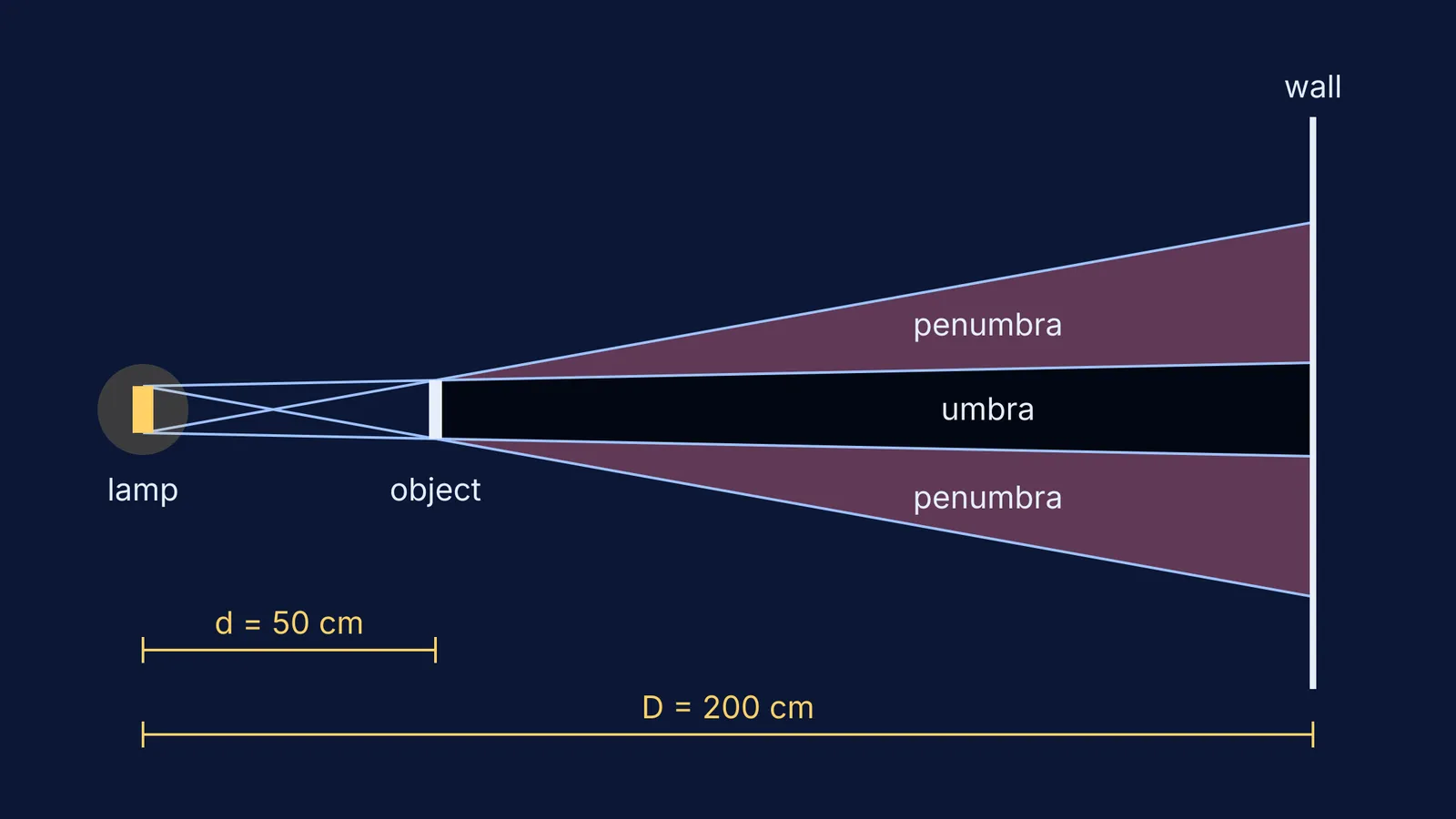
Real lamps are not points. In his lecture notes at the University of Texas at Austin, physicist Richard Fitzpatrick describes the shadow cast by an extended source as a black core called the umbra, "surrounded by a ring of gradually diminishing darkness called the penumbra". In the umbra, all the light from the source is blocked. In the penumbra, only some of it is.
The University of Illinois Ask the Van physics service gives the condition: you get a penumbra "when the light source is larger than a single point". The same answer notes that the Sun "does not cast sharp shadows because of its size".
Apply the similar-triangle rule to each edge of a wide source and you get the width of the fuzzy band on each side. This is our own working from the same geometry:
Penumbra width = source width × (object-to-wall distance ÷ lamp-to-object distance)
Run the toy example again with a frosted bulb 8 cm across:
Toy 180 cm from the bulb (20 cm from the wall): penumbra under 1 cm, so the shadow looks crisp
Toy 100 cm from the bulb: 12 cm dark core with an 8 cm penumbra on each side
Toy 50 cm from the bulb: 16 cm core with a 24 cm penumbra on each side
Toy 25 cm from the bulb: 24 cm core with a 56 cm penumbra on each side
As the object moves closer to a wide lamp, the fuzzy edge grows much faster than the dark core. That is why a shadow puppet made close to the wall looks sharp, and the same hand held near a big lampshade throws a blur.
How can you test shadow size at home?
You need a phone torch, a lamp with a frosted bulb, a bare wall, a small toy, a measuring tape and a notebook.
Put the light 2 m from the wall. Mark 150, 100, 50 and 25 cm from the light on the floor.
Use the formula to write down your predicted shadow height at each mark.
Switch on the phone torch, measure the shadow at each mark and compare it with your prediction.
Swap to the wide lamp. Before you measure, predict which mark will give the fuzziest edge.
Measure the dark core and the fuzzy band separately. A follow-up answer on the same Illinois page notes that although the umbra's edges are sharp, "the change in light intensity is gradual".
Slide the toy right up to the wall and watch the penumbra almost disappear.
Where can you explore shadows and light next?
The Fermi Simulation Lab has interactive simulations for the ideas that are easier to see than to read. If the similar-triangle step is what trips you up in numericals, the Fermi Problem Library has worked problems with a step-by-step solver that explains the reasoning rather than printing an answer.
Tonight, try the six steps. Write your predictions down before you measure.