On this page
A block slides across a rough floor, hits a spring, squashes it, is pushed back and slides away. Where does it stop? This classic Class 11 problem tests one idea: friction takes energy for every metre slid, in both directions, while the spring only stores energy and gives it back.
What energy rule applies to a block, a spring and a rough floor?
The rule you need is the work-energy theorem with non-conservative forces: the change in mechanical energy equals the work done by non-conservative forces, written W_nc = Δ(K + U) in OpenStax University Physics, section 8.3.
A spring compressed by x stores elastic potential energy U = ½kx², taking the unstretched length as zero, as shown in OpenStax, section 8.1.
Kinetic friction has magnitude f = μN, so on a level floor, where N = mg, f = μmg (OpenStax, section 6.2). It always opposes the motion, so it does negative work f × distance on the way in and again on the way out.
Static friction can reach at most μ_s N, and the same OpenStax section notes that kinetic coefficients are lower than static ones. That matters when you ask whether the block moves back at all.
Where does the block stop after it rebounds from the spring?
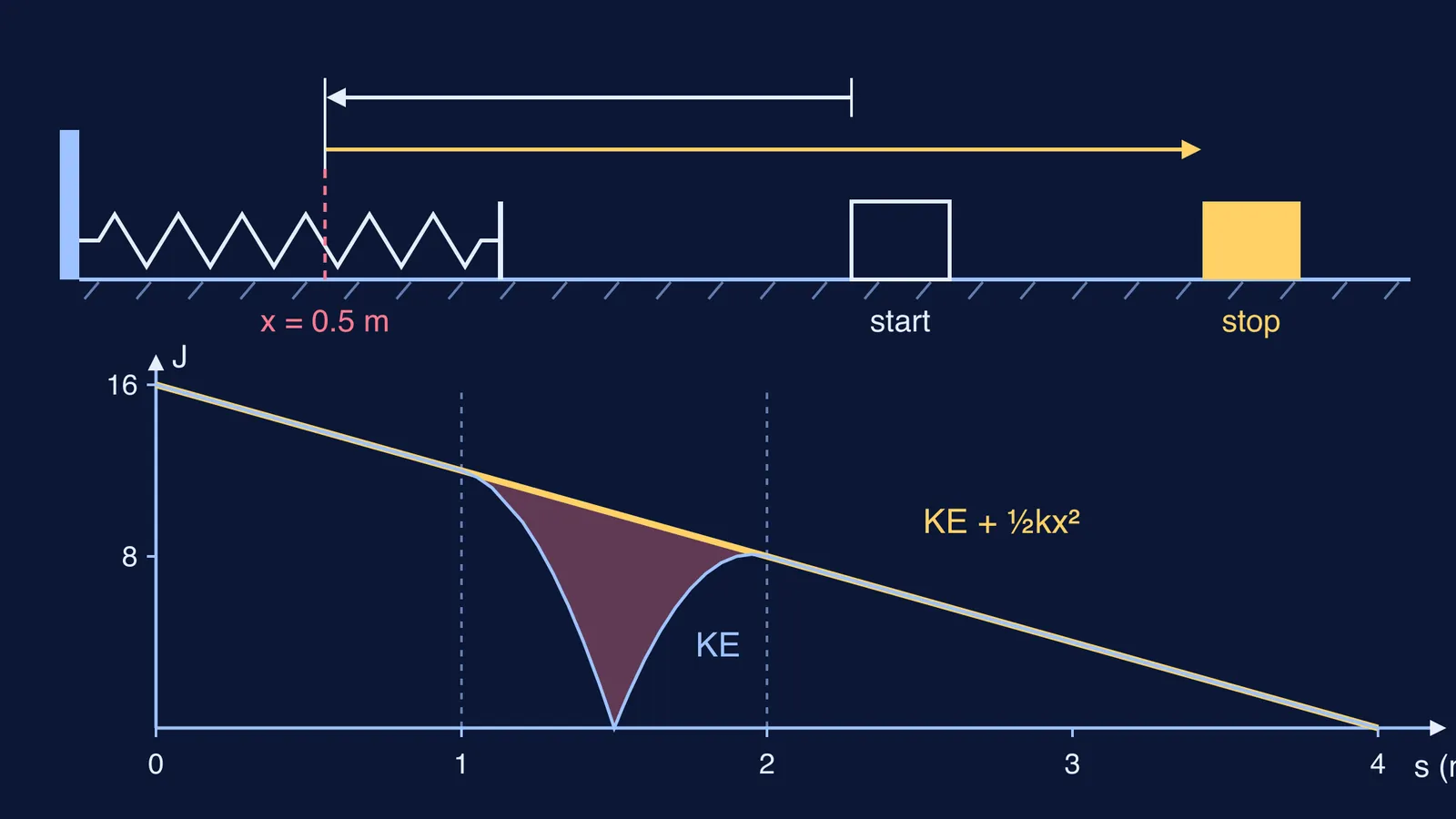
Take numbers you can check by hand. A 2 kg block moves at 4 m/s towards a spring with k = 80 N/m, starting 1 m from the spring's free end. The floor has μ = 0.2 (use it for both static and kinetic friction), and g = 10 m/s².
Friction force: f = μmg = 0.2 × 2 × 10 = 4 N, so every metre of sliding costs 4 J.
Starting energy: ½ × 2 × 4² = 16 J.
Reaching the spring: 16 − 4 × 1 = 12 J of kinetic energy is left.
Maximum compression x: 12 = ½ × 80 × x² + 4x, so 40x² + 4x − 12 = 0, which gives x = 0.5 m. The spring now holds ½ × 80 × 0.5² = 10 J, and friction took 2 J during the compression.
Does it rebound? The spring pushes with kx = 80 × 0.5 = 40 N, far more than the 4 N that static friction can hold. It moves back.
Leaving the spring: the block loses another 4 × 0.5 = 2 J while the spring relaxes, so it reaches the free end with 10 − 2 = 8 J.
Final slide: 8 J ÷ 4 N = 2 m. The block stops 2 m from the spring's free end, which is 1 m beyond where it started.
Will the block always rebound from the spring?
No. Once you know the maximum compression x, compare it with f/k and 2f/k (here f = μmg and μ_s = μ_k):
If x ≤ f/k, the spring force kx cannot beat static friction. The block stays at maximum compression.
If f/k < x ≤ 2f/k, the block moves back but stops while still pressing on the spring. Setting ½k(x² − x'²) = f(x − x') gives a final compression x' = 2f/k − x.
If x > 2f/k, the block leaves the spring with ½kx² − fx of kinetic energy and slides a further (½kx² − fx) ÷ f.
In the example, f/k = 0.05 m and 2f/k = 0.1 m, while x = 0.5 m, so the block clears the spring easily. If your question gives a separate μ_s that is larger than μ_k, use μ_s mg in the first test only.
What mistakes cost marks in spring-and-friction problems?
Writing ½mv² = ½kx² and leaving out the friction term fx during compression.
Charging friction only once, for the trip in.
Skipping the rebound test, so a block that should stay put is sent sliding back.
Giving the final position without saying where it is measured from: the spring's free end, the wall or the starting point.
For more traps of this kind, read our post on three mistakes in work-energy problems. When the spring is vertical, gravity takes the place of friction as the extra term; compare a mass dropped onto a spring. To run the logic backwards and find μ from how far something slides, see finding the coefficient of friction from stopping distance.
If your answer keeps coming out different, the Fermi Problem Library has worked problems with a step-by-step solver that explains the reasoning rather than printing an answer, so you can see which energy term you dropped.
Next time, write the energy ledger first: starting kinetic energy, minus friction for every metre, plus or minus spring energy.