

On this page
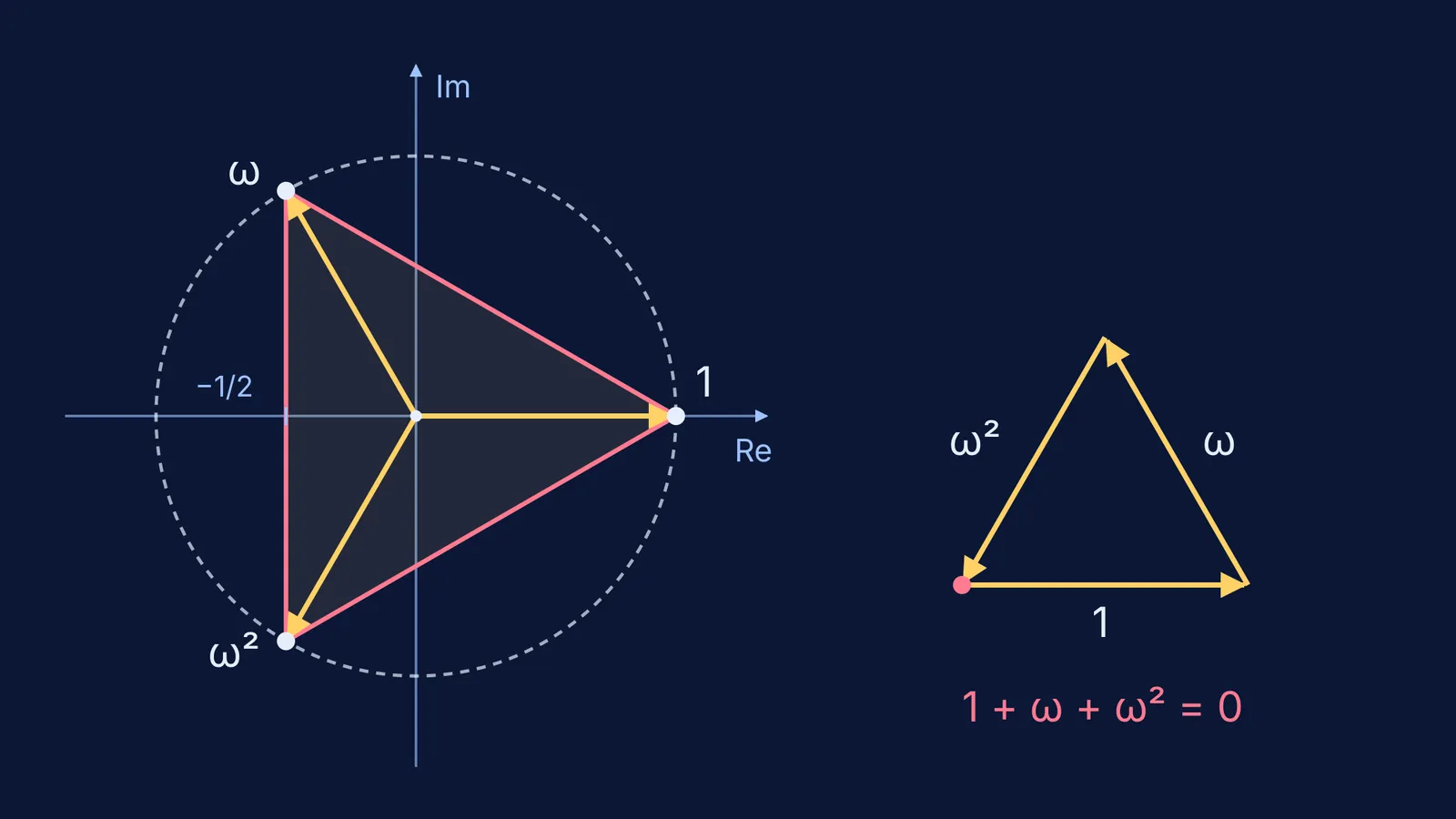
When you first meet ω in Class 11, it usually arrives as an algebra fact: 1 + ω + ω² = 0, learn it, use it. Plot the three cube roots of 1 on the Argand plane and they land evenly spaced on a circle, at the corners of an equilateral triangle. That picture explains the formula, and it works for every n.
What are the nth roots of unity?
An nth root of unity is a complex number z with zⁿ = 1, and there are exactly n of them: cos(2kπ/n) + i sin(2kπ/n) for k = 0, 1, …, n − 1 (Wikipedia: Root of unity).
The Argand plane is the complex plane drawn with real numbers along the horizontal axis and imaginary numbers up the vertical axis (Wikipedia: Complex plane), so every root is a point you can mark.
Two facts tell you where the points go. First, if zⁿ = 1 then |z|ⁿ = 1, so |z| = 1: every root sits on the unit circle. Second, raising z to the power n multiplies its angle by n, so the angle must be a whole number of full turns divided by n. If treating multiplication as rotation is new to you, read why lengths multiply and angles add when you multiply complex numbers first.
Why do the cube roots of unity form a triangle?
Put n = 3. The allowed angles are 0°, 120° and 240°, so the three roots are 1, ω = (−1 + i√3)/2 and ω² = (−1 − i√3)/2 (Wikipedia: Root of unity).
The root 1 sits at (1, 0). Both ω and ω² have real part −1/2, one at height √3/2 above the axis and one the same distance below. Three points on a circle, each 120° from the next, are the corners of an equilateral triangle. Check it by distance: ω to ω² is √3, and 1 to ω is also √3, since (3/2)² + (√3/2)² = 3.
Can you predict the polygon for any n?
Yes. The nth roots of unity are the vertices of a regular n-sided polygon inscribed in the unit circle, with one vertex at 1 (Wikipedia: Root of unity; MathWorld: Root of Unity). Predict each shape before you read it:
n = 2: just 1 and −1, the two ends of a diameter
n = 3: an equilateral triangle, vertices 1, ω, ω²
n = 4: a square, vertices 1, i, −1, −i
n = 5: a regular pentagon, vertices 72° apart
n = 6: a regular hexagon, 60° apart: the cube-root triangle plus −1, −ω, −ω²
n = 8: a regular octagon, with (1 + i)/√2 at 45°
Two predictions to test yourself with: −1 is a vertex exactly when n is even, and i is a vertex exactly when n is a multiple of 4. Both follow from asking whether 180° or 90° is a whole number of steps of 360°/n.
Why do the roots of unity always add to zero?
For every n greater than 1, the n roots of unity add to zero (Wikipedia: Root of unity). Three ways to see it:
Head to tail. Treat each root as an arrow from the origin and add the arrows tip to tail, as in the geometric meaning of adding complex numbers. Each arrow has length 1 and turns 360°/n from the last, so after n arrows you have turned a full circle and are back at the start. A closed loop means the total is zero.
Rotation. Call the sum S. Multiplying every root by ζ = cos(2π/n) + i sin(2π/n) turns the polygon one step and leaves the set unchanged. That gives ζS = S, and since ζ ≠ 1, S must be 0.
Algebra. For n = 3, ω³ = 1 gives (ω − 1)(1 + ω + ω²) = 0, and ω ≠ 1, so 1 + ω + ω² = 0.
How does the picture help in an exam problem?
Worked example: simplify (1 − ω + ω²)(1 + ω − ω²).
From 1 + ω + ω² = 0, write 1 + ω² = −ω and 1 + ω = −ω².
The first bracket becomes −ω − ω = −2ω, the second −ω² − ω² = −2ω².
Multiply: (−2ω)(−2ω²) = 4ω³ = 4.
The sketch gives you a check on step 1. The arrows for 1 and ω² are 120° apart and both have length 1, so their sum is an arrow of length 1 pointing at −60°, which is exactly where −ω sits.
For more ideas that are easier to see than to read, the Fermi Simulation Lab has interactive simulations, and the Fermi Concept Library gives each mathematics concept its own lesson. A good next step is finding the argument of a product and a quotient, which uses the same rotation picture.


