

On this page
When you first meet complex numbers, they look like pure algebra: you add the real parts together, and you add the imaginary parts together. But this algebraic rule is hiding a shape.
If you plot complex numbers on a graph—known as the Argand plane—addition and subtraction stop being arithmetic rules and become physical movements in two dimensions.
What is the geometric meaning of adding complex numbers?
Every complex number z = x + iy can be plotted as a point (x, y) on a 2D grid, where the horizontal axis is the real part and the vertical axis is the imaginary part.
However, it is often more useful to think of a complex number not just as a dot, but as an arrow (a vector) drawn from the origin (0, 0) to that point.
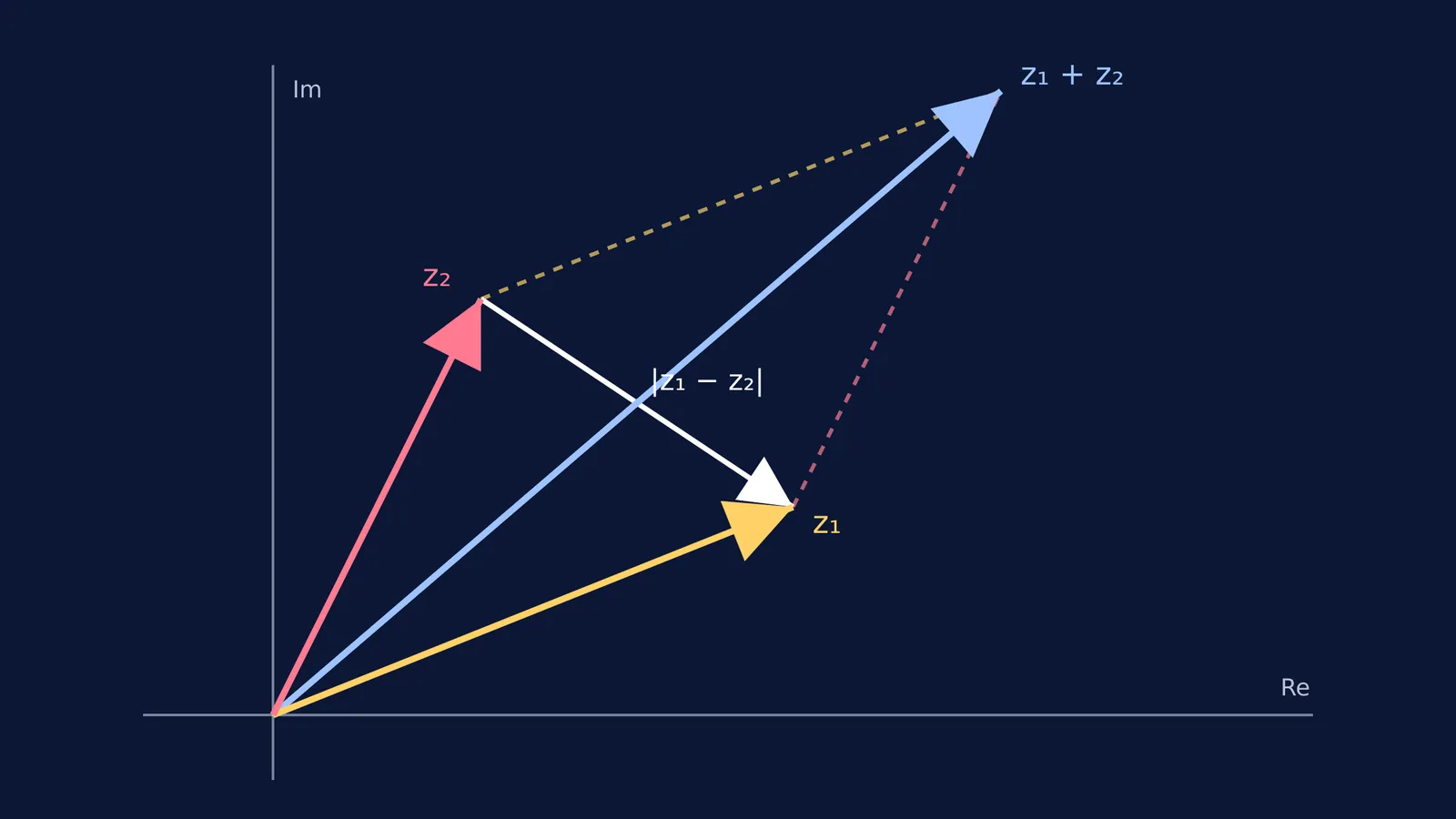
When you add two complex numbers, z₁ and z₂, you are performing vector addition. If you place the tail of the z₂ arrow at the tip of the z₁ arrow, the new tip lands exactly at z₁ + z₂.
Because you could just as easily place z₁ at the tip of z₂, the two paths trace out the sides of a parallelogram. The sum z₁ + z₂ is the long diagonal of this parallelogram starting from the origin.
Why does complex addition form a parallelogram?
Let us look at a concrete example. Suppose you have:
z₁ = 4 + 2i
z₂ = 1 + 3i
Algebraically, their sum is (4 + 1) + (2 + 3)i = 5 + 5i.
Geometrically, starting from the origin, the vector for z₁ tells you to walk 4 steps right and 2 steps up. From there, adding z₂ means walking another 1 step right and 3 steps up. You arrive at 5 + 5i.
Drawing the four points—the origin, z₁, z₂, and z₁ + z₂—and connecting the adjacent points gives you a perfect parallelogram. This is why many geometric theorems, such as the Triangle inequality for complex numbers, work exactly as they do in vector algebra. The shortest path between two points is a straight line, so the length of the sum vector |z₁ + z₂| can never be greater than the lengths of the two individual vectors |z₁| + |z₂| combined.
If you struggle to visualise these transformations, the Fermi Concept Library can help you build an intuition for the Argand plane. Fermi's AI tutor writes on a digital board and draws the figures as it explains, helping you see the geometry behind the algebra.
What does |z₁ − z₂| represent geometrically?
The modulus of a complex number, written as |z|, is its length, or its distance from the origin. For z = x + iy, the length is √(x² + y²), which is just Pythagoras's theorem.
But what happens when you subtract two complex numbers?
The vector z₁ − z₂ is the arrow that points from the tip of z₂ to the tip of z₁. Therefore, its modulus |z₁ − z₂| is exactly the straight-line physical distance between the two points on the Argand plane.
This single fact unlocks almost all complex coordinate geometry:
|z − z₁| = r means "the distance from an unknown point z to a fixed point z₁ is always a constant distance r". This is the equation of a circle with its centre at z₁ and a radius of r.
|z − z₁| = |z − z₂| means "the point z is always equidistant from both z₁ and z₂". This traces out the perpendicular bisector of the line segment joining z₁ and z₂.
|z − z₁| + |z − z₂| = 2a describes a shape where the sum of the distances to two fixed points is constant. This is the definition of an ellipse, just as you learn when using the Argand plane as a geometry tool for entrance exams.
How to use this in exams?
When a test question gives you a complicated algebraic equation involving moduli and arguments, your first step should be translating it into English distances and angles.
Instead of substituting z = x + iy and fighting through pages of algebra—a common trap that costs time and introduces arithmetic errors—draw a rough sketch of the scenario.
For instance, if a problem states that |z − 3| ≤ 2, you do not need an algebraic inequality. Read it geometrically: "the distance from z to the point 3 is less than or equal to 2". Draw a circle of radius 2 centred at (3, 0) on the real axis, and shade the inside.
If the question then asks for the maximum value of |z|, you are simply looking for the point in that shaded circular region that is furthest from the origin. Looking at your sketch, the origin is at 0, the centre is at 3, and the circle extends 2 units further to the right. The furthest point is clearly at 3 + 2 = 5. The maximum value of |z| is 5.
By treating complex numbers as geometry—building on the algebraic groundwork that Rafael Bombelli laid centuries ago—you transform abstract algebra into a puzzle you can sketch, see, and solve in seconds.


