

On this page
River-boat problems are a staple of Class 11 relative velocity and JEE practice, and the usual trap is this: the direction the boat points is not the direction it travels. A simulation shows that gap. Below are three headings to test, with numbers to predict first.
What does a river crossing simulation let you change?
The free oPhysics boat crossing simulation lets you set the direction the boat is aimed, the boat's speed relative to the water, and the river's speed relative to the ground.
The rule behind every run is vector addition. OpenStax University Physics states it as: the velocity of an object relative to one frame equals its velocity relative to a second frame plus the velocity of the second frame relative to the first. For the boat, that means velocity over ground = velocity through water + velocity of water. The NCERT Class 11 chapter Motion in a Plane warns you to keep this resultant separate from the velocity of one object relative to another.
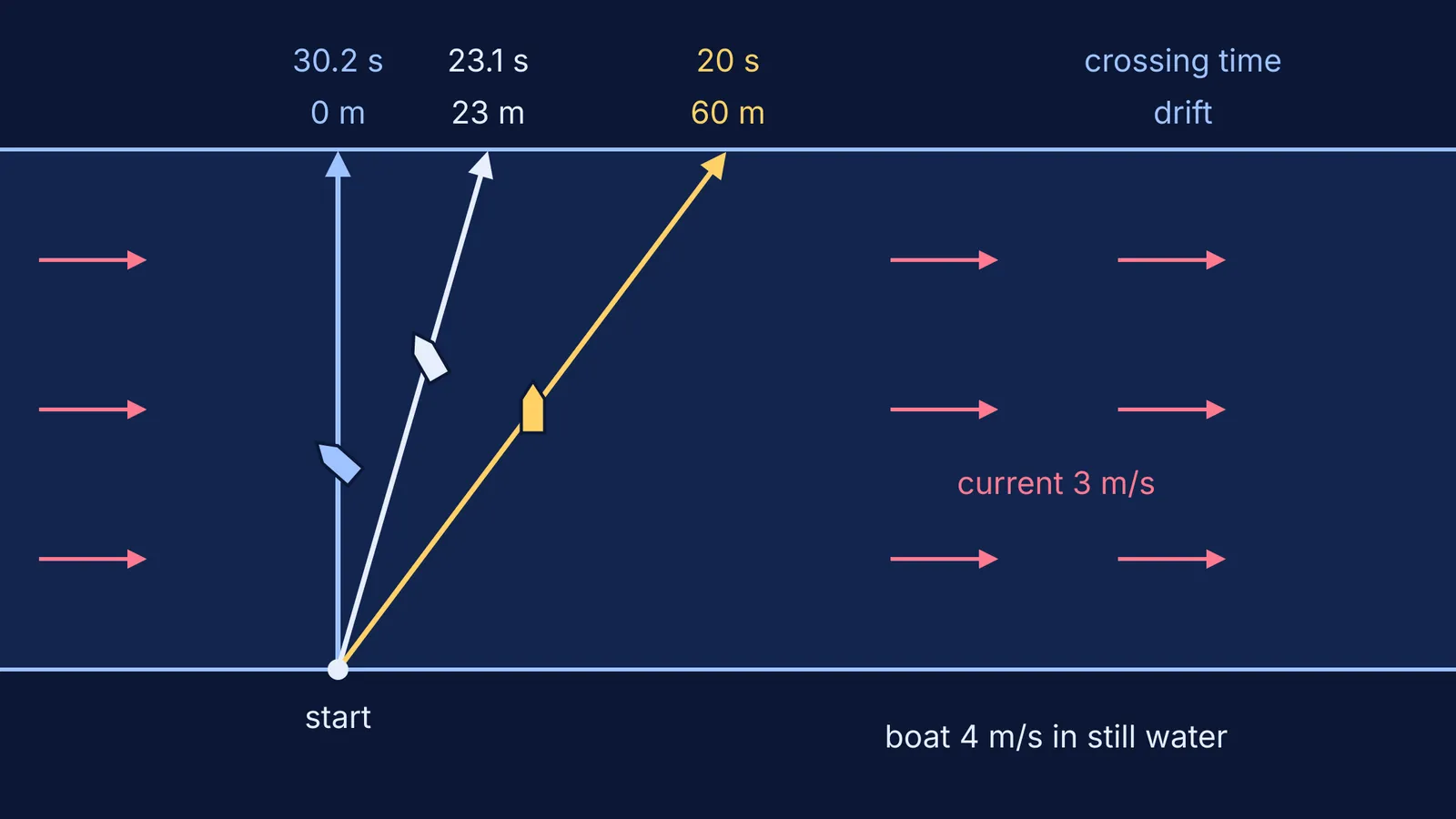
We will use one river all the way through: 80 m wide, with a boat that does 4 m/s in still water.
Which heading gives the shortest crossing time?
Point the boat straight across. In The Physics Classroom's riverboat lesson, a 4 m/s boat heading across an 80 m river with a 3 m/s current takes 80 ÷ 4 = 20 s, and drifts 3 × 20 = 60 m downstream. The same lesson says that changing the current velocity "does not affect the time required to cross the river since perpendicular components of motion are independent of each other".
Only the across part of the boat's velocity reaches the far bank, and heading straight across puts all 4 m/s there.
Test it: keep the heading straight across and run the current at 0, 3 and 5 m/s. The crossing time should stay at 20 s each time, and the landing point should move 0, 60 and 100 m downstream.
How do you reach the point directly opposite?
Aim upstream, so that the upstream part of the boat's velocity exactly cancels the current. That happens when sin θ = current speed ÷ boat speed, where θ is measured from the straight-across line.
For our river, by OpenStax's vector addition: sin θ = 3 ÷ 4 = 0.75, so θ ≈ 48.6° upstream. The part of the boat's velocity that still points across is 4 × cos 48.6° ≈ 2.65 m/s. The crossing takes 80 ÷ 2.65 ≈ 30.2 s.
So the shortest path costs you about 10 extra seconds compared with the shortest time. A middle heading shows the trade-off. Aim 30° upstream: the across speed is 4 × cos 30° ≈ 3.46 m/s, the time is about 23.1 s, and the net downstream speed is 3 − 4 × sin 30° = 1 m/s, so you land about 23 m downstream.
When is it impossible to cross straight across?
When the current is as fast as the boat or faster. Then sin θ = current ÷ boat speed would have to be 1 or more. Above 1 no angle works; at exactly 1 the boat points straight upstream and never crosses. Some drift is always left over.
Set the current to 5 m/s with the same 4 m/s boat. Heading straight across still takes 20 s (as The Physics Classroom shows), but now you drift 100 m. Drift is least when the boat's velocity is perpendicular to its track over ground: sin θ = boat speed ÷ current speed = 0.8, so θ ≈ 53.1° upstream. The across speed is 4 × 0.6 = 2.4 m/s, so the trip takes about 33.3 s. The net downstream speed is 5 − 4 × 0.8 = 1.8 m/s, so you land 60 m downstream instead of 100 m.
A five-run plan for your simulation session
Write down each prediction before you press run, then check it. The numbers extend The Physics Classroom's example.
Boat 4 m/s, current 3 m/s, aimed straight across. Predict 20 s and 60 m of drift.
Same settings, current 5 m/s. Predict 20 s again, with 100 m of drift.
Current 3 m/s, aimed 30° upstream. Predict about 23 s and 23 m of drift.
Current 3 m/s, aimed 48.6° upstream. Predict about 30 s with no drift.
Current 5 m/s, aimed 53.1° upstream. Predict about 33 s and 60 m of drift. Then try 45° and 60°: both should drift a little further, about 61 m.
For more practice with the same vectors, try predicting the resultant in a vector addition simulation, the minimum speed needed to reach a point downstream, and the angle to hold an umbrella while walking in rain.
If you get stuck between runs, Fermi's AI tutor can draw the figure and run the simulation with you, checking your understanding as it goes. More ideas that are easier to see than to read are in the Fermi Simulation Lab.


