

On this page
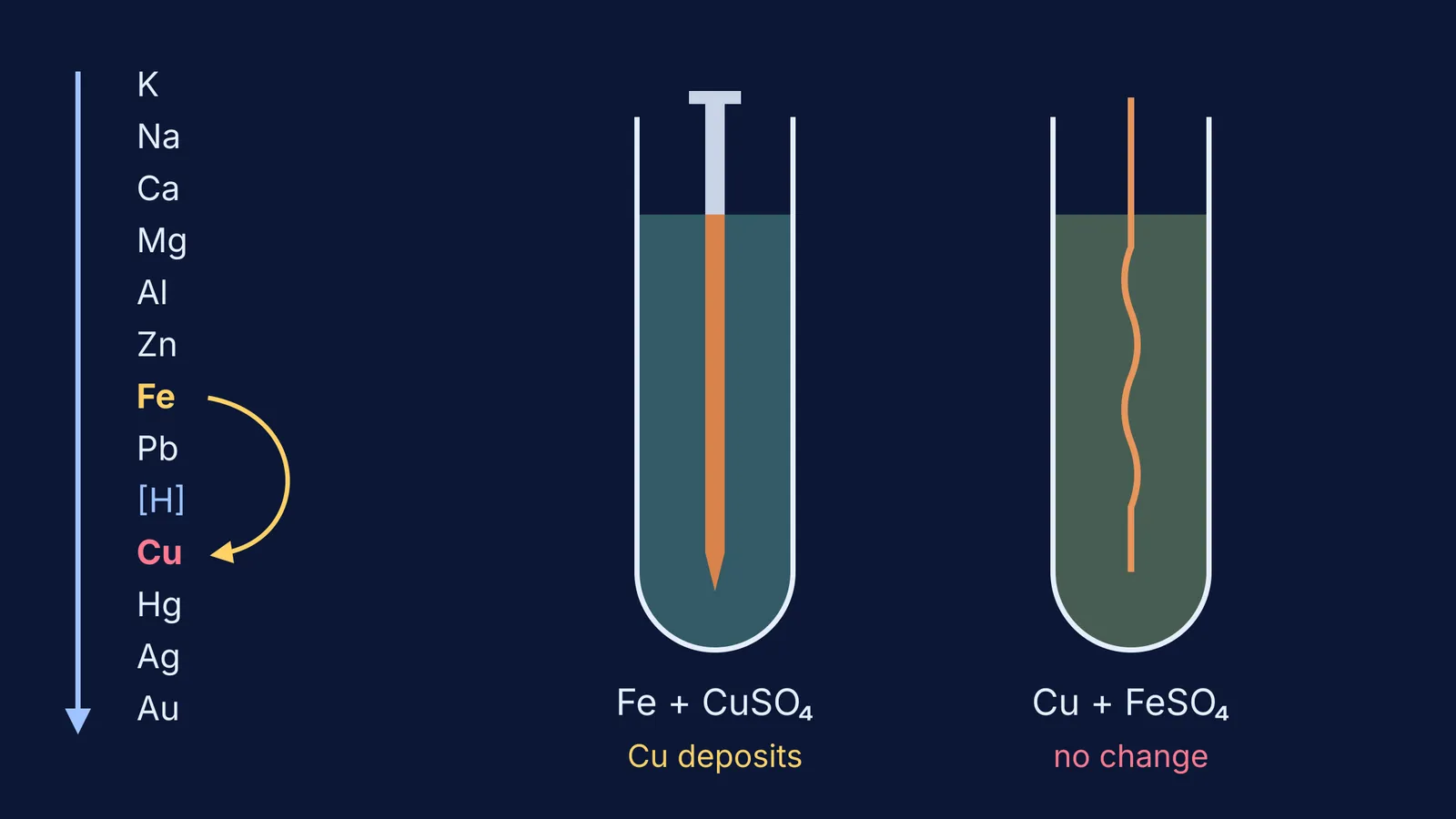
Drop an iron nail into blue copper sulphate solution and something changes. Drop a copper wire into iron sulphate and nothing happens. One list explains both: the reactivity series. Here is how to use it to predict any metal and salt pair, what to look for, and how to test your predictions in a simulation.
Which metal displaces which from a salt solution?
A metal displaces another metal from its salt solution only if it is more reactive, which means it sits higher in the reactivity series. NCERT's Class 10 chapter Metals and Non-metals puts the rule simply: if metal A displaces metal B from its solution, A is more reactive than B.
The same chapter lists the activity series from most to least reactive:
K, Na, Ca, Mg, Al, Zn, Fe, Pb, [H], Cu, Hg, Ag, Au
Hydrogen, in brackets, is the only non-metal in the list. It works as a marker: NCERT shows that copper, which sits below it, gives no bubbles with dilute hydrochloric acid.
What do you see when one metal displaces another?
NCERT's Chemical Reactions and Equations chapter has the classic example (Activity 1.9). Iron nails sit in about 10 mL of copper sulphate solution for about 20 minutes. The nails turn brownish and the blue colour of the solution fades. Iron has pushed copper out of the solution: Fe + CuSO4 → FeSO4 + Cu.
So you look for two kinds of evidence:
A deposit on the metal: the displaced metal comes out of solution and coats the metal you added.
A colour change in the solution: blue copper ions are replaced by iron ions, so the blue fades.
The same chapter shows zinc and lead displacing copper too, because both are more reactive than copper. The Royal Society of Chemistry's silver nitrate and copper demonstration shows the same idea up close: under a microscope, crystals of silver grow from the edges of a piece of copper, and enough appears to fill the view within minutes.
How do you predict the result before you drop the metal in?
Use three steps every time:
Find the free metal (the solid you drop in) in the series.
Find the metal inside the salt (copper in copper sulphate, silver in silver nitrate).
If the free metal is higher, predict a deposit and a colour change. If it is lower, predict no change at all.
Here is a worked set to try before reading the answers:
Zinc in copper sulphate: zinc is above copper, so copper deposits on the zinc and the blue fades.
Copper in zinc sulphate: copper is below zinc, so nothing happens.
Copper in silver nitrate: copper is above silver, so silver crystals grow on the copper.
Lead in copper chloride: lead is above copper, so copper is displaced.
Iron in zinc sulphate: iron is below zinc, so nothing happens.
Silver in copper sulphate: silver is below copper, so nothing happens.
Magnesium in iron sulphate: magnesium is above iron, so iron is displaced.
Notice that each "no change" answer is the reverse of a pair that does react. If iron displaces copper, copper will not displace iron from its salt solution.
How do you test your predictions in a simulation?
A simulation lets you run all seven pairs quickly. The value comes from predicting first: write your answer for each pair, then run it and compare. Our guide to the predict-then-test method with AI and simulations walks through this habit step by step.
The Fermi Simulation Lab has interactive simulations for the ideas that are easier to see than to read. A deposit creeping over a nail while the solution slowly loses its colour is that kind of idea. Whatever simulation you use, try this routine:
Pick one metal and run it through every salt solution in turn.
Note which tubes show a deposit and a colour change.
Rebuild the series from your results alone, then check it against NCERT's list.
If you mix this up with ions swapping between two salts, read displacement vs double displacement reactions. For Class 12, see the activity series vs the electrochemical series.
What can a simulation not show you?
Real metals are messier. NCERT asks you to rub tarnished samples clean with sandpaper first, and the same chapter notes that metals such as magnesium, aluminium and zinc carry a thin oxide layer on their surface. The RSC's microscale displacement practical warns that some salt solutions are slightly acidic, so you may see hydrogen bubbles, and those do not count as one metal displacing another. It also asks you to wear safety glasses throughout, since copper(II) sulfate solution can damage eyes.
Write down your seven predictions now, then test them one tube at a time.


