

On this page
Send one pulse in from the left end of a string and another in from the right, and you have one of the cleanest experiments in physics. You can predict what happens before you press play. A simulation lets you check every prediction in seconds, including a question that trips up many students: whether two opposite pulses destroy each other.
What happens when two wave pulses meet?
They add. OpenStax University Physics states the principle of superposition: when two or more travelling waves combine at the same point, the displacement of the medium there is the algebraic sum of the displacements due to the individual waves.
"Algebraic" is the important word. Upward displacement counts as positive and downward as negative, so a 2 cm crest meeting a 2 cm trough at the same point gives 0 cm there. Waves that follow this rule are called linear waves, and the same OpenStax section notes that waves which do not follow it are nonlinear. Small pulses on a stretched string, like those in a typical school simulation, are treated as linear waves.
To find the overlap shape, go point by point: read off the height each pulse would have on its own, then add the two. The result changes from moment to moment as the pulses slide over each other.
Do two opposite pulses cancel for good?
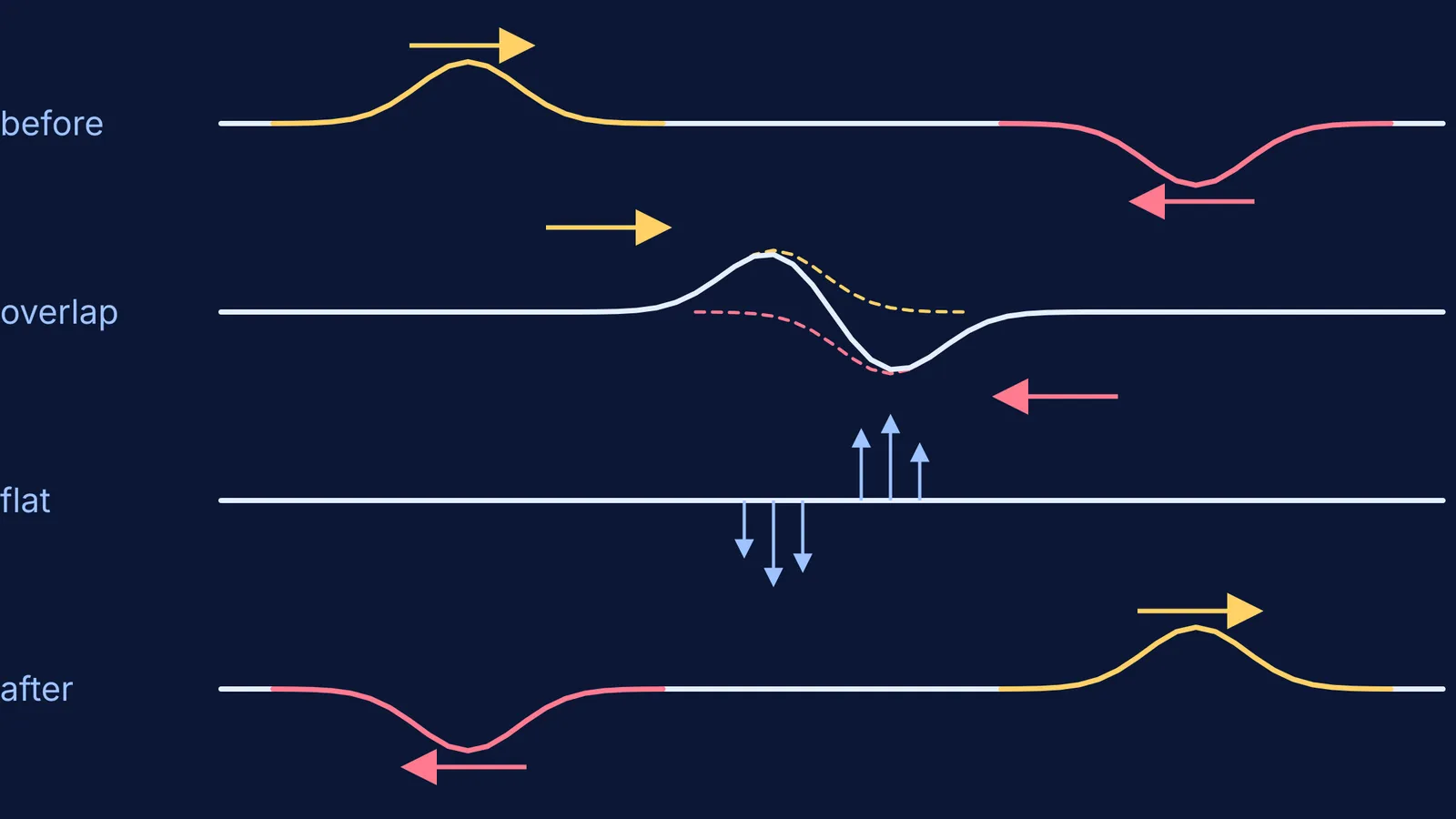
No. When an upward pulse and an equal downward pulse sit exactly on top of each other, the string is flat for an instant. Then both pulses reappear and keep going. OpenStax describes two pulses of the same amplitude moving toward each other that overlap and then "continue on unaffected by the encounter". Superposition gives the same result when one pulse is upside down: each pulse travels on as if the other were not there, so once they separate the string shows the two original pulses again.
The flat string still "remembers" the pulses because it is moving. On one side of the centre the string is rising and on the other side it is falling, so at that instant all the energy is kinetic. We explain where the energy goes, step by step, in where energy goes when two wave pulses cancel.
How do you test this in a simulation?
Use a string with fixed tension so both pulses travel at the same speed. If you want to see how tension sets that speed first, try how wave speed on a string changes with tension. Then write each prediction down before you run it:
Same side, same size. Two upward pulses of equal height and width meet. Predict the peak height at full overlap. Expected: twice the height of one pulse, which matches the doubling for constructive interference in OpenStax.
Opposite sides, same size. One up, one down, same height and width. Predict the shape at full overlap. Expected: a flat string for an instant.
Opposite sides, different heights. A 2 cm upward pulse meets a 1 cm downward pulse of the same width. Predict the peak at full overlap. Expected: 2 − 1 = 1 cm, upward.
Halfway through. Pause when the pulses overlap by about half. Sketch the shape by adding heights at five points along the string, then compare with the screen.
After passing. Predict where each pulse is, which way it faces and how tall it is once they separate. Expected: same shapes and sizes as before, each still moving in its original direction.
Writing the prediction first is the point of the exercise. Crouch, Fagen, Callan and Mazur compared ways of presenting classroom demonstrations in the American Journal of Physics in 2004. Students who only watched understood the concepts no better than students who saw no demonstration at all, while students who predicted the outcome first showed significantly greater understanding.
What does each pulse look like after passing?
Exactly as it did before. Each pulse keeps its height, width and orientation, and keeps travelling the way it was going. That raises a sharp question: with two identical upward pulses, how could you tell whether they passed through each other or bounced off? On screen the two stories look the same.
The fix is to make the pulses different. Send a tall, narrow pulse from the left and a short, wide one from the right. If they passed through, the tall narrow pulse ends up on the right. If they had bounced, it would come back to the left. Run it and you will see the tall pulse finish on the right, which is the evidence that waves pass through each other while solid objects collide.
The same adding rule explains standing waves on a string: a continuous wave and its reflection from a fixed end overlap all the time, and their sum gives the fixed pattern of nodes and antinodes.
If you find it hard to picture the overlap shape from a textbook figure, our Fermi Simulation Lab has interactive simulations for ideas that are easier to see than to read. Pause at the overlap, sketch your prediction, then let it run.


