

On this page
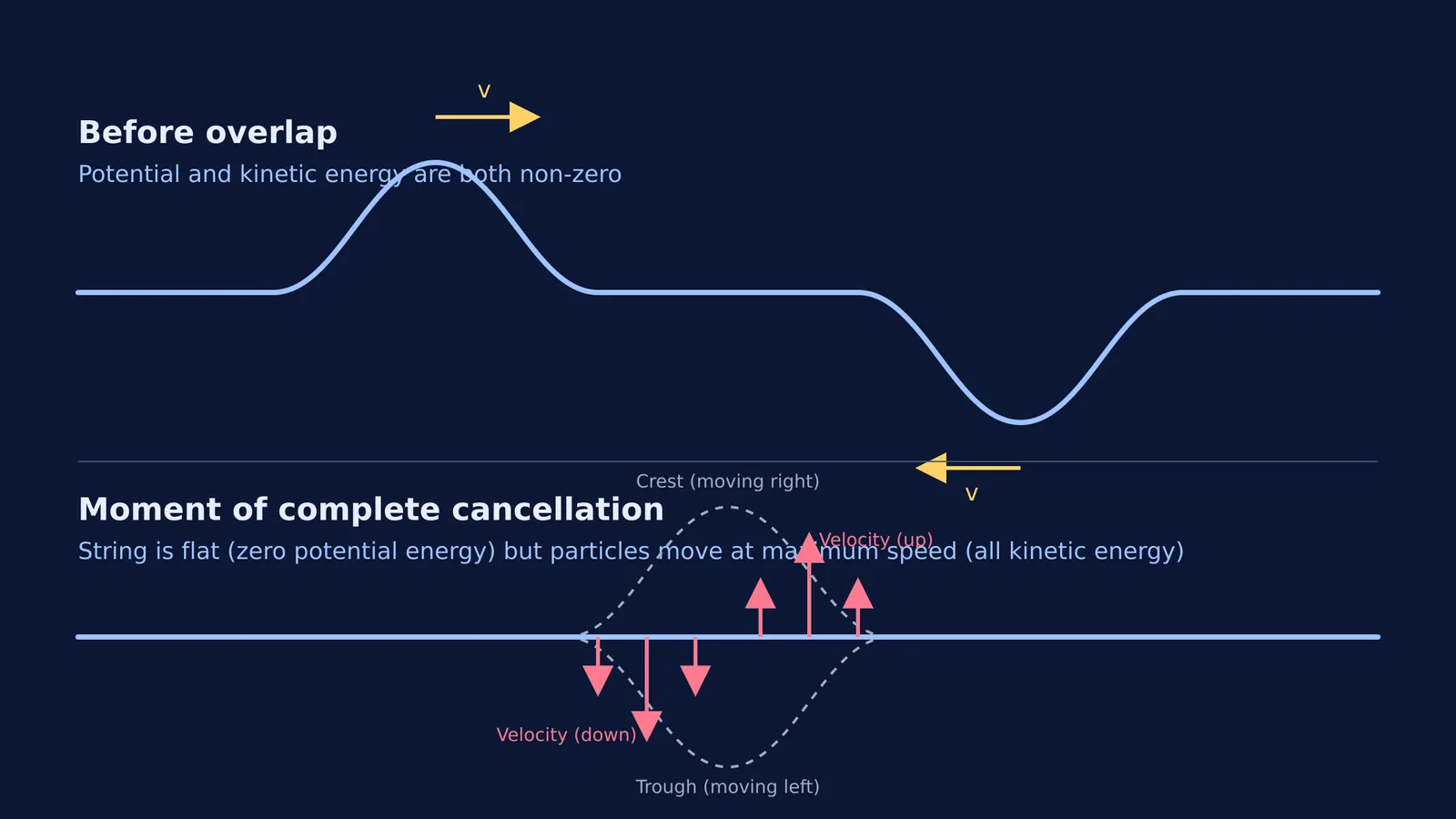
Have you ever watched two ripples on a pond collide and temporarily vanish, only to emerge on the other side unchanged? In physics, this phenomenon is called destructive interference. When a crest (an upward wave pulse) and a trough (a downward wave pulse) travelling on a string perfectly overlap, they cancel each other out completely. For a split second, the string appears perfectly flat.
If the string is flat, its physical displacement is exactly zero. But a fundamental law of physics tells us that energy cannot simply disappear into nothingness. So, where does the energy go during that fleeting instant of complete cancellation?
The answer lies in understanding the two forms of energy carried by a mechanical wave, the principle of superposition, and what happens to the vertical velocity of the string when two waves meet in the middle.
What are the two halves of wave energy?
To solve the mystery of the missing energy, we need to look at how a mechanical wave stores energy as it travels. According to OpenStax *University Physics*, the total mechanical energy of a wave on a string is the sum of its kinetic energy and potential energy. (You may recall learning about the basic definitions of these two forms when studying work and energy in Class 9).
Potential Energy: This comes from the string stretching against its own internal tension. When a wave pulse travels through, it forces the string away from its horizontal resting position. This physical deformation requires work, which is stored in the string as potential energy. A flat string has no stretch, meaning its potential energy is exactly zero.
Kinetic Energy: This comes from the physical motion of the string. As the wave passes, the individual particles of the string move up and down, perpendicular to the wave's overall direction of travel.
When a single wave pulse moves along a string, the wave's total energy is distributed between these two forms. The string stretches (gaining potential energy) and moves (gaining kinetic energy). But when two separate pulses interact, this balance shifts dynamically.
Where does the energy go when two wave pulses cancel?
When an upward pulse and a downward pulse meet, they obey the principle of superposition. This principle states that the resulting shape of the string is the algebraic sum of the two individual waves at every point.
At the exact moment the two pulses perfectly overlap, the positive upward displacement of the crest cancels out the negative downward displacement of the trough. Because the string is momentarily completely flat, the potential energy drops to zero.
However, the superposition principle does not just apply to the shape of the string; it also applies to the vertical velocity of the string's particles.
Even though the string is completely flat, it is definitely not stationary. Consider the leading edge of the crest: it is pulling the string upwards. At the very same moment, consider the trailing edge of the trough: it is also pulling the string back upwards towards the equilibrium position. Instead of cancelling out, the up-and-down velocities of the string particles from the two overlapping pulses actually add together.
At the instant of complete cancellation, the string particles are moving at their absolute maximum vertical speed. The wave's energy has not disappeared; rather, all the potential energy has been converted into kinetic energy. The string is completely flat, but it is moving furiously.
Once that instantaneous moment passes, the string's own momentum and inertia carry it past the flat equilibrium position. The string stretches again, converting that kinetic energy back into potential energy. As OpenStax *University Physics* notes, the two pulses then separate and continue on completely unaffected by the encounter, as if they had never met.
How can you picture this for your exams?
Understanding this dynamic behaviour is a powerful tool for JEE and NEET physics problems. Examiners often test your intuition on energy conservation and wave mechanics. Students who just memorize the superposition formula for displacement (y = y₁ + y₂) often get stumped when asked about velocity or energy, much like they do when forgetting how to use the kinetic energy and momentum relation in mechanics problems.
Instead of relying solely on algebraic equations, try to picture the actual physical motion of the string. You can use the Fermi Concept Library to explore every concept in physics and see exactly how the velocity vectors add up even when the displacement vectors cancel out. By watching the energy toggle between potential and kinetic, you build a robust mental model that makes tricky conceptual questions much more intuitive.
The next time you encounter a problem about waves cancelling out, remember: a flat string does not automatically mean a stationary string. The energy is not gone; it is simply hiding in the motion.


