

On this page
Try this puzzle first. You sit in a chair hung from a rope. The rope goes up over one fixed pulley and comes back down to your hands. How hard must you pull to hold yourself still: your full weight, half of it, or something else? Write your answer down, then check it below.
How much force do you need to pull yourself up with a pulley?
About half the combined weight of you and the chair. A physics lecture at Ohio University works this exact case: a person weighing 800 N on a chair weighing 10 N needs a pull of 405 N to stay still. The same slides find that rising with an acceleration of 0.5 m/s² takes about 426 N, slightly more, because the rope must also speed you up.
Here is the same idea with your own numbers, using g = 9.8 m/s² as those slides do:
You have a mass of 50 kg and the chair 5 kg, so the total is 55 kg.
Total weight W = 55 × 9.8 = 539 N.
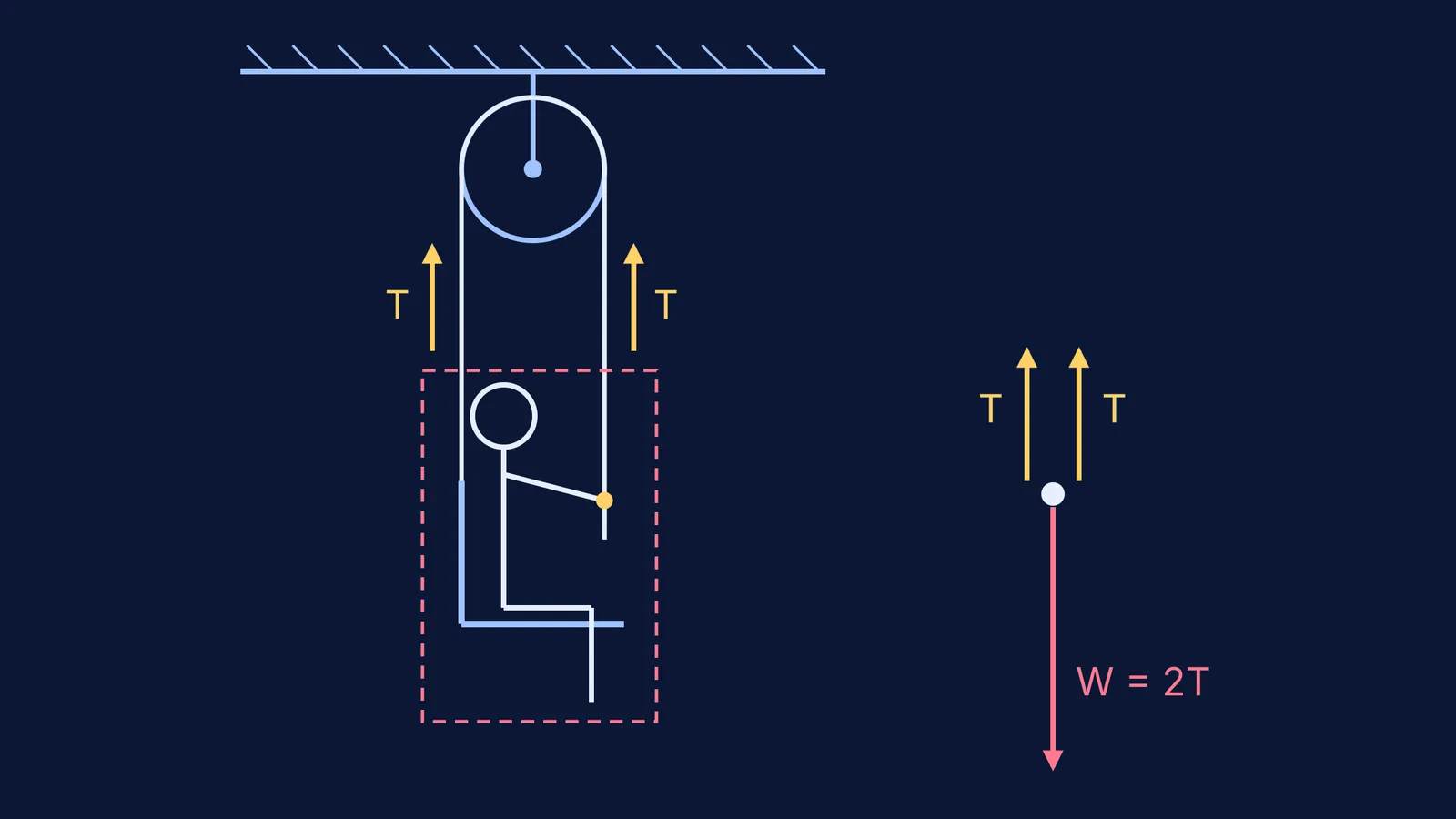
Two rope segments hold you up, so 2T = W and T = 269.5 N.
That pull equals the weight of about 27.5 kg: a heavy suitcase, not a whole person.
Why is the pull only half your weight?
Draw a dashed box around you and the chair together, then count every rope that crosses the box. There are two. One rope segment pulls up on the chair. The other pulls up on your hands, because when you pull down on the rope, the rope pulls up on you (Newton's third law). A light rope over a smooth pulley has the same tension T all along it, so the box feels 2T upwards. Hold still and 2T = W.
For why the tension matches on both sides, see our explainer on when tension stays the same along one string.
What if a friend on the ground pulls you up instead?
Now only one rope segment crosses your box: the one tied to the chair. Your friend's hands are outside it. So your friend must pull with your full weight: 810 N with the Ohio lecture numbers, not 405 N. Same pulley, same chair, double the force. For your friend, the pulley only changes the direction of the pull. For you, it brings a second rope into your box.
The half-force trick has a cost. To rise 1 m, both rope segments above you must get 1 m shorter, so 2 m of rope passes through your hands. A science centre in Sweden makes the same point with a chair lift built as a block and tackle in which four of its five pulleys each halve the force: you lift with one sixteenth of your weight but pull 16 times as much rope as the height you gain. To see where the energy goes, try our walkthrough on finding the speed of blocks on a pulley using energy.
How can you test it at home without lifting a person?
Do not hang a person from a home-made rig. Use a bag of rice or books, a small pulley hooked to something strong, a rope and a luggage spring scale.
Predict each scale reading and write it down.
Hang the bag from the scale alone and read its weight. Call it W.
Tie one end of the rope to the bag handle, run it over the pulley, and tie the other end to the scale's hook. Clip the scale's body to the bag. The scale is now your hands. Let the bag hang still and read it.
Unclip the scale from the bag and hold it yourself, like the friend on the ground. Read it again.
Compare. Expect step 3 to read close to W/2 and step 4 close to W.
Your step 3 reading will likely sit a little above half. The Ohio slides note that pulley friction reduces the mechanical advantage somewhat, and the scale's own weight is inside your box too. Our piece on why no real machine reaches 100% efficiency explains where that extra force goes.
Why should you predict before you test?
In a study of physics lecture demonstrations, Catherine Crouch, Eric Mazur and colleagues found that students who only watched a demonstration understood the idea no better than students who never saw it, while students who predicted the outcome first showed significantly greater understanding. Writing your guess down is what turns the rice-bag test into learning.
If a pulley set-up is hard to picture, the Fermi Simulation Lab has interactive simulations for ideas that are easier to see than to read, so you can predict first and then watch. When a textbook problem adds a second pulley and your answer comes out wrong, the Fermi Problem Library has a step-by-step solver that explains the reasoning rather than printing an answer.
Before your next pulley question, draw the box, count the ropes that cross it, and divide.


