

On this page
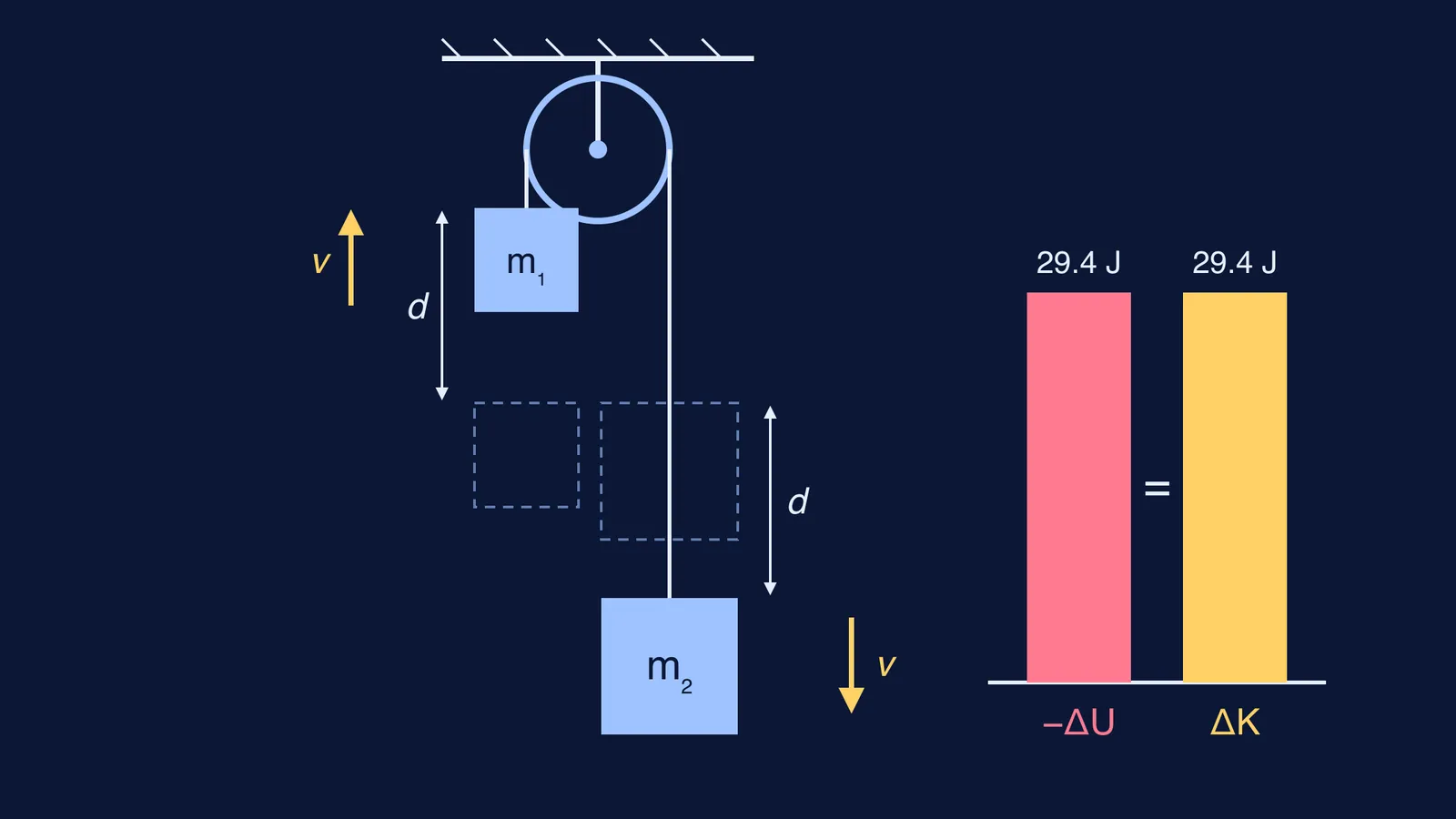
Two blocks hang over a pulley and are released from rest. How fast are they moving once the heavier one has dropped a distance d? The usual route is two free-body diagrams, solve for acceleration and tension, then use v² = 2ad. That works, but energy gets you there in one line, and you never need the tension at all.
How do you find the speed of blocks using energy?
The rule comes from OpenStax University Physics, section 8.3: mechanical energy stays constant unless forces outside the system or non-conservative forces do work on it. The same page says the law applies to any system, as long as you include the kinetic and potential energies of all the particles and the work done by any non-conservative forces.
For an Atwood machine, with a lighter mass m₁ and a heavier mass m₂ on a light string over a light, frictionless pulley, that gives three steps:
Find the net potential energy lost. m₂ falls d and loses m₂gd; m₁ rises d and gains m₁gd. The system loses (m₂ − m₁)gd.
Write the kinetic energy of the whole system. The string stays taut, so both blocks share the same speed v, and K = ½(m₁ + m₂)v².
Set the two equal and solve: v = √[2(m₂ − m₁)gd / (m₁ + m₂)].
Why does tension drop out of the energy equation?
Tension does work on both blocks, but with opposite signs. On m₁ it pulls up while m₁ moves up, so it does +Td. On m₂ it also pulls up, but m₂ moves down, so it does −Td. With a light string that does not stretch, running over a frictionless pulley, T is the same on both sides and the two pieces of work cancel. So you can leave T out.
Worked example: how fast are the blocks after 1.5 m?
Take m₁ = 3 kg and m₂ = 5 kg, released from rest, with g = 9.8 m/s². Find their speed after m₂ has fallen 1.5 m.
Potential energy lost: (5 − 3) × 9.8 × 1.5 = 29.4 J.
Kinetic energy gained: ½ × (3 + 5) × v² = 4v².
So 4v² = 29.4, giving v² = 7.35 m²/s² and v ≈ 2.71 m/s.
Now check it the long way. The acceleration is a = (m₂ − m₁)g / (m₁ + m₂) = 2 × 9.8 / 8 = 2.45 m/s², and v² = 2ad = 2 × 2.45 × 1.5 = 7.35 m²/s². Same answer, more steps.
What changes if the pulley has mass or one block is on a table?
A pulley with mass spins, so it carries rotational kinetic energy ½Iω². If the string does not slip, the rim moves at the blocks' speed, v = Rω. Example 16.4 in Dourmashkin's Classical Mechanics on LibreTexts/16%3A_Two_Dimensional_Rotational_Kinematics/16.04%3A_Conservation_of_Energy_for_Fixed_Axis_Rotation) uses this for a hanging block pulling a block along an incline: the kinetic energy becomes ½(m₁ + m₂ + I/R²)v², and for a uniform disc pulley I/R² is half the pulley's mass. The same term applies to our example: a 2 kg disc adds 1 kg to the bracket, so 4.5v² = 29.4 and v ≈ 2.56 m/s. The pulley takes a share of the energy, so the blocks move a little slower.
If one block slides on a table, only the hanging block changes height, but both blocks still move. OpenStax problem 71 in chapter 8 sets this up with a 2.0 kg hanging block, a 4.0 kg block on a frictionless table and a 2.0 m move. Write m₁gd = ½(m₁ + m₂)v², try it yourself, then check: you should get about 3.6 m/s.
If the table has friction, the OpenStax rule still holds: the change in mechanical energy equals the work done by non-conservative forces. Subtract the friction work, μm₂gd, from the potential energy lost before you solve.
When should you use energy instead of F = ma?
A quick decision check:
Asked for speed after a distance: use energy.
Asked for tension or acceleration: use Newton's laws, since the whole-system energy equation never gives you T.
Asked for speed after a time t: you need a, so use Newton's laws and kinematics.
Pulley with mass: energy, with I/R² added to the mass bracket.
Friction on a surface: energy, with the friction work subtracted.
If you keep picking the long route or dropping a term, the Fermi Problem Library has worked problems with a step-by-step solver that explains the reasoning rather than printing an answer, so you can compare its setup with yours line by line. And if energy moving between two blocks is hard to picture, the Fermi Simulation Lab has interactive simulations for ideas that are easier to see than to read.
Next time a pulley question asks how fast after d metres, write the energy line first.


