On this page
In short The probability of rolling at least one six in four rolls of a fair die is 671/1296. In 1654, the Chevalier de Méré's questions about this bet and double-sixes led mathematicians Blaise Pascal and Pierre de Fermat to develop the foundations of modern probability theory. You can verify this mathematical result by running a simple computer simulation.
The Chevalier de Méré, a 17th-century gambler, noticed something that puzzled him about a popular dice game. He consistently won money by betting that he could roll at least one six in four throws of a single die. But when he bet on rolling at least one double-six in 24 throws of a pair of dice, he lost (University of York).
He expected the odds to be exactly the same. De Méré famously wrote to the mathematician Blaise Pascal, creating a "scandal" that ultimately launched the mathematics of probability.
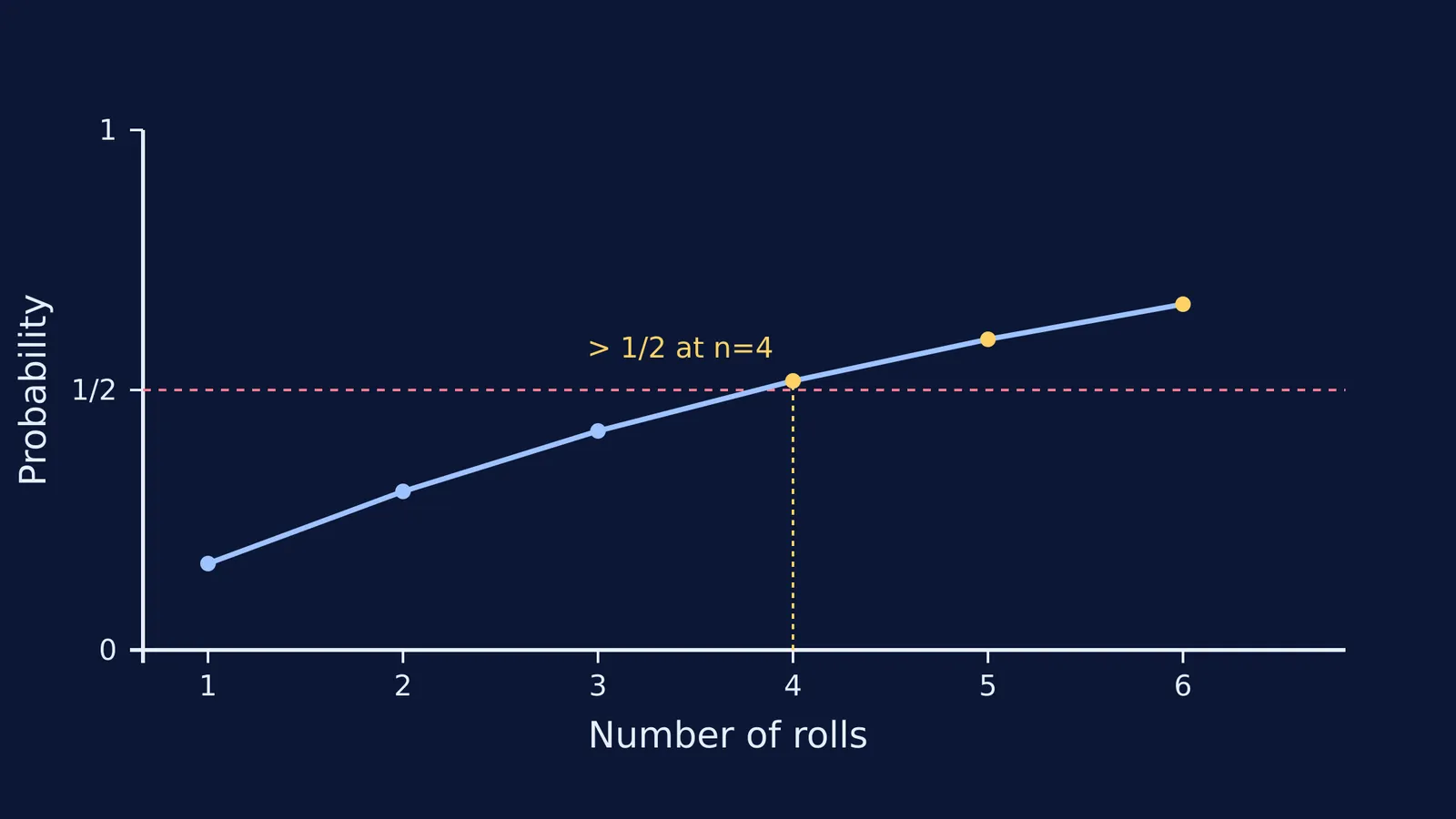
What is the probability of at least one six in four rolls?
The easiest way to calculate this is to work out the probability of *not* getting a six, and then subtract that from 1. This is known as the complementary probability.
The probability of not rolling a six on one throw: A fair six-sided die has five faces that are not a six. The probability of getting any of these is 5/6.
The probability of not rolling a six in four throws: Because each roll is independent, you multiply the probabilities together for the four throws. This gives (5/6)⁴, which equals 625/1296.
The probability of getting at least one six: This is 1 minus the chance of getting no sixes at all. 1 − (625/1296) gives 671/1296.
Because 671 is greater than half of 1296, the bet was mathematically in de Méré's favour (University of York).
Why did de Méré think the odds were different?
De Méré fell for a common trap in probability problems. He believed that probabilities simply added up linearly.
Since the chance of a six on one die is 1/6, he reasoned that four throws gave him a 4 × (1/6) = 4/6 (or 2/3) chance of success. By the same logic, since a double-six on two dice has a probability of 1/36, he calculated that rolling 24 throws should give him a 24 × (1/36) = 24/36 (or 2/3) chance (University of York).
However, probabilities of independent events are multiplied, not added. If you calculate the complementary probability for 24 rolls of two dice, you find it is 1 − (35/36)²⁴. This works out to be just under half. Because it is under a half, a gambler playing this second game repeatedly will lose money in the long run.
According to Pascal, de Méré initially believed this discrepancy meant that "arithmetic was demented" (University of York).
How to write a simple simulation to test it?
You do not have to roll a die by hand to prove Pascal and Fermat right. A short computer script can simulate the game and confirm the theoretical result. This is an excellent way to check a mathematical formula when you are unsure of your own working.
Here is a plan for a basic simulation you can write in Python or JavaScript:
Set a counter for `wins` to 0.
Create a loop that runs for many separate games.
Inside the loop, simulate four dice rolls by picking four random integers between 1 and 6.
If any of those four numbers is a 6, add 1 to the `wins` counter.
After the loop finishes running, divide your total `wins` by the number of games to find the experimental probability.
If you write and run this code, your experimental answer will consistently land very close to 671/1296. The Fermi Simulation Lab offers interactive simulations for the ideas that are easier to see than to read, turning abstract probabilities into visible patterns.
What does this teach us about learning maths?
De Méré's story is a reminder that mathematical intuition can sometimes mislead us. When a calculation gives an answer that feels wrong, the best response is not to declare that arithmetic is broken, but to break the problem down into smaller, logical steps. This is a crucial habit for mastering advanced mathematics.
Working through the reasoning line by line, exactly as Pascal and Fermat did, is how you build true understanding and discover the mathematical laws that govern our universe. If you find yourself stuck on a similar numerical problem, the Fermi Problem Library offers worked problems with a step-by-step solver that explains the reasoning rather than printing an answer. By identifying where your logic diverges from the mathematical rules, you can turn a confusing result into a foundational insight that stays with you.