

On this page
Why does the doubling pattern break after two cuts?
Picture a round pizza on a table. Before cutting, you have 1 whole piece. A single straight cut produces 2 pieces. A second straight cut across the first creates 4 pieces. At this stage, it is easy to assume the count doubles with every cut: 1, 2, 4, 8, and so on. Yet as documented in Wolfram MathWorld's analysis of circle division by lines, 3 straight cuts yield at most 7 pieces.
If you make 3 cuts that all pass through the centre like bicycle spokes, you divide the crust into 6 equal slices. To get more, you must shift the third cut away from the center so it intersects both earlier cuts at separate points. That creates a central triangular piece and gives 7 pieces, but 8 remains impossible.
The doubling pattern fails because of geometry. For a straight cut to double the existing piece count, it would have to divide every single existing piece in half. In a circular disk, that would require one straight line to pass through 4 separate regions simultaneously. Because straight lines cannot bend or weave, a line can only cross pieces that lie directly in its path. Unlike combinatorial puzzles such as finding power patterns in the Tower of Hanoi where states truly double, cutting a plane adds pieces in arithmetic steps rather than exponential leaps.
How many pieces can you get with 4 and 5 straight cuts?
To find the maximum pieces for 4 and 5 cuts, look at what happens along the knife edge as it enters the circle. The sequence of maximum pieces for n cuts—catalogued in The On-Line Encyclopedia of Integer Sequences entry A000124—proceeds as 1, 2, 4, 7, 11, 16, and 22.
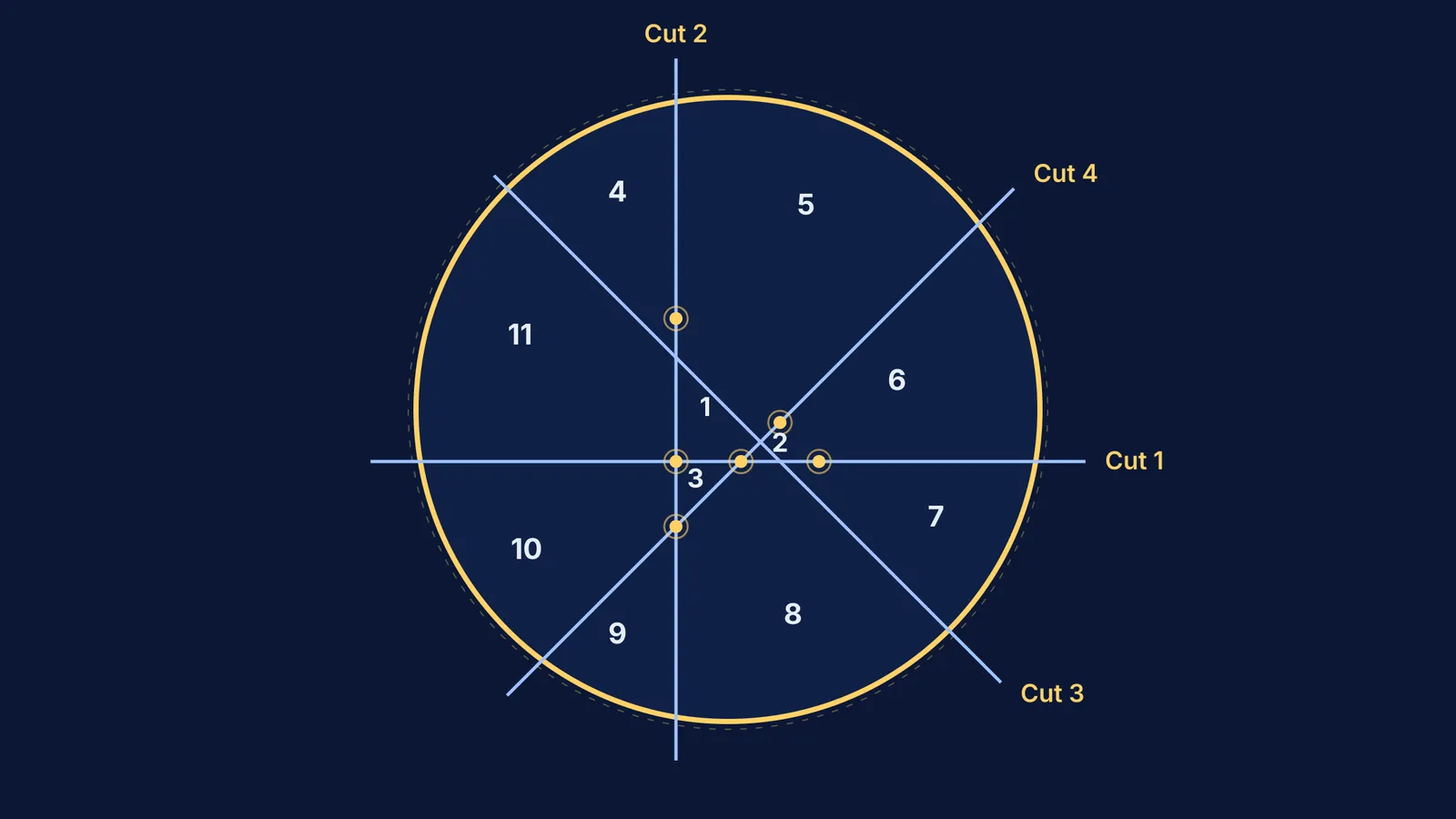
When making a 4th straight cut across a pizza with 7 pieces, your blade can cross at most the 3 existing lines. Those 3 intersection points divide the 4th cut into 4 line segments inside the circle. Each segment enters an existing piece, cuts across it, and divides it into two. That adds exactly 4 new pieces: 7 + 4 = 11 pieces.
Adding a 5th straight cut repeats the mechanism. The 5th line can cross at most 4 existing lines, producing 4 interior intersection points. These points carve the 5th cut into 5 consecutive segments, each splitting an existing region: 11 + 5 = 16 pieces.
What rule determines the maximum number of pieces?
The pattern is additive: the n-th cut adds n new pieces. This gives the recurrence relation L(n) = L(n − 1) + n, with base case L(0) = 1. Expanding this recurrence gives the initial piece plus the sum of the first n positive integers: L(n) = 1 + (1 + 2 + 3 + ... + n).
The sum of the first n integers equals n(n + 1)/2, known as the n-th triangular number. This is the same triangular progression seen when visualising triangular numbers in the handshake problem. Adding the uncut pizza gives the closed-form formula: L(n) = n(n + 1)/2 + 1 = (n² + n + 2)/2.
In 1826, Swiss geometer Jacob Steiner published this exact recurrence and closed formula in Crelle's Journal while establishing the foundations of plane and space division. Steiner proved that n straight lines partition a plane into at most (n² + n + 2)/2 distinct regions.
Visualising how straight lines partition a surface becomes increasingly difficult as the number of cuts grows. The Fermi Simulation Lab provides interactive simulations for the ideas that are easier to see than to read, helping students test parameters and explore visual patterns directly.
How do you test line placements without missing a piece?
Drawing 4 or 5 cuts on paper often produces fewer pieces than expected. A missing piece occurs whenever the lines deviate from general position. In the American Journal of Physics, researchers Audrey Champagne, Leopold Klopfer, and John Anderson demonstrated that testing intuitive predictions against structured observations exposes deeply held misconceptions and drives conceptual understanding.
You can systematically test your drawing against a four-step checklist:
Check for parallels: verify that no two cuts are parallel, as parallel lines never intersect and forfeit 1 potential piece.
Check for concurrent vertices: ensure no three cuts meet at the same point, which merges two intersection points into one and destroys a region.
Keep intersections inside the rim: ensure all crossing points lie inside the circle, because intersections outside the pizza do not divide the dough.
Count boundary and interior pieces: n cuts in general position always produce 2n boundary pieces along the crust and (n − 1)(n − 2)/2 interior pieces enclosed entirely by lines. For 4 cuts, this inventory yields 8 boundary pieces and 3 interior pieces, making 11 pieces.
Testing your own sketches against these criteria mirrors the active investigation habits explained in our guide on how to use an AI tutor with simulations. For students practicing geometry and combinatorics, the Fermi Problem Library offers worked problems with a step-by-step solver that explains the reasoning rather than printing an answer.
The next time you face a sequence problem, sketch small cases and predict the next value before calculating. Testing where your lines fall turns an abstract formula into an intuitive geometric discovery.


