

On this page
Imagine a room of 10 people where each person shakes hands with everyone else once. How many handshakes occur?
Most students multiply 10 by 9 to predict 90. The intuition seems simple: 10 people each greet 9 others. Yet the true count is exactly 45. As introduced in NCERT Class 11 Mathematics Chapter 6, understanding why this naive product doubles the actual total reveals the difference between permutations and combinations.
Why do 10 people make 45 handshakes instead of 90?
The error lies in ignoring mutual symmetry. As formalised in NCERT Class 11 Mathematics Chapter 6, when Person 1 shakes hands with Person 2, both complete the greeting simultaneously. Counting Person 2 with Person 1 records the same handshake twice.
This distinction defines combinations. A permutation treats (Person 1, Person 2) as distinct from (Person 2, Person 1), producing 10 × 9 = 90 directed greetings. Because a handshake is an unordered pair, order does not matter:
Total Handshakes = (10 × 9) / 2 = 45
This is the standard combination formula ⁿC₂ = n! / (2!(n − 2)!), which simplifies to n(n − 1) / 2.
How does drawing a network reveal the combinatorics?
When algebra feels abstract, translating the problem into a network reveals its counting structure. As formalised in graph theory tracing to Leonhard Euler's 1736 paper on network vertices and edges (Euler Archive E53), geometric representations clarify how connections accumulate.
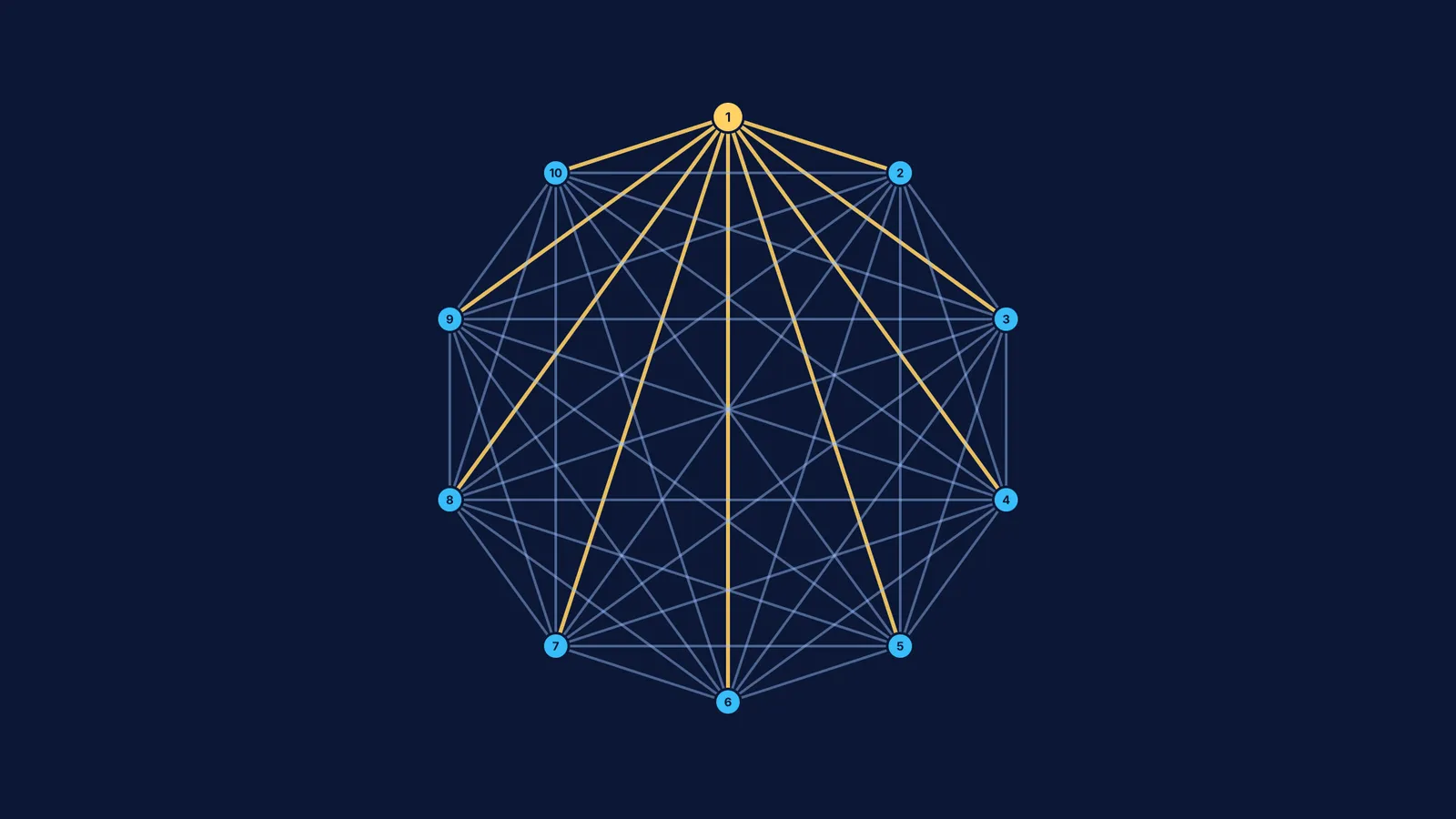
Represent each of the 10 people as a vertex along a circle, and each handshake as an edge. Because everyone connects with all others, this forms a complete graph on 10 vertices, denoted K₁₀.
You can count the edges in two equivalent ways:
The additive sequence: Person 1 draws 9 lines. Person 2 is already connected to Person 1, so they draw 8 new lines. Continuing to Person 9, who draws 1 line, yields the sum 9 + 8 + 7 + 6 + 5 + 4 + 3 + 2 + 1 = 45.
The degree-sum method: Each of the 10 vertices connects to 9 edges, giving 10 × 9 = 90 endpoints. Because every edge has two endpoints, the total edges equal 90 / 2 = 45.
Euler's Handshaking Lemma proves this universal rule: the sum of vertex degrees in any graph equals twice the number of edges.
In the Fermi Simulation Lab, interactive simulations for ideas that are easier to see than to read allow students to manipulate networks and watch complete graphs form, making combination formulas intuitive.
Why do students struggle with combination formulas?
Combinatorics is challenging when students memorize formulas without anchoring them in concrete outcomes.
In a 2013 study in *The Journal of Mathematical Behavior*, Elise Lockwood introduced a model of combinatorial thinking linking formulas, counting processes, and sets of outcomes (Lockwood, 2013). In 2018, Lockwood, Nicholas H. Wasserman, and William McGuffey published research in the *International Journal of Research in Undergraduate Mathematics Education* examining how students categorize combination problems (Lockwood et al., 2018). They found that while undergraduates readily identify unordered selections of distinct items—such as committees and handshakes—as combinations, they stumble when tasks involve indistinguishable arrangements or when they fail to link pairwise interactions to underlying subsets.
This combinatorial insight has ancient roots. Around 850 CE, Indian mathematician Mahavira gave general rules for combinations in the *Ganita Sara Sangraha*, demonstrating how systematic selection avoids duplicate counting (Mahavira's combination rules in the Ganita Sara Sangraha).
How can you test your combinatorial reasoning?
In a 2004 study in *Mathematical Thinking and Learning*, Michal Mashiach Eizenberg and Orit Zaslavsky found that students rarely detect counting errors by re-reading formulas (Eizenberg and Zaslavsky, 2004). Instead, two strategies proved most effective: testing simpler cases and using alternative representations.
Apply this four-step verification plan to any pairwise problem:
Test a smaller case: Reduce to 3 people. The formula 3 × 2 gives 6, but listing the 3 pairs (A-B, B-C, C-A) shows 3 handshakes, confirming the division by 2.
Draw the network: Sketch points on paper and connect them. Notice that each new vertex adds k − 1 edges to the existing k vertices.
Check for symmetry: If swapping two participants leaves the outcome unchanged, order does not matter. Use combinations rather than permutations, as detailed in our guide on avoiding double counting in permutations and combinations.
Re-solve with a second method: Compute both the combination ¹⁰C₂ = (10 × 9) / 2 and the additive series 9 + 8 + ... + 1. Reaching 45 through two different paths verifies your solution.
For problems with extra constraints, see our guide on selection problems with combinations. The Fermi Problem Library offers worked problems with a step-by-step solver that explains the reasoning rather than printing an answer, helping students build genuine combinatorial mastery.


