

On this page
The Tower of Hanoi is a classic mathematical puzzle invented by the French mathematician Édouard Lucas in 1883 according to Wikipedia.
The objective is simple: move the entire stack of discs from the first peg to the last. However, you must follow two rules: you can only move one disc at a time, and you can never place a larger disc on top of a smaller one. Playing with physical discs or a tower of hanoi moves pattern interactive simulation helps build a mental model of how recursion works.
If you want to practice visualizing these mathematical rules, the Fermi Simulation Lab has interactive simulations for ideas that are easier to see than read.
How many moves for 3, 4 and 5 discs?
To find the pattern, we start by solving the puzzle for a small number of discs and counting the minimum moves required according to Wikipedia.
1 disc: 1 move
2 discs: 3 moves
3 discs: 7 moves
4 discs: 15 moves
5 discs: 31 moves
You can verify these numbers by playing the game manually. Each time you add a new disc to the bottom of the stack, the number of required moves is slightly more than double the previous amount.
What is the pattern for the Tower of Hanoi moves?
The sequence of minimum moves (1, 3, 7, 15, 31) reveals a clear exponential relationship. The minimum number of moves required to solve a Tower of Hanoi puzzle with n discs is exactly 2ⁿ − 1 according to Wikipedia.
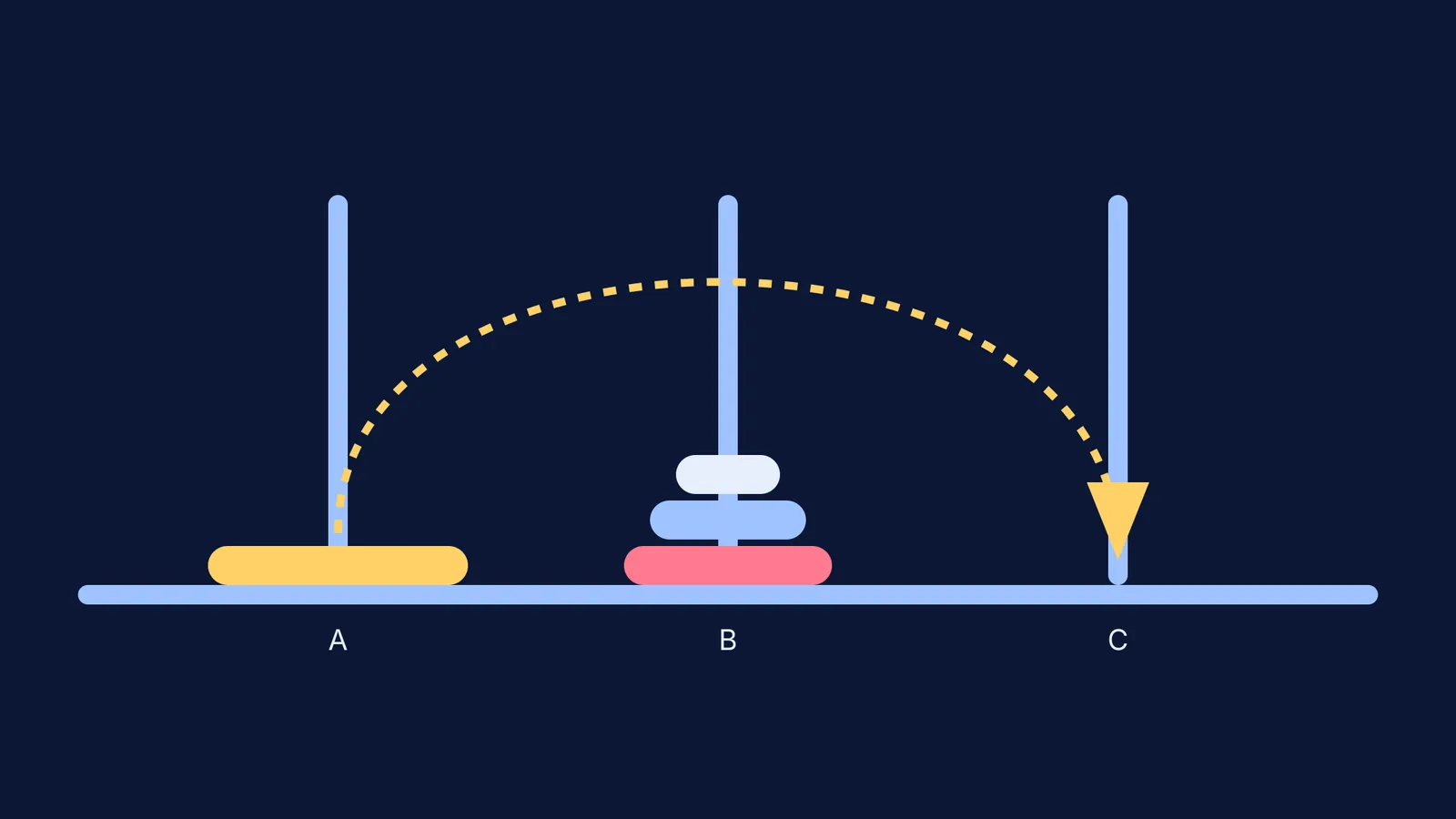
This formula comes from a mathematical recurrence relation. To move n discs to a destination peg, you must perform three distinct steps:
Move the top n − 1 discs to an auxiliary peg.
Move the largest, bottom disc to the destination peg (1 move).
Move the n − 1 discs from the auxiliary peg to the destination peg.
If moving n − 1 discs takes M moves, then moving n discs takes 2M + 1 moves. For 4 discs, the math is 2(7) + 1 = 15. Spotting relationships like this is exactly like Finding Aⁿ for a matrix by spotting the pattern.
How long would it take to solve 64 discs?
When Édouard Lucas released the puzzle in 1883, he included a fictional legend about a temple in Benares noted by Wikipedia. According to the story, Brahmin priests have been moving a stack of 64 golden discs since the beginning of time, and when they finish, the world will end.
Using the 2ⁿ − 1 pattern, we can predict exactly how many moves this would take: 2⁶⁴ − 1, which is over 18.4 quintillion moves (18,446,744,073,709,551,615). If the priests moved one disc every single second without ever making a mistake, it would take them approximately 585 billion years to finish, which is roughly 42 times the estimated current age of the universe as calculated on Wikipedia.
Learning mathematical patterns with AI
Understanding sequences often requires stepping back and looking at the logic behind the numbers. Fermi's AI tutor can work out what you already know and build a plan for the session, so you sit down to a clear next step when tackling mathematical series.
If you get stuck on a specific recurrence relation, the Fermi Problem Library has worked problems with a step-by-step solver that explains the reasoning rather than just printing an answer. Mastering these recursive logic steps is crucial when studying Sequences and series for JEE: derive the sums, don't memorise them.
A step-by-step framework for 3 discs
If you are trying to solve the 3-disc puzzle by hand, use this exact sequence of 7 moves. Label your pegs A (start), B (auxiliary), and C (destination).
Move the smallest disc from A to C.
Move the middle disc from A to B.
Move the smallest disc from C to B (Peg B now holds the top two discs).
Move the largest disc from A to C.
Move the smallest disc from B to A.
Move the middle disc from B to C.
Move the smallest disc from A to C.


