On this page
Flip a notebook-margin flipbook slowly and you see a stack of drawings. Flip it fast and the figure walks. Somewhere in between, your brain switches from "pictures" to "movement". Here is how to predict where, then measure it with a phone stopwatch.
How many frames per second look like motion?
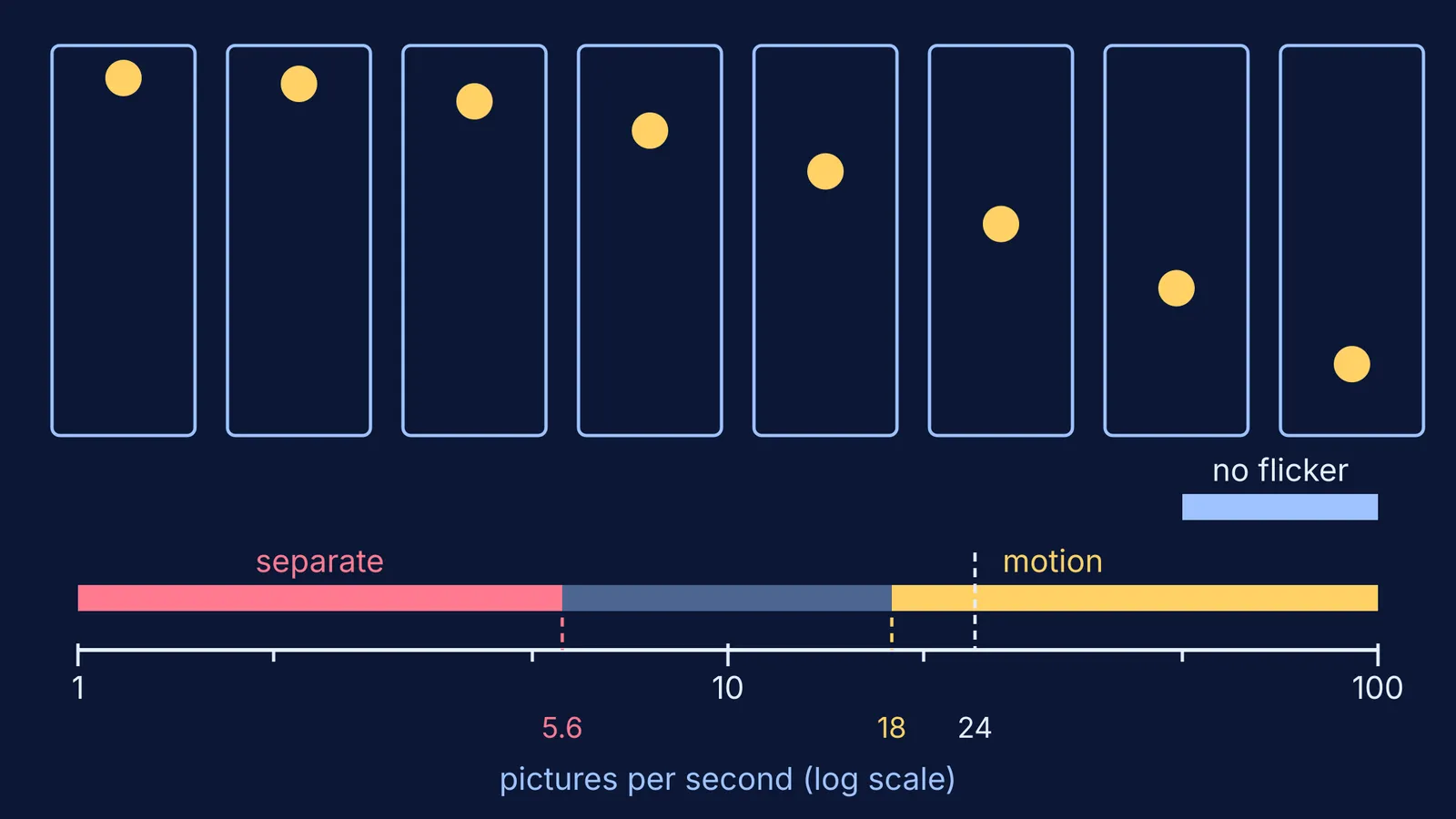
Psychologist Max Wertheimer ran his main experiments in Frankfurt in 1910 and submitted them as his postdoctoral thesis in 1912, according to the University of Würzburg's archive on Wertheimer's tachistoscope. He showed two stimuli one after the other and changed the gap between them.
With a gap of 30 ms, people saw both stimuli at the same time.
With a gap of about 56 ms, they saw one thing move from the first place to the second.
With a gap of 180 ms, the movement disappeared and they saw two separate stimuli.
To turn a gap into pages per second, divide 1,000 by the milliseconds: 56 ms is about 18 per second, 180 ms about 5.6. Wertheimer used two flashes, not a flipbook, so treat these as a rough guide.
Cinema settled a little higher. A 2015 study from York University in Toronto notes that the 24 frames per second standard was fixed in the 1920s to keep sound and picture in step (Marianovski, Wilcox and Allison, 2015). The same paper notes that projectors typically flash each frame two or three times.
Is flicker the same as jerky motion?
No. They are two different effects, and a film projector shows why. McGill University's guide The Brain from Top to Bottom explains that the shutter closes once between frames and once more while each frame is in place. So at 24 frames per second you actually see 48 images alternating with 48 moments of darkness. Starting at about 50 images per second, people stop noticing the dark gaps and see the light as continuous. The guide adds that this was long blamed on "retinal persistence", but the real explanation now appears to be quite different.
So there are two thresholds:
Motion: when separate positions join into one moving object.
Flicker: when light that switches on and off looks steady.
The flicker threshold is the higher one. Studies of the critical flicker fusion rate have reported the maximum observable rate as 50 to 90 Hz, and a 2015 study in Scientific Reports found that people could see flicker artefacts at rates over 500 Hz when a display had sharp, fine edges (Davis, Hsieh and Lee, 2015).
A paper flipbook sits in steady room light, so it does not flicker like a projector. At low speed you see stutter: the drawing jumps. That is the motion threshold, and you can measure it at home.
How do you test a flipbook at home?
You need about 30 sticky notes or a small notebook, a pen, a friend and a phone stopwatch.
Draw a falling ball, near the top on page 1 and a little lower on each page, with each step slightly bigger than the last because a falling ball speeds up. Keep steps to a few millimetres.
Count your pages. Call the number N.
Flip slowly while your friend times first page to last. Write down the time T in seconds.
Repeat at a medium and a fast speed, three runs each.
For each run, work out pages per second as N ÷ T, and time per page as 1,000 ÷ (N ÷ T) milliseconds.
Next to each run, write what you saw: separate drawings, jerky motion or a smooth fall.
Here is a worked example for a 30-page flipbook. The comparison gaps come from Wertheimer's two-flash experiments and the 24 frames per second film standard, so treat each prediction as a guess to test.
Slow flip in 6.0 s: 30 ÷ 6.0 = 5 pages per second, 200 ms per page. That is longer than Wertheimer's 180 ms gap, where movement disappeared: predict separate drawings.
Medium flip in 2.0 s: 15 pages per second, about 67 ms per page. Between his 180 ms and 56 ms marks: predict jumpy motion.
Fast flip in 1.2 s: 25 pages per second, 40 ms per page. Close to film's 24: predict a smooth fall.
Now redraw the ball with 2 cm jumps between pages and flip at your fast speed. Does it still look smooth? If not, step size matters as well as speed.
Where else does frame rate show up?
Every film, phone video and game samples time the way your flipbook does. For the history, read how the Lumière brothers' cinematograph and the first film show brought projected frames to an audience. Other animals sample the world differently too: see why houseflies are hard to swat.
If changing speed and step size in your head is hard, the Fermi Simulation Lab has interactive simulations for ideas that are easier to see than to read. To use one with the same predict-then-check habit, follow our guide on using an AI tutor with a physics simulation.
Make the flipbook tonight, time three flips, and see whether your eyes agree with Wertheimer.