

On this page
On December 28, 1895, at the Salon Indien du Grand Café in Paris, Auguste and Louis Lumière presented their invention to the public. For an entry fee, around 40 visitors sat down in the basement room to watch the first commercial public screening of moving pictures. This quiet winter evening marked the birth of the cinema as a shared, communal experience.
Within months, the invention crossed the globe. On July 7, 1896, the Lumière brothers' camera operator, Marius Sestier, set up the machine at Watson's Hotel in Bombay (now Mumbai), completely changing the landscape of Indian entertainment.
What made the Lumière brothers' cinematograph different?
Before the Lumière brothers, inventors like Thomas Edison had introduced moving images through devices like the Kinetoscope. However, Edison's machine was a "peep-show" cabinet meant for one viewer at a time. The Lumière brothers' invention, the *cinématographe*, was an all-in-one marvel: it was a camera, a printer, and a projector packed into a single portable wooden box.
Instead of moving the film in a continuous blur, the hand-cranked mechanism used a clever claw system—adapted from sewing machines—to pull the perforated film down exactly one frame at a time. The machine would pause the film briefly, open a shutter to project the image onto a screen, and then close the shutter to advance to the next frame.
This mechanism exploited the persistence of vision. Because the human eye retains an image for a fraction of a second, flashing 15 frames per second blends them into a continuous moving picture. Some ideas in physics, particularly in optics and mechanics, are incredibly difficult to picture from a static textbook diagram. Seeing a mechanism in motion changes everything—which is why the Fermi Simulation Lab uses interactive models to let you manipulate the variables directly and watch the physical laws unfold.
The first film show: what did the audience see?
The 1895 Paris audience watched a program of ten short films. Each segment consisted of 17 metres of film, which took about 50 seconds to crank through the projector. The very first film shown was *Workers Leaving the Lumière Factory*, a single unedited shot of ordinary men and women walking out of the gates of the brothers' photographic plant in Lyon.
There were no special effects, no elaborate costumes, and no narrative arcs. Yet, the effect was profound.
The brothers also screened *The Sprinkler Sprinkled*, which is often considered the first comedy film. It showed a gardener being tricked into inspecting his hose just as a boy turns the water back on. Despite the success of these shows, the Lumière brothers famously saw film as a scientific novelty, once stating that "the cinema is an invention without any future", and soon returned to their work in colour photography.
When did the cinematograph reach India?
The arrival of the cinematograph in Bombay in 1896 was a pivotal moment for the subcontinent. Advertised in the *Times of India* as the "Marvel of the Century", the screening at Watson's Hotel charged an admission of 1 Rupee per person.
The colonial audience, seated in the grand hotel, was treated to six short films. Among them was the famous *Arrival of a Train*, a film so realistic that legends claim early audiences jumped out of their seats to avoid being run over. The impact was immediate and long-lasting. Among the local attendees was a photographer named Harishchandra Sakharam Bhatavdekar. He was so inspired by the technology that he ordered his own camera from London, ultimately laying the foundation for the massive Indian film industry that thrives today.
What can students learn from the Lumière brothers?
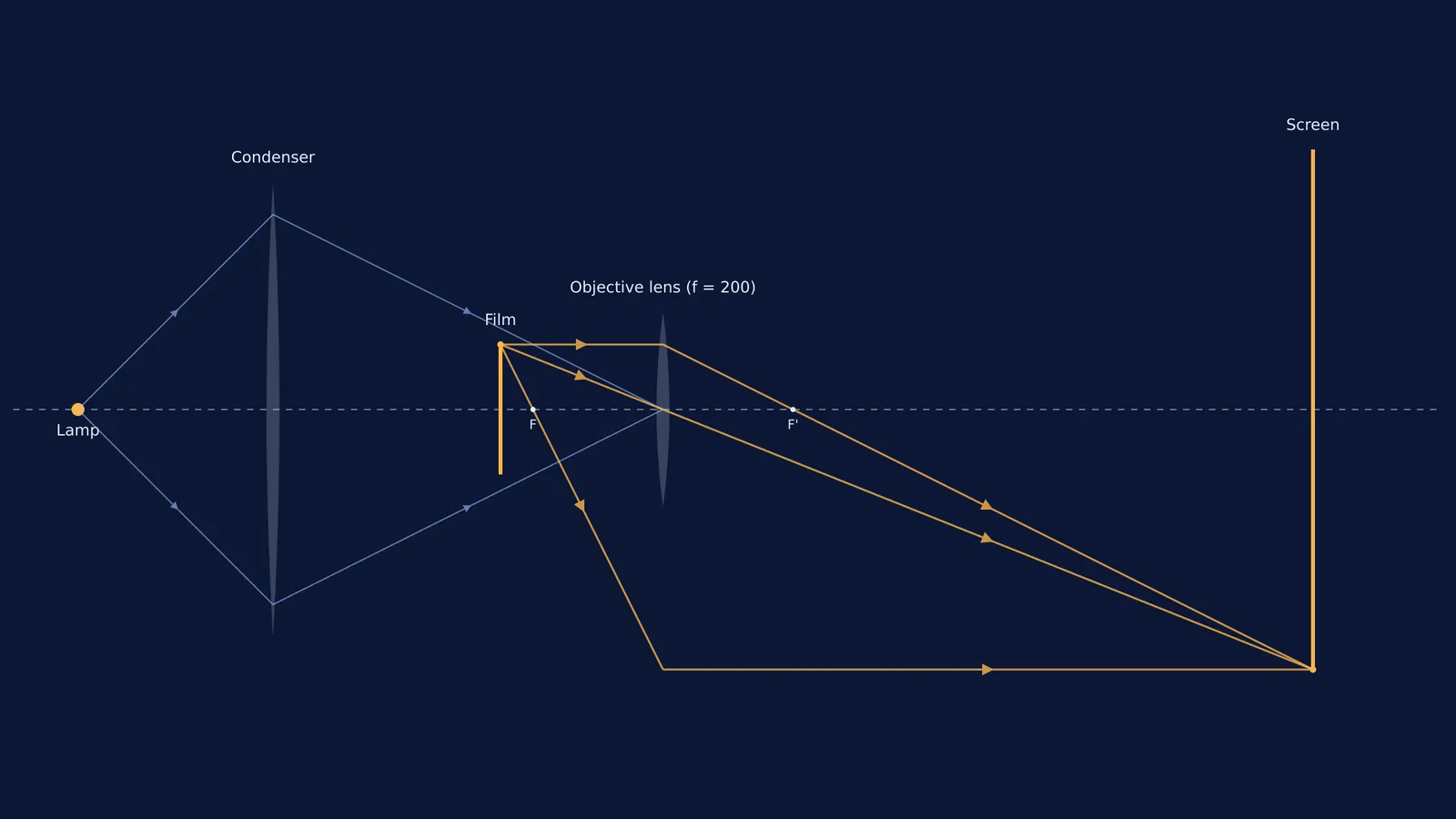
The Lumière brothers did not just file a patent or write a theoretical paper; they built a physical machine and took it out of the laboratory to show the world. When studying physics or optics, the goal is not merely to memorize formulas for magnification and focal lengths. It is about understanding how light bends, how lenses work together to focus an image, and how a mechanical design solves a real-world problem.
If you are studying these optical principles, you can read more about tracing a ray through a glass slab or look at concave mirror images for all six object positions. And if you are struggling to map out how these concepts connect to create a working system, Fermi's AI tutor can work through the ray diagrams with you step-by-step.


