

On this page
You have likely experienced the frustration of trying to swat a resting housefly, only to watch it vanish just before your hand arrives. The fly is not merely faster than you; it is perceiving and calculating the world on an entirely different scale of time.
Why are houseflies so hard to swat?
The answer lies in how animals process visual information. Animals do not see continuous motion; their eyes and brains capture discrete "frames" of light and blend them together. The speed at which an animal's visual system can process these flickering light signals before they blur into a steady image is known as the Critical Flicker Fusion (CFF) frequency.
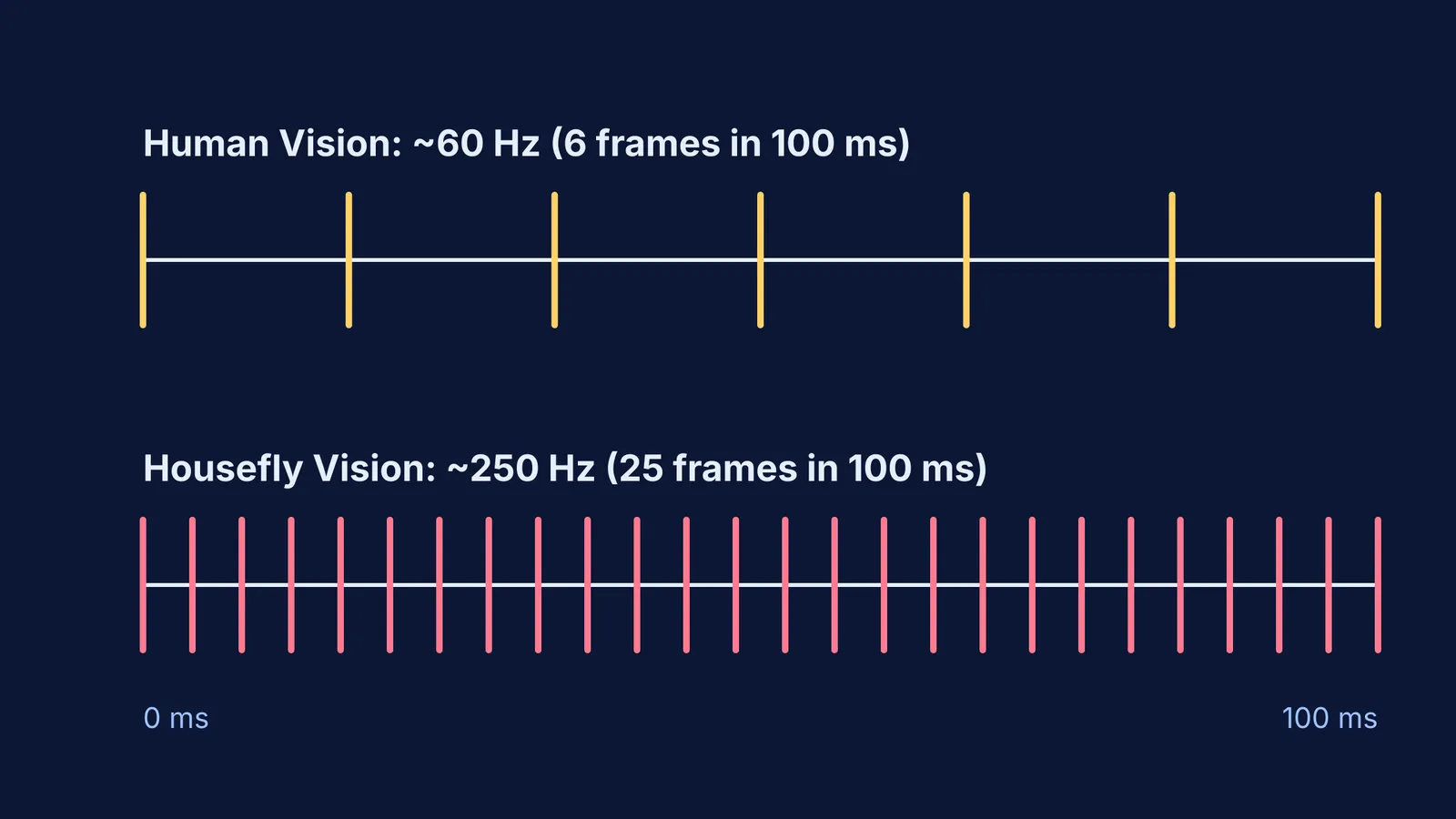
A study of temporal information processing across species found that humans have a CFF of roughly 60 frames per second (Healy et al., 2013). This is why television screens updating at 60 Hz appear smooth to us. Houseflies, however, have a much higher metabolic rate and a smaller body size, allowing them to resolve visual data at an astonishing 250 frames per second.
Do flies see in slow motion?
Because a fly processes visual information about four times faster than a human (Healy et al., 2013), an event that unfolds over one second provides a fly with 250 visual updates, compared to our 60. From the fly's perspective, a rolled-up newspaper hurtling towards it is not a sudden strike, but a sluggish, easily tracked object.
When we examine questions of animal behaviour, it becomes clear that this high-speed vision is an evolutionary adaptation. Being able to perceive predators in slow motion is essential for survival in a hostile environment.
How do flies jump backward?
While their vision provides early warning, their physical escape response helps ensure their survival. High-speed digital imaging reveals that flies do not just take off randomly when threatened. In just 200 milliseconds, they perform calculated postural adjustments before their wings ever beat (Card & Dickinson, 2008).
The fly's brain integrates the position of the approaching threat and plans a jump in the optimal direction. If the threat approaches from the front, the fly shifts its middle legs forward, leans back, and launches itself backward. If the threat comes from behind, it shifts its weight to jump forward.
This rapid reflex relies on giant fibre neurons that bypass complex processing, sending signals directly to the leg muscles. Biology students studying hormone action and the nervous system learn that such direct neural pathways are essential for split-second survival mechanisms.
If you find it difficult to picture rapid biological processes or physical motion, the Fermi Simulation Lab provides interactive simulations for the ideas that are easier to see than to read.
The predictive swatting strategy
You cannot out-speed a fly's visual processing, but you can use physics to outsmart its motor planning. Because the fly calculates a jump away from the threat, it will predictably launch itself in the opposite direction of your swing.
Here is a practical checklist for swatting a fly:
Identify the approach angle: Notice where the fly is facing.
Anticipate the jump: If you approach from the front, the fly will jump backward.
Aim for the destination: Do not strike where the fly is currently sitting. Aim slightly behind the fly (or ahead of its predicted trajectory).
Use a wider surface: Swatters work better than hands because they cover the area the fly intends to jump into.
Predicting trajectories is a fundamental skill in physics. Much like calculating the midair collision of projectiles, anticipating the fly's escape path ensures your hand and the fly reach the same point at the same time. If you need help mastering these kinds of predictive calculations in physics, the Fermi Problem Library offers worked problems with a step-by-step solver that explains the reasoning rather than printing an answer.


