On this page
Drop potassium permanganate into ice-cold, room-temperature and hot water, and the purple spreads at three different speeds. NCERT's Class 8 science textbook Curiosity sets exactly this challenge in its chapter on the particulate nature of matter, and reports that the colour "spreads the fastest in hot water, less quickly in water at room temperature, and the slowest in ice-cold water". If you are in Class 9 now, the new Exploration textbook picks up the same particle idea in its chapter on the atom, Journey Inside the Atom.
Why does colour spread faster in hot water than cold?
The NCERT chapter gives the particle picture: water particles are in constant motion, pull permanganate particles out of the grain, and keep hitting them until the colour fills the glass (NCERT Curiosity, Chapter 7). Heat the water and those collisions become more energetic.
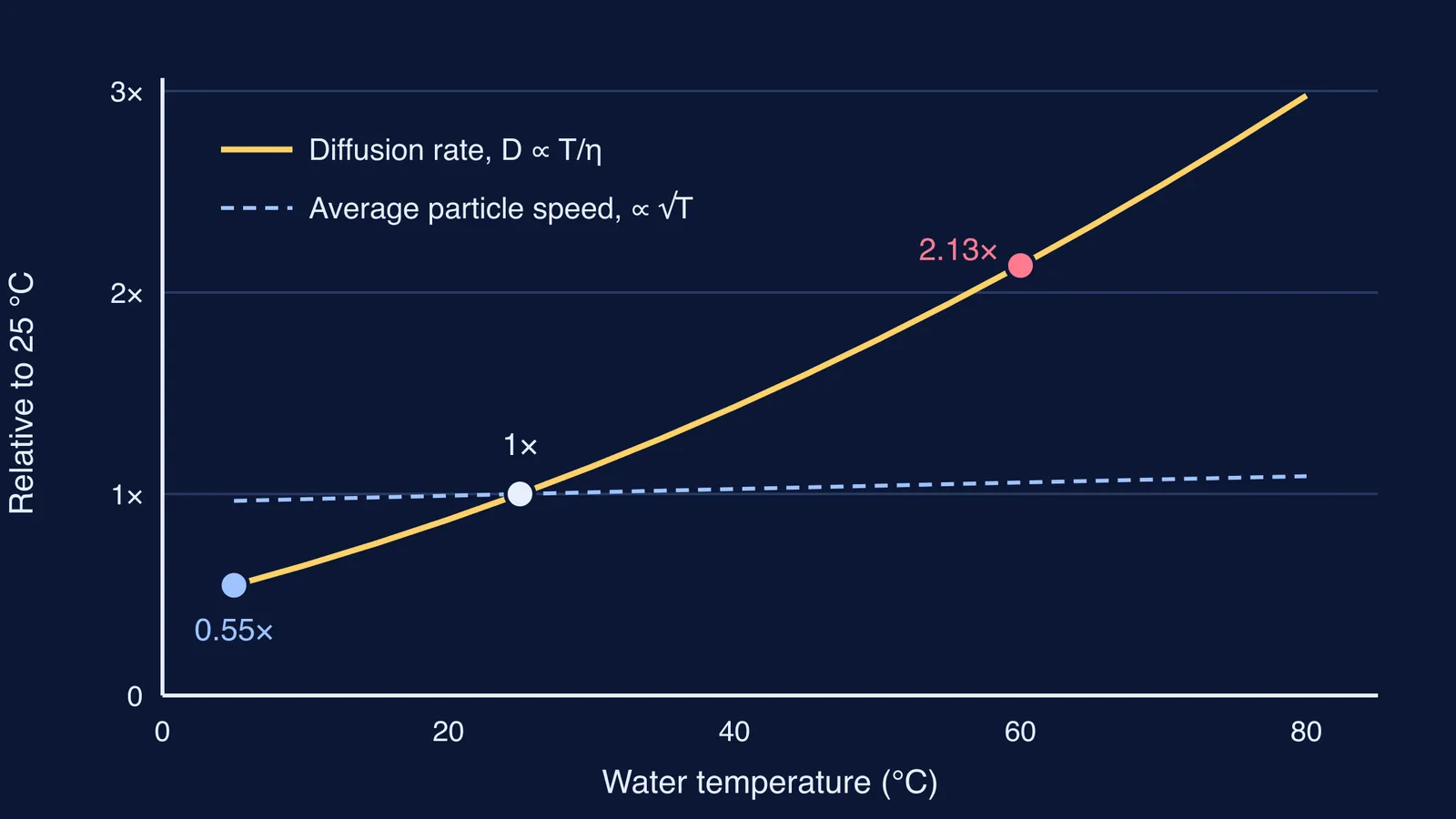
In kinetic theory, a particle's average translational kinetic energy is (3/2)kT, where T is the absolute temperature (equipartition theorem). Because kinetic energy goes as speed squared, average speed goes as the square root of T. Warming water from 5 °C (278 K) to 60 °C (333 K) therefore makes its particles only about 9% faster on average.
Nine per cent cannot explain a glass that colours several times faster. The bigger change is that hot water is much less viscous, so a dissolved ion meets less drag as it is knocked about. The Stokes–Einstein relation, D = kT/(6πηr), puts both effects together: the diffusion coefficient D rises with temperature T and falls with the viscosity η (Einstein relation)).
How much faster does permanganate spread in hot water?
Here is a worked example using measured viscosities of water at normal air pressure from the NIST Chemistry WebBook: 1.518 mPa·s at 5 °C, 0.890 mPa·s at 25 °C and 0.466 mPa·s at 60 °C.
Stokes–Einstein says D is proportional to T/η, with T in kelvin.
Ice-cold, 5 °C: 278.15 ÷ 1.518 ≈ 183.
Room temperature, 25 °C: 298.15 ÷ 0.890 ≈ 335.
Hot, 60 °C: 333.15 ÷ 0.466 ≈ 715.
Divide by the room-temperature value: diffusion runs about 0.55 times as fast at 5 °C and 2.13 times as fast at 60 °C. Hot against ice-cold is about 3.9 times.
Time follows from the same numbers. In diffusion, the mean squared distance travelled grows as 2Dt (mean squared displacement), so the time to spread a given distance goes as 1/D. Whatever time the room-temperature glass takes to reach a mark, the ice-cold glass should take about 1.8 times as long and the hot glass a little under half as long.
Pure diffusion is also slow. A table of ionic diffusion coefficients, drawn from the CRC Handbook, lists 1.632 × 10⁻⁹ m²/s for the permanganate ion. Taking that as the room-temperature value, x² = 2Dt gives roughly 8.5 hours for the colour to spread 1 cm by diffusion alone, roughly 4 hours at 60 °C and over 15 hours at 5 °C.
How do you time the three-glass experiment at home?
Fill three identical clear glasses with 200 mL each: ice water with the ice removed, room-temperature tap water, and kettle water mixed to about 60 °C. An adult should handle the hot water.
Stick tape on each glass 2 cm above the bottom. Stand them on white paper and wait two minutes for the water to settle.
Pick up a small grain with a spoon tip or spatula, never with your fingers. Drop it in and start a stopwatch. Repeat with similar grains.
Do not stir. Note when the colour first reaches the tape, and when the glass looks evenly coloured.
Divide each time by the room-temperature time and compare with the prediction of about 1.8 : 1 : 0.47.
Your order should match NCERT's: hot fastest, ice-cold slowest. Your ratios probably won't match exactly, because currents add to diffusion and the hot glass cools as you watch. Writing down why is what a good practical record does.
If it is hard to picture particles jostling at different speeds, the Fermi Simulation Lab has interactive simulations for ideas like this that are easier to see than to read.
What should you write in an exam answer?
For a school answer: in hot water, particles have more kinetic energy and move faster. The particles of potassium permanganate are knocked about more and spread through the spaces between water particles more quickly. So the rate of diffusion increases with temperature.
For a deeper answer, once you have met viscosity in Class 11 physics, add one line: D = kT/(6πηr), so heating raises D both directly through T and because water's viscosity falls.
To go further, read how absolute temperature tracks average kinetic energy, why sugar seems to vanish into the spaces between water particles, and our guide to states of matter, evaporation and latent heat. If kinetic theory itself feels shaky, the Fermi Concept Library has every concept in physics, chemistry, biology, mathematics and computing, each with its own lesson.