

On this page
Your Class 8 science book asks you to put sugar into half a glass of water, mark the level, then stir. As the sugar disappears, the level does not climb further; it slips back a little. That small dip is the textbook's evidence that matter is made of particles with gaps between them.
What does the Class 8 sugar activity actually show?
In the NCERT Class 8 science textbook Curiosity, the chapter Particulate Nature of Matter has you fill a glass vessel about half with water and mark the level (A), add two teaspoons of sugar and mark the new level (B), then stir with a glass rod until the sugar dissolves and mark the level again.
The level goes up when the crystals go in, because solid sugar pushes water aside. After stirring, it comes down slightly. The textbook's explanation is that the dissolved sugar particles occupy the spaces between water particles, called interparticle spaces.
Why does the water level not rise when sugar dissolves?
Strictly, it does rise, by about the volume of the crystals, the moment you add them. It just does not rise again when the sugar dissolves, because dissolving adds no new matter; it only spreads the sugar out among the water particles. If those particles needed exactly the room they had in the crystal, the level would stay at B. If some of them slip into the gaps between water particles, the level falls below B. A small fall is what you see, which supports the second picture.
How much room does dissolved sugar really take?
Here is the calculation for 10 g of sugar in 90 g of water at about 20 °C, which makes a 10% solution.
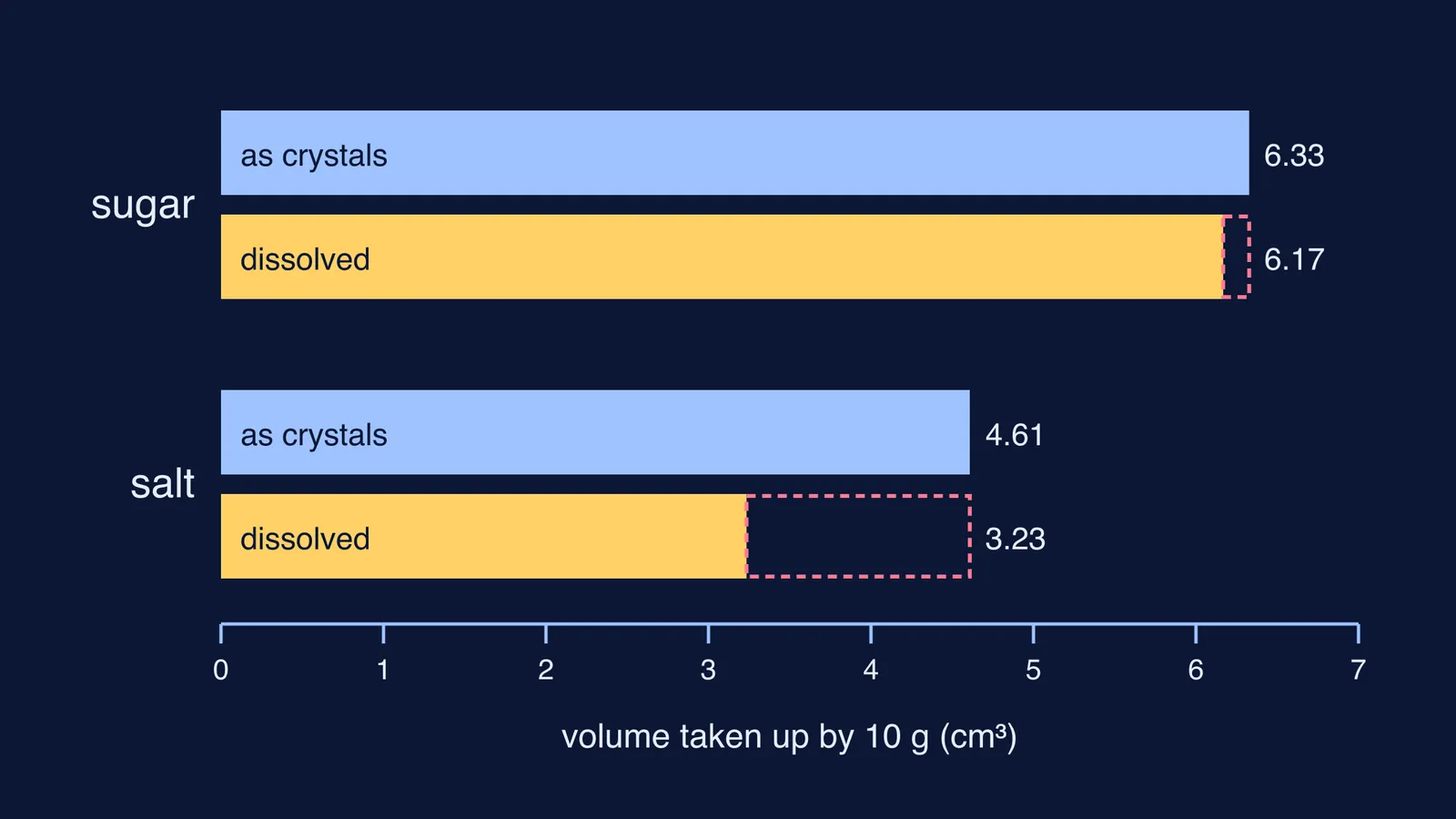
Sugar crystals: sucrose has a density of about 1.58 g/cm³ (PubChem, citing the CRC Handbook), so 10 g fills 10 ÷ 1.58 ≈ 6.33 cm³.
Water: its density at 20 °C is 0.9982 g/cm³ (Engineering ToolBox), so 90 g fills about 90.16 cm³. Kept apart, water plus crystals take 96.49 cm³.
The solution: a 10% sucrose solution has a density of 1.0381 g/cm³ at 20 °C (Engineering ToolBox), so the 100 g fills 100 ÷ 1.0381 ≈ 96.33 cm³.
The difference: 96.49 − 96.33 = 0.16 cm³ has gone missing, about 2.5% of the sugar's crystal volume.
Now pour it into a glass 6 cm across, with an inside area of about 28.3 cm². Adding the crystals lifts the water by 6.33 ÷ 28.3 ≈ 0.22 cm, a little over 2 mm. Dissolving then lowers it by 0.16 ÷ 28.3 ≈ 0.006 cm, well under a tenth of a millimetre.
So sugar particles do fill some gaps between water particles, but most of the sugar still needs room of its own.
Why does salt show the gaps more clearly than sugar?
Run the same sum with common salt. Sodium chloride has a specific gravity of 2.17 (PubChem, citing the CRC Handbook), so 10 g of crystals fill about 4.61 cm³. A 10% salt solution has a density of 1.0707 g/cm³ at 20 °C (Engineering ToolBox), so the 100 g of solution fills 93.40 cm³ instead of the 94.77 cm³ you would expect. About 1.37 cm³, roughly 30% of the salt's crystal volume, disappears into the water. In the same 6 cm glass, that is a dip of about 0.5 mm after stirring.
One likely reason: salt splits into charged particles, sodium and chloride ions, which pull nearby water particles in close around them. Sugar molecules stay whole and uncharged, so they pack in less tightly.
Gas particles are far apart, which is why gases can be squeezed into LPG and CNG cylinders, and moving particles spreading into gaps is how a smell like perfume crosses a room.
If the particle idea still feels shaky, the Fermi Concept Library gives each concept in chemistry and physics its own lesson and its place in the map.
How can you test interparticle spaces at home?
Predict first: will sugar or salt make the level drop more after stirring, and why?
Use a narrow, straight-sided container such as a measuring cylinder; the narrower it is, the bigger each change in height.
Fill it about halfway with room-temperature water and mark level A with tape, reading at eye level.
Weigh about 10 g of salt on a kitchen scale, add it, wait for any air bubbles to rise and pop, and mark level B.
Stir gently until the water is clear, let it settle, and mark level C.
Repeat with fresh water and 10 g of sugar, then compare how far C sits below B each time.
A clearly bigger salt dip matches the numbers above. For practice on density and volume sums like these, the Fermi Problem Library has worked problems with a step-by-step solver that explains the reasoning rather than printing an answer.
Want to see particles go the other way? Growing salt or sugar crystals at home shows them leaving the water and packing back into a solid.


