

On this page
When your textbook calls temperature a “measure of average kinetic energy”, it means something exact for an ideal gas. Heat a gas and its molecules move faster on average; cool it and they slow down. The surprising part, and one exam questions like to test, is that the type of gas does not matter.
What does temperature measure in a gas?
The NCERT Class 11 physics chapter on kinetic theory combines PV = (2/3)E with the ideal gas equation to get E/N = ½m⟨v²⟩ = (3/2)kT (Eq. 12.19). In words, the average translational kinetic energy of one molecule is proportional to the absolute temperature of the gas. NCERT adds that this result is “independent of pressure, volume or the nature of the ideal gas”.
The constant linking the two is the Boltzmann constant, k = 1.380649 × 10⁻²³ J/K, which NIST lists as exact. It is exact because, under the SI revision adopted in 2018, the kelvin itself is defined by fixing that numerical value of k.
For the steps behind PV = (2/3)E, see our walk-through on how to derive the pressure of an ideal gas for board exams.
Why is the average kinetic energy the same for every gas?
Molecules keep colliding and trading energy. NCERT's kinetic theory chapter states that “in equilibrium, the average kinetic energy of the molecules of different gases will be equal”. The OpenStax University Physics text makes the same point: nothing in (3/2)kT depends on molecular mass, pressure, or anything but temperature.
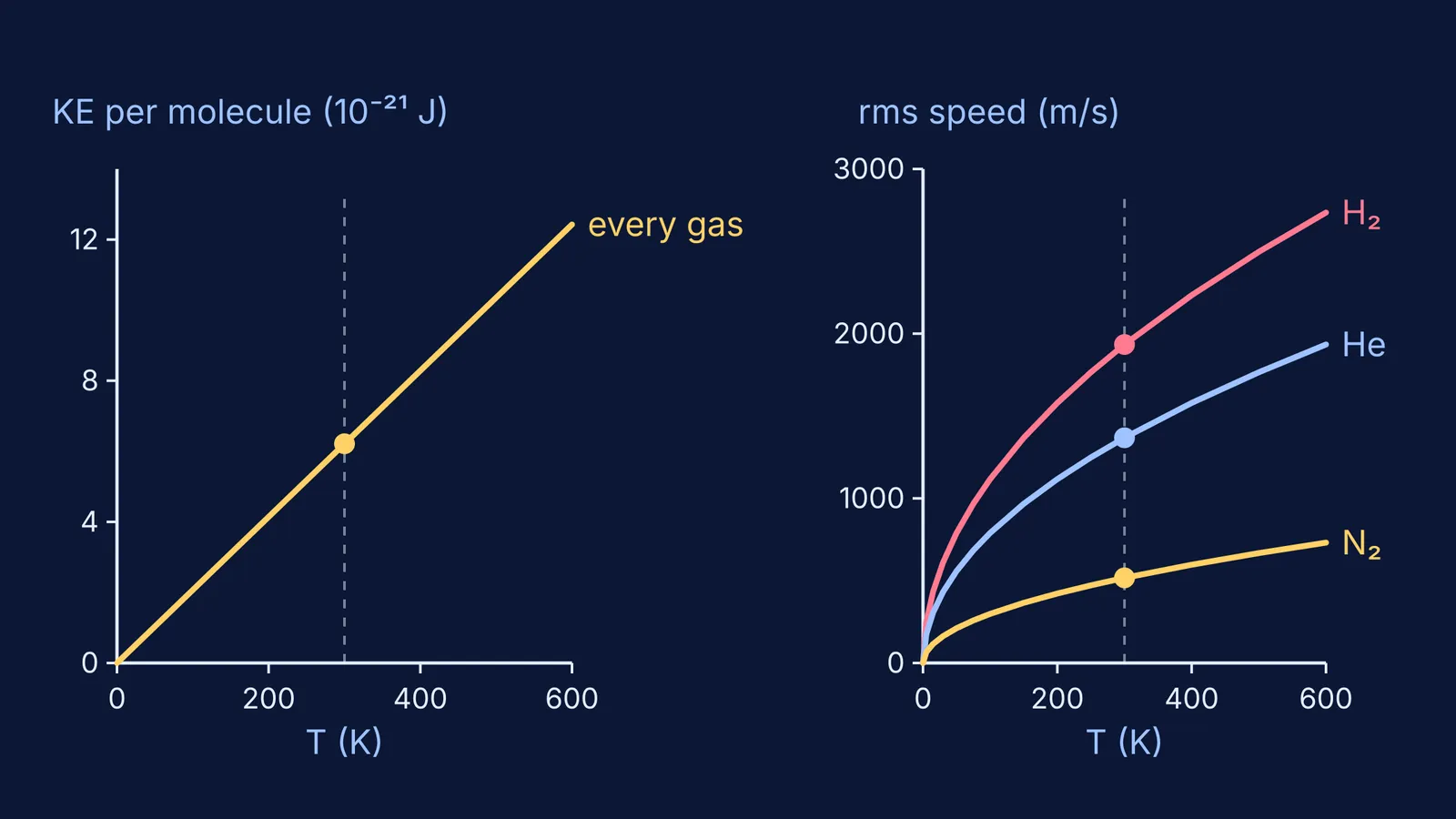
What does depend on the gas is speed. Since the average of ½mv² is fixed, a heavier molecule has to move more slowly. The root-mean-square speed is v_rms = √(3kT/m), as OpenStax gives it. The chart at the top of this post shows one energy line for every gas, but three different speed curves for hydrogen, helium and nitrogen.
For how speeds spread out around that average, see our post on the Maxwell speed distribution and what heating a gas does.
Worked example: argon and chlorine at 27 °C
NCERT's Example 12.5 in the kinetic theory chapter asks about a flask holding argon (39.9 u) and chlorine (70.9 u) at 27 °C. Here it is with every number filled in, using k from NIST and R = N_A × k ≈ 8.314 J mol⁻¹ K⁻¹, where the Avogadro constant N_A = 6.02214076 × 10²³ mol⁻¹ is also exact.
Convert to kelvin: T = 27 + 273.15 ≈ 300 K.
Average kinetic energy per molecule: (3/2) × 1.380649 × 10⁻²³ × 300 ≈ 6.21 × 10⁻²¹ J, for argon and chlorine alike. The ratio is 1 : 1.
Speeds: v_rms = √(3RT/M) with M in kg/mol. Argon: √(3 × 8.314 × 300 ÷ 0.0399) ≈ 433 m/s. Chlorine: √(3 × 8.314 × 300 ÷ 0.0709) ≈ 325 m/s.
Ratio of speeds: 433 ÷ 325 ≈ 1.33, which equals √(70.9 ÷ 39.9), the answer NCERT gives.
NCERT also points out that the proportion of the two gases by mass makes no difference. Hydrogen (2 u) at 300 K averages about 1,930 m/s, with the same kinetic energy per molecule as the slow chlorine.
Does doubling the Celsius temperature double the kinetic energy?
No, and this is a common slip. Kinetic energy is proportional to temperature in kelvin, and the Kelvin scale starts at absolute zero, –273.15 °C, with T = t + 273.15, as NCERT's chapter on thermal properties of matter sets out. Warming a gas from 20 °C to 40 °C takes it from 293.15 K to 313.15 K, so the average kinetic energy rises by a factor of 313.15 ÷ 293.15 ≈ 1.07. That is about 7%, not 100%. To double it you would need 586.3 K, or about 313 °C.
Five checks before you use 3/2 kT
Kelvin first. Every T in (3/2)kT or √(3kT/m) is absolute temperature.
Per molecule or per mole? (3/2)kT is per molecule. Per mole it becomes (3/2)RT, about 3.74 kJ at 300 K, with R = N_A × k from the NIST constants.
Translational only. A footnote in the NCERT chapter notes that this E is the translational part of the internal energy, which may include energy from other degrees of freedom; the chapter's section 12.5 adds rotation for diatomic gases. That is why heat capacities differ between gases; see why Cp is greater than Cv and what γ tells you.
Ideal gas. The result is derived for an ideal gas. NCERT notes that real gases approach ideal behaviour at low pressures and high temperatures.
Mass changes speed, not energy. At one temperature, the energy ratio of any two gases is 1 : 1.
When a kinetic theory numerical goes wrong and you cannot see which step broke, the Fermi Problem Library has worked problems with a step-by-step solver that explains the reasoning rather than printing an answer. If absolute temperature itself still feels shaky, the Fermi Concept Library gives each concept its own lesson and its place in the map.


