

On this page
The pressure of an ideal gas is one of the long derivations in Class 11 physics. The CBSE 2026-27 curriculum lists "Kinetic theory of gases - assumptions, concept of pressure" and "Kinetic interpretation of temperature" in Chapter 12, inside a group of units worth 20 of the 70 theory marks (CBSE Physics curriculum 2026-27). Here are the assumptions, the steps in NCERT's order, and the link to temperature.
How do boards mark a physics derivation?
Marking schemes give marks for steps, not just the last line. In CBSE's official Class XII sample paper marking scheme for 2025-26, a single answer is split into ½-mark and 1-mark pieces written next to separate lines of working (CBSE marking scheme 2025-26). Your Class 11 paper may use different marks, but the idea holds: write a chain of short, labelled lines an examiner can tick.
What assumptions should you state before deriving gas pressure?
Write these first. They come from Sections 12.4 and 12.4.1 of the NCERT Class 11 kinetic theory chapter.
A gas is made of a very large number of molecules in constant random motion.
The molecules are tiny compared with the distances between them; NCERT says the average spacing is a factor of 10 or more than a molecule's typical size (about 2 Å).
Interactions between molecules are negligible except during collisions, so between collisions they move in straight lines (Newton's first law).
All collisions, with each other and with the walls, are elastic, so total kinetic energy is conserved.
The time spent in a collision is small compared with the time between collisions.
The gas is isotropic: no direction of motion is preferred.
How do you derive P = ⅓ρv² step by step?
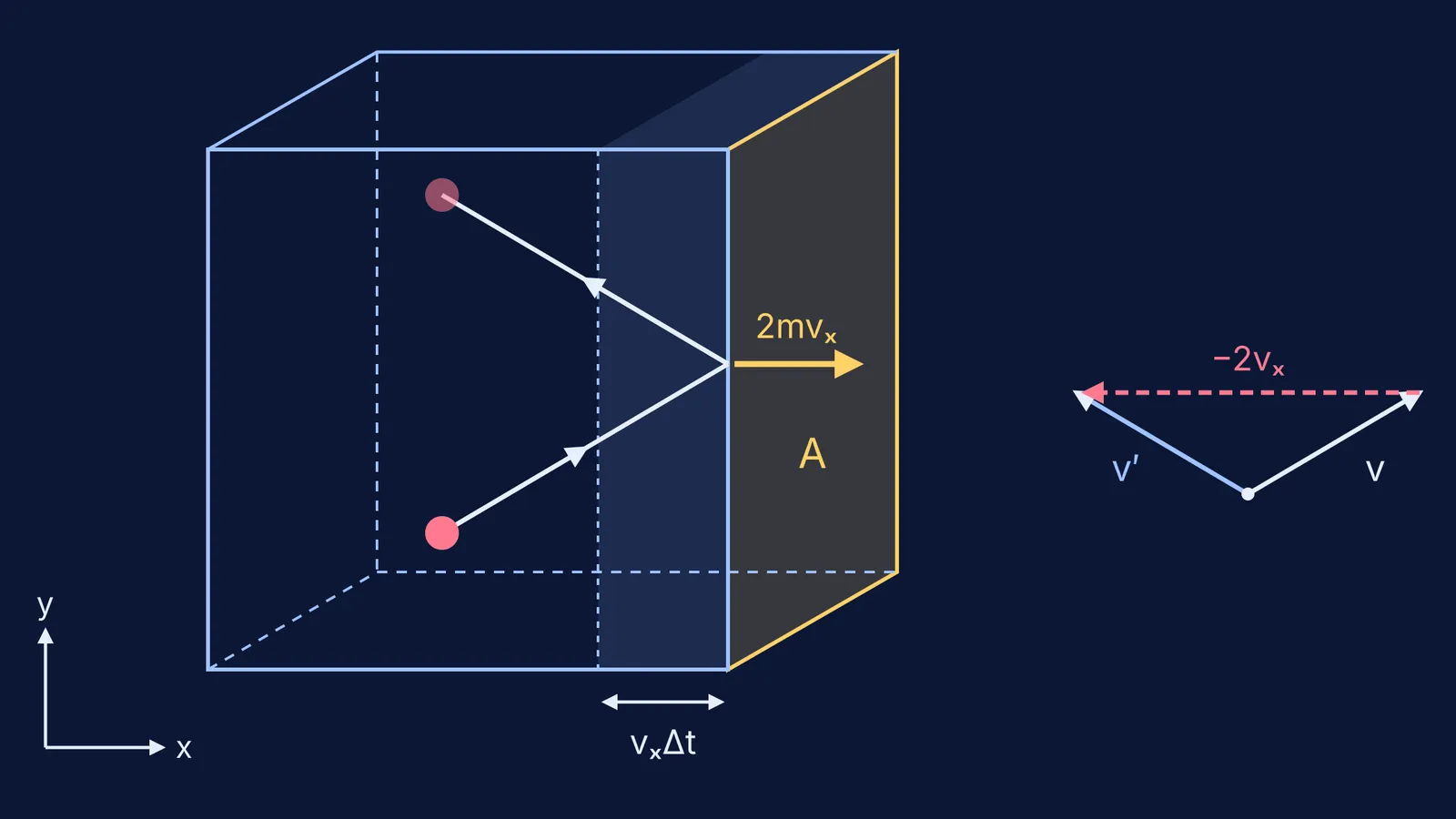
NCERT uses a cube of side l; draw it. Each line below is one tickable step (our breakdown, not an official CBSE scheme).
Set-up. Take a molecule of mass m with velocity (vₓ, v_y, v_z) hitting the wall parallel to the yz-plane, of area A = l².
One collision. The collision is elastic, so the velocity becomes (−vₓ, v_y, v_z). The molecule's momentum changes by −mvₓ − mvₓ = −2mvₓ, so the wall receives 2mvₓ.
How many hit in time Δt. Only molecules within a distance vₓΔt of the wall can reach it, that is, those in a volume AvₓΔt. On average half move towards the wall, so the number is ½nAvₓΔt, where n is the number of molecules per unit volume.
Momentum delivered. Q = (2mvₓ)(½nAvₓΔt) = nmAvₓ²Δt.
Force and pressure. Force is Q/Δt, and pressure is force per unit area, so P = nmvₓ². Molecules have a spread of speeds, so you average: P = nm⟨vₓ²⟩.
Use isotropy. ⟨vₓ²⟩ = ⟨v_y²⟩ = ⟨v_z²⟩, and their sum is ⟨v²⟩, so ⟨vₓ²⟩ = ⅓⟨v²⟩. Hence P = ⅓nm⟨v²⟩.
Bring in density. nm is the mass per unit volume, ρ. So P = ⅓ρ⟨v²⟩, often written P = ⅓ρv²_rms.
If time allows, add NCERT's remarks: the container's shape does not matter, and ignoring collisions between molecules does not change the result in a steady state.
How does gas pressure link to temperature and kinetic energy?
This is NCERT Section 12.4.2. Multiply P = ⅓nm⟨v²⟩ by the volume V, with N = nV molecules:
PV = ⅔N(½m⟨v²⟩) = ⅔E, where E is the total translational kinetic energy.
The ideal gas equation in molecular form is PV = Nk_BT, where NCERT gives the Boltzmann constant k_B as 1.38 × 10⁻²³ J K⁻¹. Put the two together and you get:
½m⟨v²⟩ = (3/2)k_BT.
The average kinetic energy of a molecule depends only on absolute temperature, not on the pressure, the volume or which gas it is. That is the kinetic interpretation of temperature. Related reads: why kinetic energy per unit volume of a gas equals 3P/2 and how the Boltzmann constant relates to the gas constant.
Does the formula give the right speed for nitrogen?
The NCERT chapter finds that nitrogen at 300 K has an rms speed of about 516 m s⁻¹. You can check it by combining P = ⅓ρv² with the chapter's gas law P = ρRT/M, which gives v_rms = √(3RT/M). With R = 8.314 J mol⁻¹ K⁻¹ and M = 0.028 kg mol⁻¹ for nitrogen, v_rms = √(3 × 8.314 × 300 / 0.028) = √267,000 ≈ 517 m s⁻¹, a match to within rounding.
How should you practise this derivation?
Day 1: write the seven steps with the book open, saying why each line follows.
Day 2: write it from memory, then tick it against the seven steps and the four leaks above.
Day 3: write the assumptions and the temperature link, then redo the nitrogen check without notes.
If you keep losing the same step, the Fermi Problem Library has worked problems with a step-by-step solver that explains the reasoning rather than printing an answer. If the gap is an idea, such as why isotropy gives ⅓, the Fermi Concept Library gives each physics concept its own lesson and shows its place in the map.
For layout, see our guide to improving answer writing for boards.


