

On this page
Pascal's triangle starts with a 1 at the top, and every number below it is the sum of the two numbers just above. NCERT's Class 11 chapter on the binomial theorem builds it this way, from the coefficients of (a + b)⁰ up to (a + b)⁴, and notes that the same array is also known as Meru Prastara by Pingla.
Wolfram MathWorld records that it appeared in Blaise Pascal's posthumous work in 1665, though Yang Hui and Omar Khayyám described it centuries earlier.
Each pattern below gets one rule: write down your prediction before you colour or add anything. In a Harvard study of physics lecture demonstrations, Crouch, Fagen, Callan and Mazur (2004) found that students who only watched understood the ideas no better than those who never saw the demonstration, while students who predicted the outcome first showed significantly greater understanding.
How do you build Pascal's triangle?
Write a 1, then add neighbouring pairs to make each new row, with a 1 at each end:
Row 0: 1
Row 1: 1 1
Row 2: 1 2 1
Row 3: 1 3 3 1
Row 4: 1 4 6 4 1
Row 5: 1 5 10 10 5 1
Row 6: 1 6 15 20 15 6 1
Row 7: 1 7 21 35 35 21 7 1
Row 8: 1 8 28 56 70 56 28 8 1
We count rows from 0, so that row n matches the power n in (a + b)ⁿ.
What patterns are in Pascal's triangle?
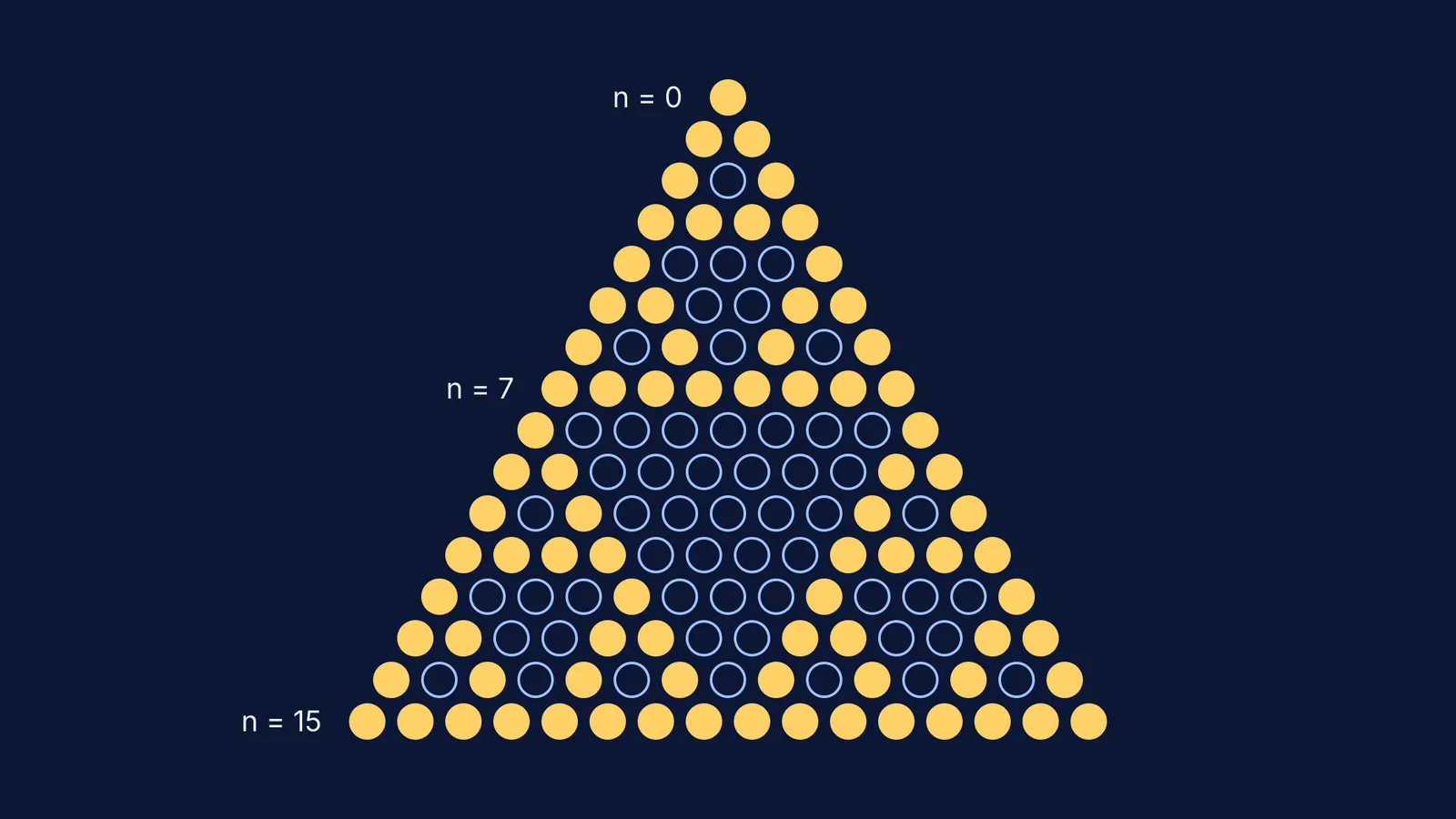
Round 1: colour the odd numbers. Predict first: will the odd numbers be scattered, or will they make a shape? Triangles appear inside triangles. MathWorld states that Pascal's triangle modulo 2 is equivalent to the Sierpiński sieve, the fractal in the picture at the top of this post.
Look at rows 3 and 7: every entry is odd. You can colour much further without the real numbers, because odd + odd and even + even give even, while odd + even gives odd. Predict the next all-odd row before you check it. (It is row 15.)
Round 2: add each row. Predict the sum of row 6 before you add it. The row sums go 1, 2, 4, 8, 16, and MathWorld gives the rule: the sum of row n is 2ⁿ. Each number feeds two entries in the next row, so the total doubles.
Round 3: trace the diagonals. The outer diagonal is all 1s. The next one counts 1, 2, 3, 4. The one after that goes 1, 3, 6, 10, 15, the triangular numbers; MathWorld notes that the diagonals hold the figurate numbers. That diagonal is also why 10 people make 45 handshakes: 45 is ¹⁰C₂, sitting in row 10.
Now try the shallow diagonals, which climb at a gentler slope. Their sums run 1, 1, 2, 3, 5, 8, which are the Fibonacci numbers, as MathWorld shows.
How do you use Pascal's triangle to expand (a + b)ⁿ?
NCERT's chapter gives three observations you can use with any row. The expansion has n + 1 terms. The power of a falls by 1 while the power of b rises by 1. In every term, the two powers add up to n. NCERT then writes the coefficients of row n as ⁿCᵣ = n!/(r!(n − r)!).
Worked example: expand (x − 2)⁴.
Take row 4: 1 4 6 4 1.
Write the powers: x⁴, x³(−2), x²(−2)², x(−2)³, (−2)⁴.
Multiply each term by its coefficient: x⁴ − 8x³ + 24x² − 32x + 16.
Check with x = 1: 1 − 8 + 24 − 32 + 16 = 1, and (1 − 2)⁴ = 1.
The patterns also catch slips. Build row 7 from row 6, then check two things: every entry is odd, and the sum is 128, which is 2⁷.
For large powers, skip the triangle and use ⁿCᵣ directly. Our guides to finding the numerically greatest term in a binomial expansion and the binomial theorem for negative and fractional index pick up from here.
A 20-minute plan to try at home
Each step follows the predict-first rule above.
Write rows 0 to 15 on squared paper; after row 8, just mark odd or even (5 minutes).
Write your prediction for the odd-number picture, then colour it (5 minutes).
Predict the sums of rows 6 and 7, then check against 2ⁿ (3 minutes).
Trace three diagonals and name each sequence (3 minutes).
Expand (2x + 1)⁵ and check with x = 1: the terms should add up to 243, which is 3⁵ (4 minutes).
Parents can join in by asking: "Before you colour it, what will it look like, and why?"
The predict-then-check habit works for other ideas that are easier to see than to read; the Fermi Simulation Lab has interactive simulations for those. If ⁿCᵣ itself still feels shaky, the Fermi Concept Library gives every concept in mathematics its own lesson.


