On this page
You found a good paragraph for your project. It is not in your words, so you paste it into a paraphrasing tool, press a button, and get back something that looks new. It feels like a fix. It isn't, and the reason is simple: the tool changed the words, not whose work it is.
Is using a paraphrasing tool plagiarism?
Yes, when you hand in the output as your own writing. India's University Grants Commission, in its 2018 academic integrity regulations for colleges and universities, defines plagiarism as “the practice of taking someone else's work or idea and passing them as one's own”. That definition says work or idea. A tool that swaps “tiny” for “minute” leaves the idea, the order of points and the structure exactly where the original author put them.
A real paraphrase is something else. The Purdue Online Writing Lab describes it as “your own rendition of essential information and ideas expressed by someone else, presented in a new form”, and says it is a legitimate way to borrow when it comes with accurate documentation. A tool's output fails on both counts: it is not your rendition, and it carries no citation unless you add one.
Your school may have its own rules on AI help, so check them. If you did use an AI tool honestly, here is how to mention AI use in a school project, with sample lines. For the wider picture, see what counts as plagiarism in college assignments.
Will a teacher notice a paraphrased paragraph?
Software may miss it, but the text itself often leaves clues. In a 2017 study, Ann Rogerson and Grace McCarthy ran published text through online paraphrasing tools, compared the output of two paraphrasing sites, and reported that originality checkers such as Turnitin performed poorly at identifying the output and linking it to its source. They also discussed clues that can help teachers spot it.
One clue is strange vocabulary. Felicity Prentice and Clare Kinden noticed student essays where unusual synonyms replaced standard medical terms. When they put the source text through six free online paraphrasing tools, the tools did not treat medical terminology as fixed and swapped in synonyms. In our made-up example below, a teacher who knows the subject would spot “water fume” where “water vapour” belongs.
What does the difference look like?
Here is a made-up textbook sentence and two rewrites.
Source: “Stomata are tiny pores on the leaf surface that let carbon dioxide in and water vapour out.”
Tool-style rewrite (our illustration): “Stomata are minute openings on the foliage exterior that permit carbon dioxide entry and water fume exit.”
Same order, same structure, one word per slot, and a technical term ruined. This is still the author's sentence in a disguise.
Your rewrite, written with the book closed: “A leaf has to let carbon dioxide in, and the cost is that water escapes. Both happen through stomata, the tiny pores on its surface (textbook, chapter and page).”
The second version starts from the idea, not the wording. It keeps the correct term, explains why it matters, and says where it came from.
How do you paraphrase honestly?
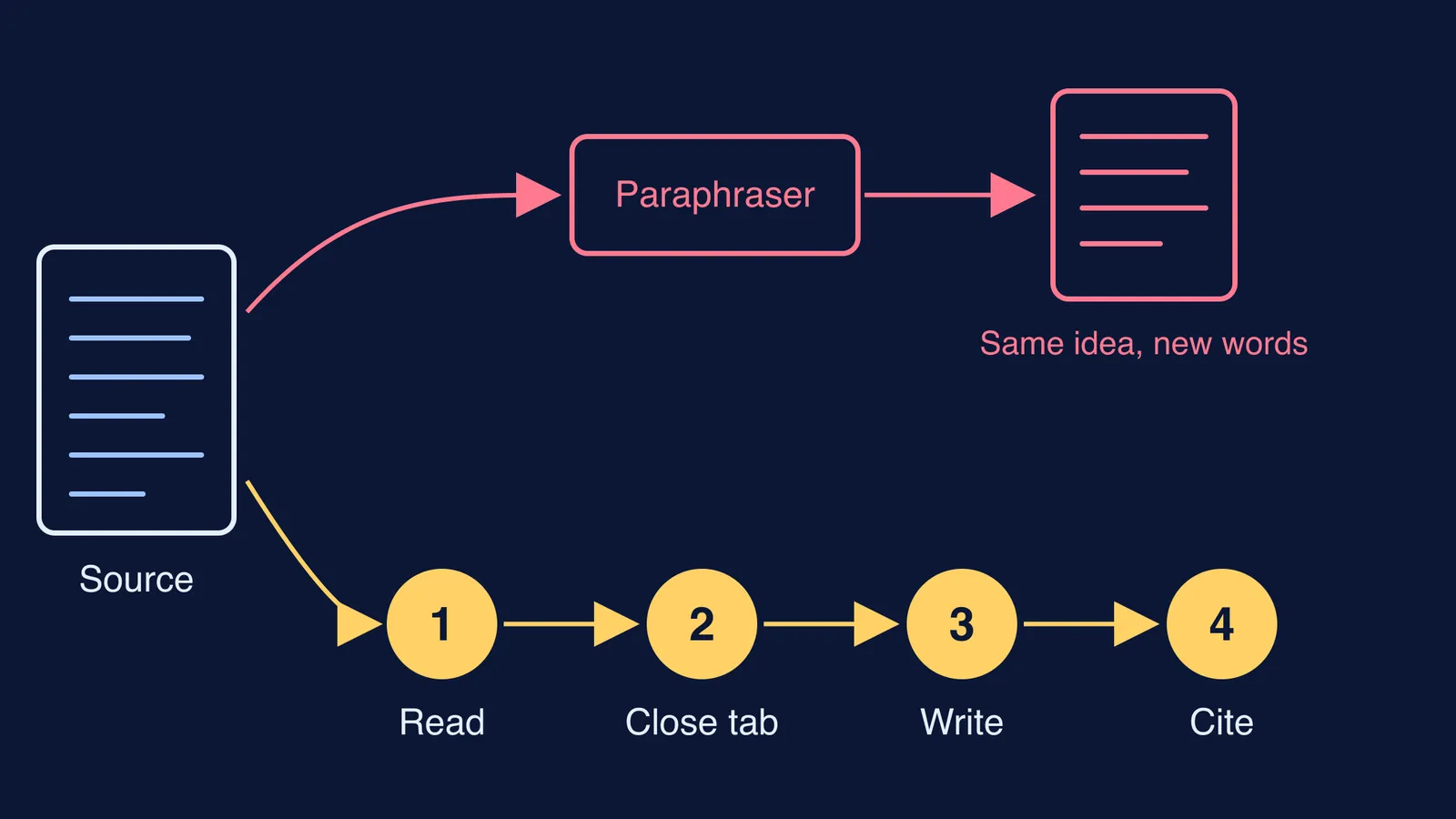
Use four steps. They are adapted from the method Purdue's writing lab recommends, which begins with rereading the passage until you understand it and then setting the original aside before you write.
Read. Go through the source until you can say its main point out loud in one breath.
Close the tab. Shut the book or the browser window. If you can still see the source, you will copy its shape.
Write. Put the idea down from memory, in your own order, with the technical terms kept as they are.
Cite. Reopen the source, check you got it right, put quotation marks around any exact phrase you kept, and add the reference.
Step 2 does more than keep you honest. In a 2006 study, Henry Roediger and Jeffrey Karpicke found that students who practised recalling prose passages remembered more on tests two days and one week later than students who simply restudied, even though restudying made students feel more confident. Writing from memory is a similar kind of recall practice. For a related habit, try to write your summary, then compare it with AI.
Sometimes the block is the idea, not the wording. If you cannot explain a concept even after rereading, the Fermi Concept Library has a lesson for each concept in physics, chemistry, biology, mathematics and computing, so you can learn it first and write about it after.
What can parents say?
If you find a paraphrasing tool open on your child's screen, a lecture rarely helps. Try this instead:
“I am not upset that you looked things up. That is what research is.”
“The problem is handing in words you did not write. Close the tab and tell me what the paragraph says.”
“Now write that down, the way you just said it, and put the book's name at the end.”
A few minutes of this teaches more than the tool ever could, and the paragraph your child hands in is theirs.