On this page
The transition from high school to college brings a sharp increase in the volume and complexity of assignments. When deadlines loom, the line between studying together and academic dishonesty can sometimes blur. Understanding exactly what constitutes plagiarism can save you from severe penalties and help you develop better research habits.
What is direct copying and paraphrasing?
The most straightforward form of plagiarism is copying text verbatim without quotation marks or citation. However, many students fall into the trap of "masking"—changing a few words or swapping synonyms while keeping the original sentence structure intact. Unless you completely rewrite the idea in your own words and cite the original author, this is still considered plagiarism.
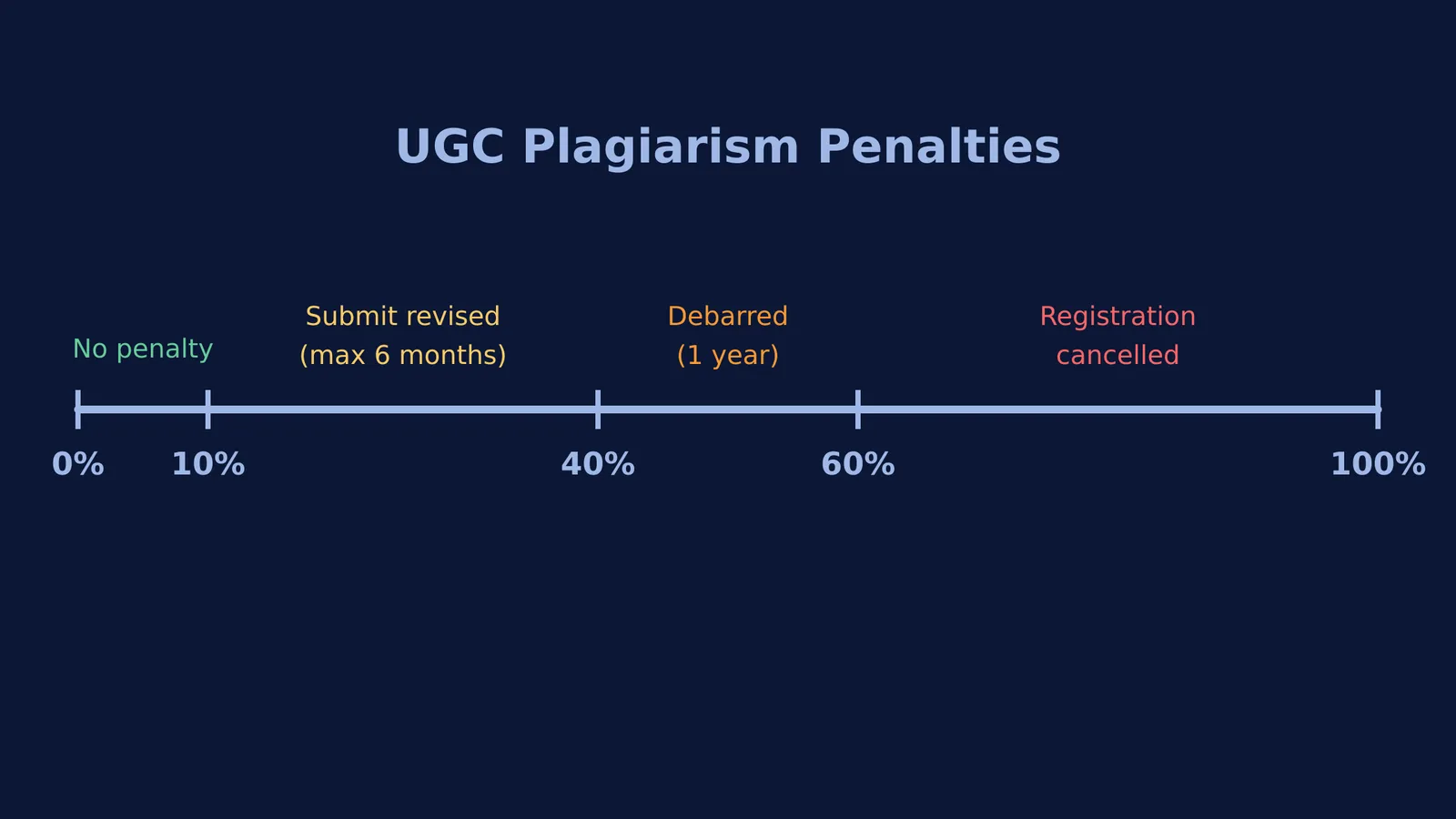
In India, the University Grants Commission (UGC) Regulations, 2018 set clear, tiered penalties for similarities found in student submissions:
Level 0 (Up to 10% similarity): Minor similarities; no penalty.
Level 1 (10% to 40% similarity): The student must submit a revised script within a maximum of six months.
Level 2 (40% to 60% similarity): The student is debarred from submitting a revised script for one year.
Level 3 (Above 60% similarity): The student's registration for the program is cancelled.
What counts as plagiarism in coding assignments?
Source code plagiarism involves representing someone else's code or logic as your own. While it is common to look up syntax or use small snippets from forums, copying entire functions or the core logic of a program without attribution is a violation of both academic integrity and IPR and open-source licences.
Changing variable names or adding comments to copied code does not bypass plagiarism detectors. Universities use specialized software that compares the underlying logic and control structures of the submissions. A common litmus test used by computer science instructors is the code walk-through: if a student cannot explain how their submitted code works, it is treated as evidence of academic dishonesty.
Furthermore, university policies typically state that providing your work to another student—even if they copy it without your explicit permission—can lead to a facilitation of dishonesty charge. Both the giver and the receiver are held equally responsible.
What is the policy for sharing lab reports?
Science courses encourage lab partners to work together during the experiment, but the write-up must be independent. University policies generally distinguish between authorized collaboration (collecting data together) and unauthorized collusion (writing the report together).
If you are writing up a physics practical, such as the prism i-d graph experiment or tracing a ray through a glass slab, you can share the raw measurements you took with your lab partner. However, your graphs, calculations, and final analysis must be your own. Sharing a completed spreadsheet or a draft paragraph "just as an example" frequently leads to identical wording that will be flagged by plagiarism software.
How can you avoid the plagiarism trap?
Plagiarism often stems from panic. When you stare at a blank screen hours before a deadline, the temptation to copy becomes overwhelming. The best defense is a proactive approach to learning.
If you find yourself completely stuck on where to begin, Fermi's AI tutor can work out what you already know and build a plan for the session, so you sit down to a clear next step rather than a blank page. Getting guided help to understand the material removes the need to lift someone else's work.
To avoid accidental plagiarism when researching, try the "Wait and Write" framework:
Read the source material until you understand the core concept.
Close the book or the browser tab.
Wait a few minutes. Think about how you would explain the idea to a classmate.
Write the explanation in your own words, then add the citation.
This simple habit ensures that you are actively processing the information rather than passively copying it, keeping your academic record clean and your learning intact.