

On this page
When you run current through two wires placed side by side, they do not just sit there. Because moving charges generate magnetic fields, the wires exert a physical force on one another. This interaction is a classic trap in physics exams because it seems counterintuitive at first glance—especially if you mix up your rules for charges and your rules for currents.
Do parallel currents attract or repel?
The rule for two parallel, current-carrying conductors is straightforward:
Currents in the same direction attract each other.
Currents in opposite directions (antiparallel) repel each other.
This might feel backwards if you are used to electrostatics, where "like charges repel." With currents, "like directions attract."
The magnetic force per unit length between them is given by Ampère's force law. The formula is F/L = (μ₀ I₁ I₂) / (2πd), where I₁ and I₂ are the currents, and d is the distance separating the wires.
How do you predict the force with the right-hand rule?
You do not have to memorise the attraction rule if you know how to derive it. Finding the force direction is a two-step process that combines the magnetic field generated by the first wire and the Lorentz force felt by the second.
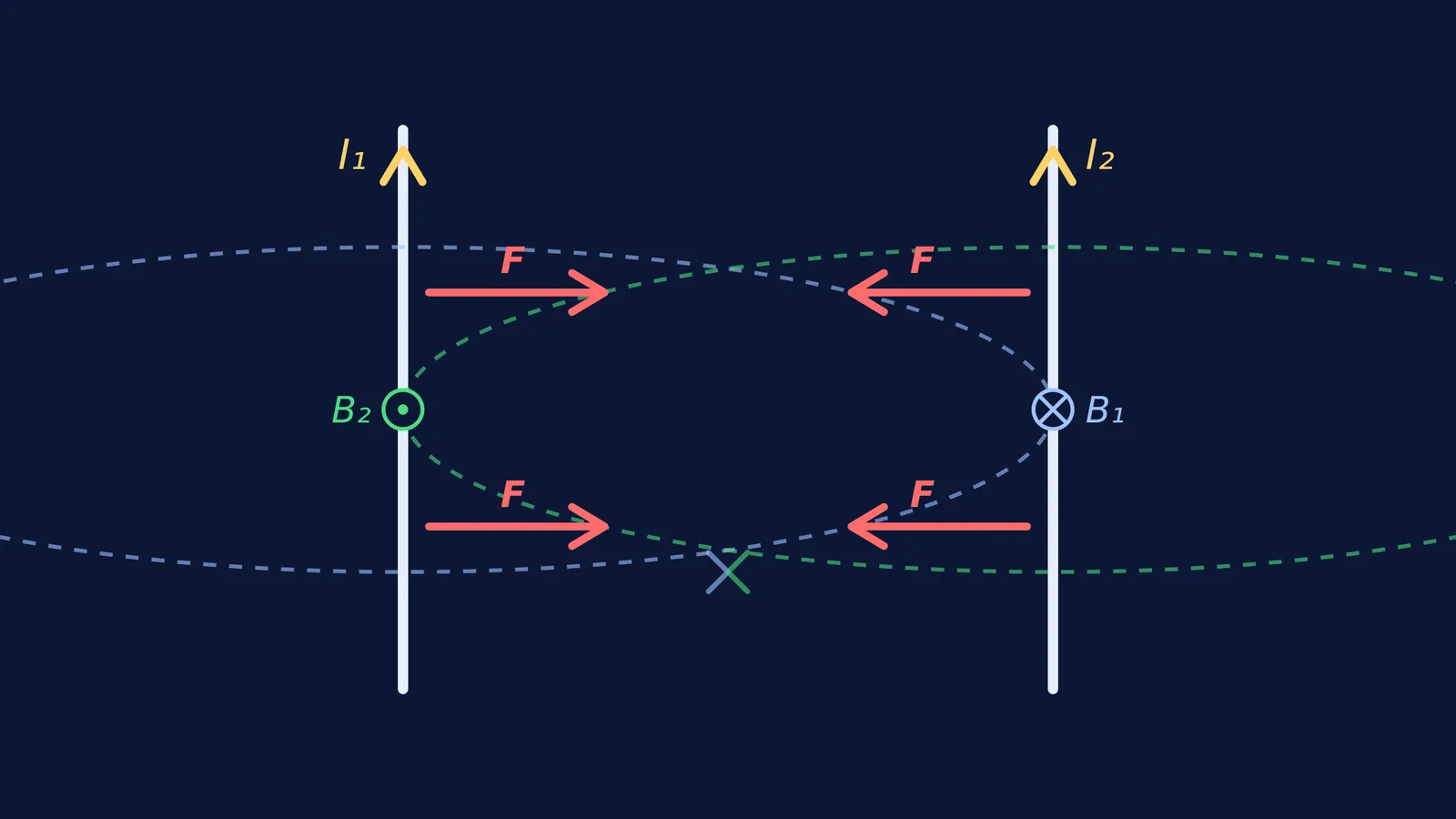
Find the magnetic field: Point the thumb of your right hand in the direction of the current in the first wire. Your fingers curl in the direction of the magnetic field it creates. If the first wire is on the left and its current flows "up," its magnetic field points into the page by the time it reaches the second wire.
Find the force: Now apply the right-hand rule for the Lorentz force on the second wire. Point your fingers in the direction of the second wire's current (up) and curl them toward the magnetic field (into the page). Your thumb points to the left, towards the first wire.
Because the force points towards the source of the field, the wires attract. If you flip one of the currents, the final thumb direction flips too, meaning they repel. This step-by-step check is a great way to avoid right-hand-rule mistakes with magnetic force on charges and wires.
What does a parallel currents attract or repel simulation show?
When you just read about 3D vectors on a 2D page, it is easy to misinterpret which way a field line curves. Setting this up in a physical lab requires strong currents to produce a visible movement, which is not always practical to do at home.
This is where a parallel currents attract or repel simulation bridges the gap. Instead of guessing, you can place two wires on a screen, set their currents to flow in the same direction, and watch the force vectors point inward. If you struggle with reading electric and magnetic field lines, the Fermi Simulation Lab provides interactive simulations for the ideas that are easier to see than to read. You can flip the current in one wire to negative and instantly see the vectors switch to repulsion.
According to Ampère's force law, you can also test the limits of the formula. What happens if you double the distance between the wires? The force drops by half. What if you double both currents? The force quadruples. Testing these relationships dynamically builds better intuition than reading static equations, similar to the benefits found when comparing simulations or static diagrams.
How should you solve exam questions on parallel wires?
When an exam question asks about the force between multiple wires, follow this sequence:
Draw the diagram first: Sketch the wires and label the current directions clearly.
Pair them up: Calculate the force between each pair of wires independently.
Assign directions: Write "attract" (pull together) or "repel" (push apart) next to each pair based on their current directions.
Add the vectors: Sum the forces on the wire in question.
If you get stuck applying the right-hand rule in a complex problem, Fermi's AI tutor works out what you already know, builds a plan for the session, and teaches through it — drawing the figure and checking understanding as it goes. Mastering the basics of how parallel wires interact will make the hardest magnetism problems feel routine.


