

On this page
Hold your thumb at arm's length and look at it with one eye, then the other. Your thumb jumps sideways against the wall behind it. ESA uses this same experiment to explain how its Gaia spacecraft measures star distances: the angle your thumb moves gives a direct measure of how far away it is. Below, you'll test predictions in a simple parallax simulation, then scale it up to the stars.
What is parallax in astronomy?
Parallax is the apparent shift of a nearby object against a far background when you view it from two places. With your eyes, ESA puts the gap at typically some 7 cm.
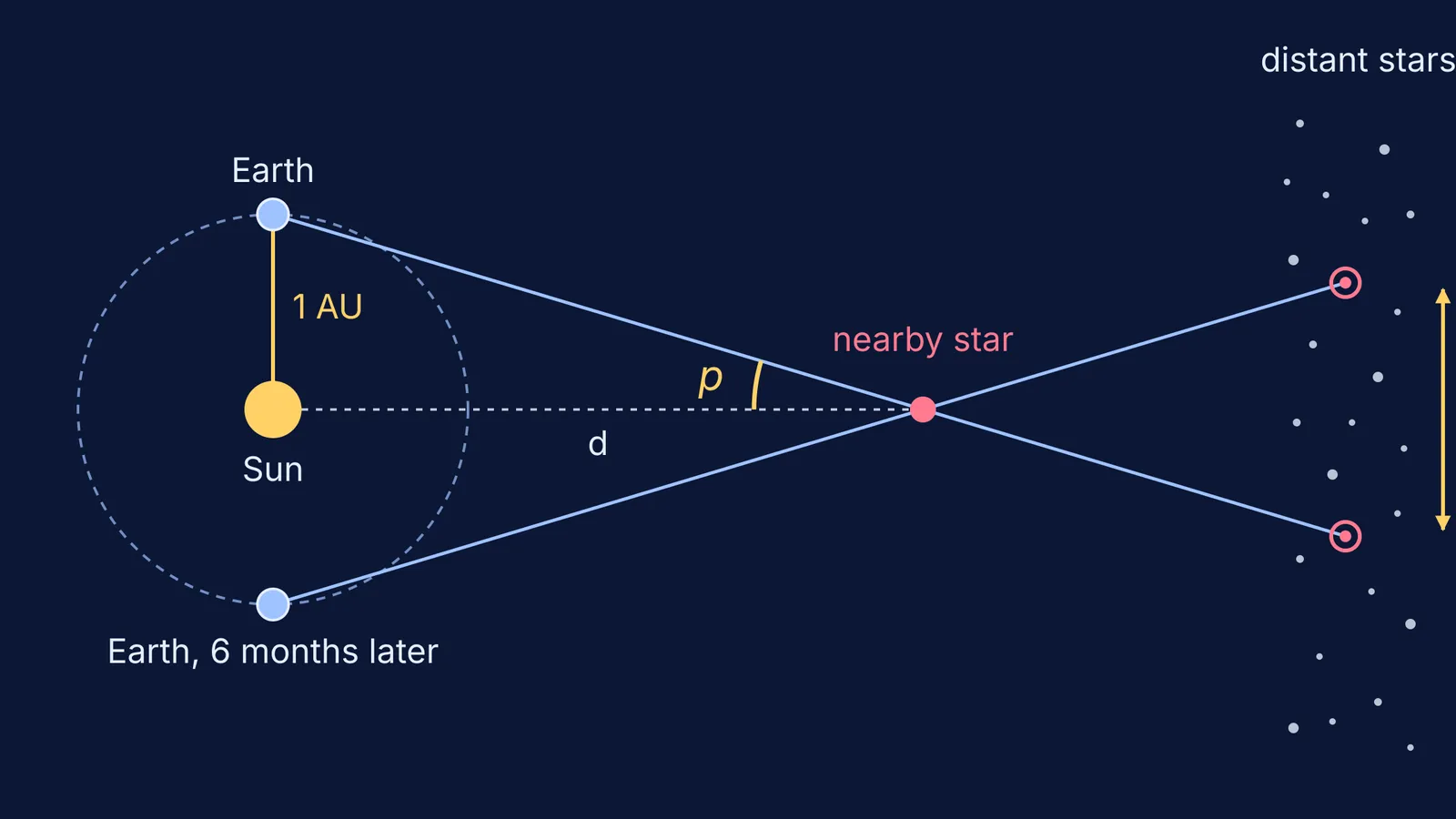
Astronomers need a much longer baseline. On the same ESA page, Earth sits about 150 million km from the Sun, so two views taken six months apart are about 300 million km apart. A nearby star seen in January and again in July shifts slightly against the much more distant stars behind it.
The parallax angle p is measured with the Earth–Sun distance (1 AU) as the baseline. That makes it half of the full January-to-July shift.
How do you calculate distance from a parallax angle?
A parsec is the distance at which an object has a parallax of one arcsecond, and ESA gives one parsec as 3.26 light years, or 206,265 AU. An arcsecond is 1/3600 of a degree. This gives the standard rule:
distance in parsecs = 1 / (parallax in arcseconds)
Worked example 1: ESA lists Proxima Centauri, the closest star to the Sun, at 1.294 parsecs, or 4.22 light years. Working backwards, its parallax is 1 / 1.294 = 0.77 arcseconds, or about 0.0002 of a degree. Even the nearest star barely moves.
Worked example 2: in 1838, Friedrich Wilhelm Bessel measured a parallax for 61 Cygni of 0.3 seconds of arc, which the Linda Hall Library describes as 83 millionths of a degree. One divided by 0.3 gives about 3.3 parsecs, or about 11 light years, as that article says. A post on Karl Menten's blog at the Max Planck Institute for Radio Astronomy calls this the first distance to a star other than the Sun measured by trigonometric parallax, and gives today's distance to 61 Cygni as 10.4 light years. In 2020 Mark Reid and Karl Menten re-analysed the 1830s data and could generally reproduce Bessel's results.
Try it: a parallax simulation with predictions
Use your thumb, paper or any two-point parallax simulation. An observer moves from point A to point B. That distance is the baseline b. A nearby object sits at distance d, and a background sits much farther away. When the angle is small, the shift in radians is roughly b / d. Multiply by 57.3 to get degrees.
Before you move the observer each time, write down a number. Then check it.
Start with your eyes. Take b = 7 cm, ESA's figure for eye spacing, and put your thumb at d = 60 cm. Predict 7 / 60 = 0.117 radians, about 6.7 degrees. Blink between eyes and watch the jump against a door frame.
Halve the distance. Bring your thumb to 30 cm. Predict that the shift roughly doubles, to about 13 degrees.
Double the baseline. Move the observer twice as far. Predict that the shift doubles too.
Bring the background closer. The background now shifts too, so the object's shift against it gets smaller. Read that as a parallax and you place the object too far away.
Scale up. Set b = 1 AU and d = 1 parsec. The angle is 1 arcsecond, matching the definition above.
Step 4 matters most: parallax only gives the right distance when the background is far enough away to stay still.
If watching the angle change helps more than redrawing it, the Fermi Simulation Lab has interactive simulations for ideas that are easier to see than to read.
Why can't parallax measure every star?
Because the angle shrinks as distance grows. A star ten times farther away shifts ten times less, so every step outward needs finer measurement. ESA's Gaia spacecraft sits about 1.5 million km from Earth in the anti-Sun direction and travels with Earth around the Sun, so its baseline is Earth's orbit.
Gaia Data Release 3 came out on 13 June 2022 with full astrometric solutions, including parallaxes, for 1.467 billion sources. The geometry is still Bessel's: two viewpoints, one angle and 1/p.
Where to go next
For unit practice, read our guide to converting light years, parsecs and astronomical units to metres. The same shift causes parallax error when you read a scale in the lab. If you enjoy the sky itself, read how to prepare for astronomy olympiad observation.
If you get stuck on a step, such as why p is half the shift, Fermi's AI tutor can draw the figure and run the simulation with you. It checks your understanding as it goes.


