

On this page
Most physics and mathematics competitions test you on theory, with problems solved purely on paper. The astronomy olympiad is different. To succeed in the Indian National Astronomy Olympiad (INAO) and ultimately the International Olympiad on Astronomy and Astrophysics (IOAA), you must also master the practical side of the subject.
According to the official IOAA structure, the practical components—Observation and Data Analysis—account for exactly 50% of your total score. The Homi Bhabha Centre for Science Education (HBCSE), which conducts the Indian olympiad stages, rigorously tests these skills at the Orientation-cum-Selection Camp (OCSC).
Here is a detailed look at what the Observation and Data Analysis rounds test, and a practical plan to help you prepare.
What does the data analysis round test?
In the data analysis section, you are given raw astronomical data—such as tables of brightness over time or spectral wavelengths—and asked to derive physical properties. This mimics the work that professional astronomers do every day.
The absolute core of this round is error analysis. When you measure a physical quantity, you must know how to propagate the uncertainties through a multi-step calculation. You are expected to reliably identify random and systematic errors, calculate the mean and standard deviation, and track significant figures throughout your work.
You will also need to graph data and interpret complex charts. Common tasks include:
Analysing the light curves of eclipsing binaries or transiting exoplanets to find orbital periods.
Linearising a non-linear relationship (such as a power law) to plot a straight line and find the line of best fit using linear regression.
Plotting star clusters on a Hertzsprung-Russell (H-R) diagram to estimate their age and distance.
Using the distance modulus formula to scale distances across the galaxy.
How to prepare for sky observation?
The observation round takes you away from the desk and under the real night sky, or occasionally into a planetarium. You are tested on your practical familiarity with the celestial sphere and your ability to handle astronomical instruments like telescopes.
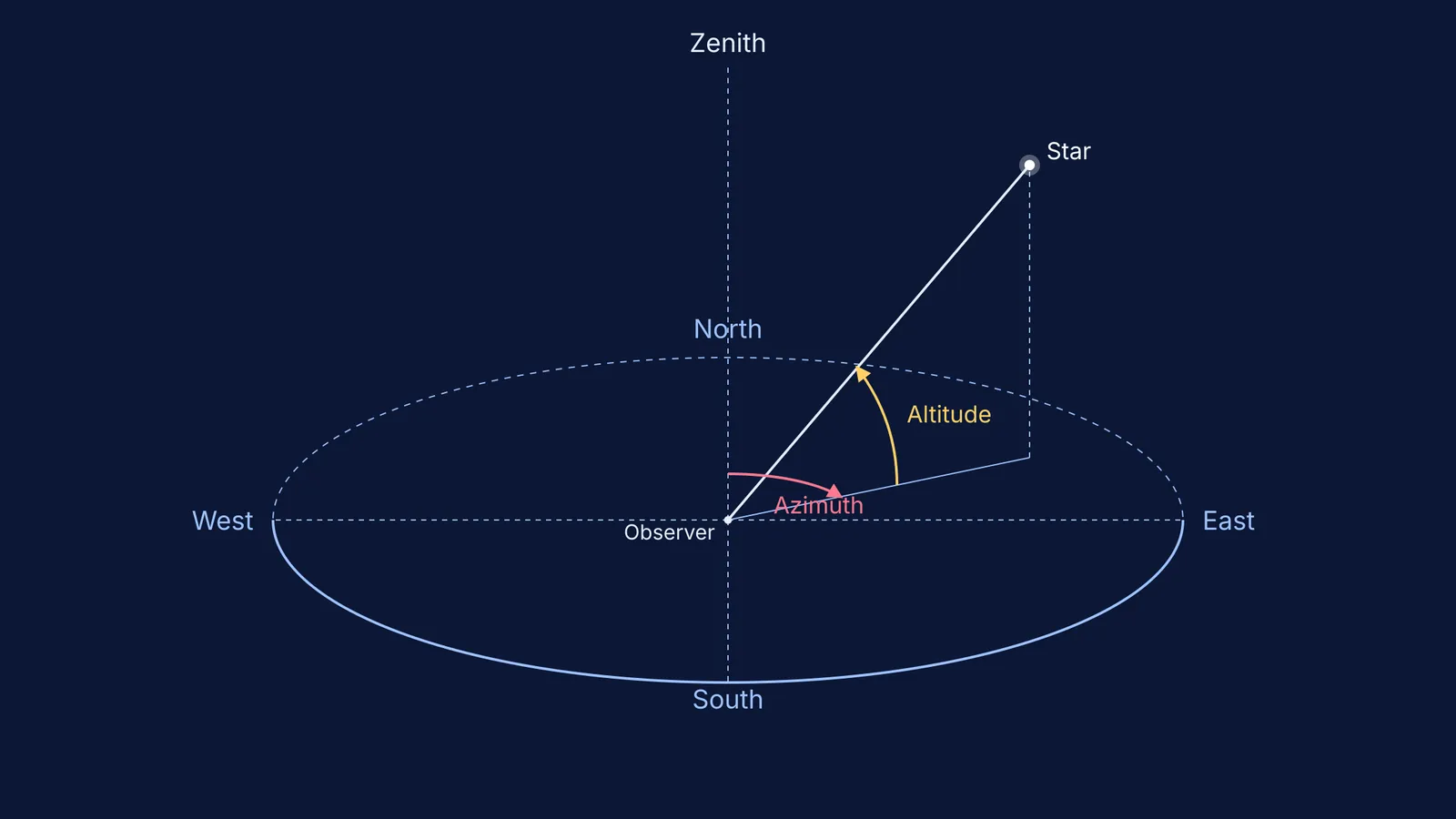
You must be able to identify major constellations, bright stars, and visible planets entirely with the naked eye. This requires knowing your way around the Altitude-Azimuth coordinate system (based on your local horizon and zenith) and the Equatorial coordinate system (Right Ascension and Declination). You will frequently be asked to estimate angular distances between stars using just your hands, and to use star charts to navigate from a known constellation to a fainter target.
You must also understand the optics behind the instruments. Expect questions that test your understanding of a telescope's focal length, f-ratio, magnification, and resolving power (the Rayleigh criterion).
The best way to prepare is to go outside on a clear night with a printed star map and a red-light torch. For daytime practice, free desktop planetarium software like Stellarium is invaluable. It lets you simulate the sky from any location and time, making it easier to learn the coordinates and the diurnal movements of celestial bodies.
Research by Carl Wieman and colleagues published in *Science* (2008) showed that interactive simulations allow students to construct accurate mental models of scientific ideas. If you struggle to picture how coordinate systems or planetary retrograde motions work in three dimensions, the Fermi Simulation Lab has interactive simulations for the ideas that are easier to see than to read.
A practical preparation plan
To build your practical astronomy skills, focus on these three concrete steps:
Master error analysis first: Read a standard university text like *An Introduction to Error Analysis* by John R. Taylor. You must be completely comfortable with the statistics of uncertainties before you attempt handling complex astronomical data.
Practise with real numbers: Work through the data analysis chapters in *A Problem Book in Astronomy and Astrophysics* by Aniket Sule. More importantly, solve past INAO and OCSC papers from the HBCSE archive to understand the exact format and rigor expected.
Shore up your classical mechanics: Astronomy is heavily rooted in classical physics. If you get stuck on the underlying forces of an orbit or the dynamics of a rotating body, the Fermi Problem Library has worked problems with a step-by-step solver that explains the reasoning rather than printing an answer.
By balancing your theoretical study with rigorous data practice and regular stargazing sessions, you will be well prepared for the unique practical challenges of the astronomy olympiad.
For more on the physics behind observational astronomy, see our guides to Kepler's second law from angular momentum: areal velocity worked and Norman Pogson and the 2.512 rule for star brightness.


