

On this page
Cutting equal squares from the corners of a sheet and folding up the sides is one of the most common optimisation questions in Class 12 maths. NCERT's chapter on Application of Derivatives asks it twice in Exercise 6.3: once with a square piece of tin of side 18 cm, and once with a rectangular sheet of 45 cm by 24 cm (NCERT Class 12 Mathematics, Chapter 6). Here you will play with the box first, commit to a guess, and only then let calculus judge it.
That order is deliberate. In a study of classroom demonstrations, students who only watched a demonstration understood the concept no better than students who did not see it at all, while students who predicted the outcome first showed greater understanding (Crouch, Fagen, Callan and Mazur, American Journal of Physics, 2004).
How do you set up the open box volume problem?
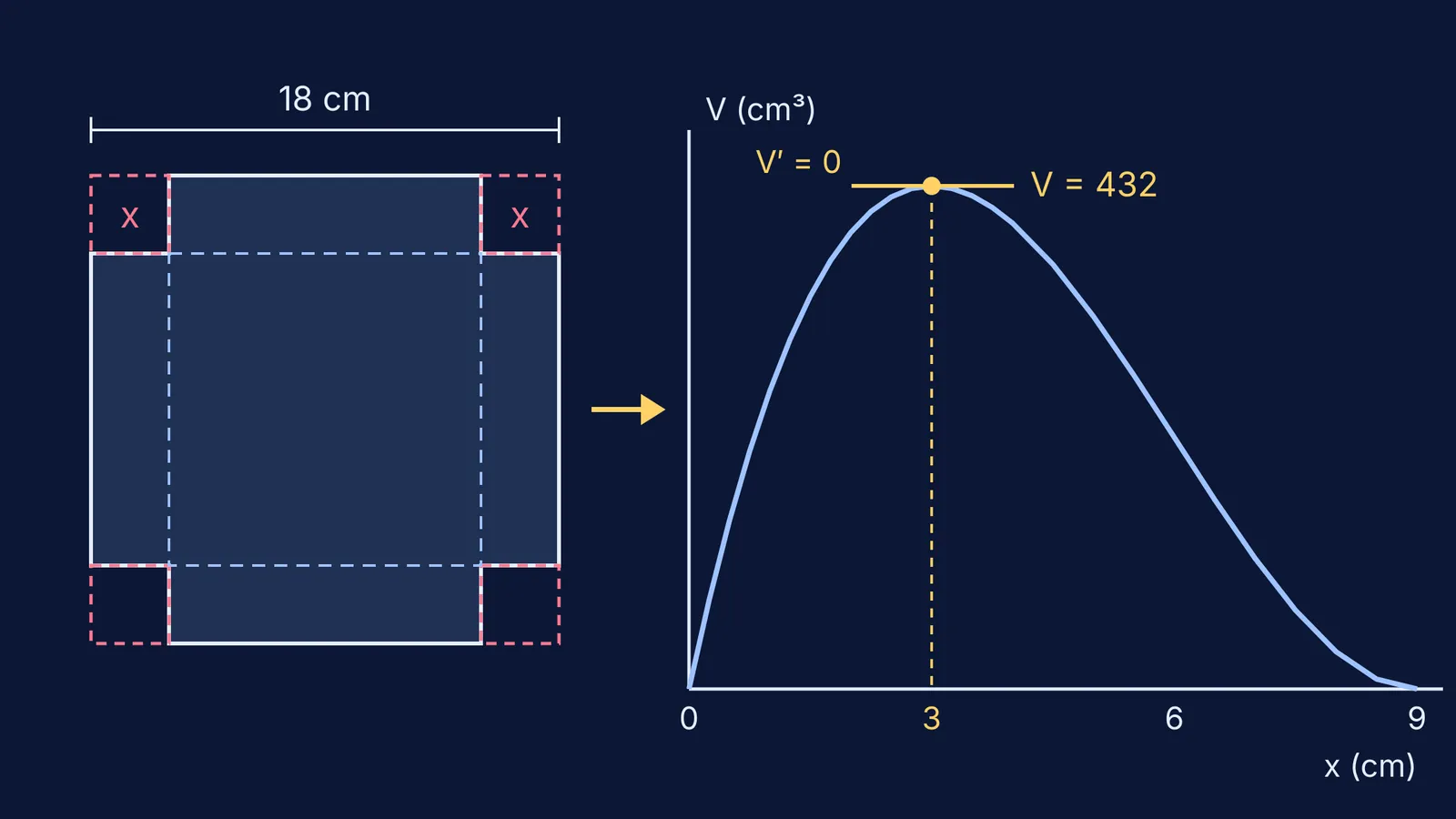
Take NCERT's square sheet of side 18 cm and cut a square of side x from each corner (NCERT, Exercise 6.3, question 17). Fold up the four flaps and:
the height of the box is x
the base is a square of side 18 − 2x
the volume is V(x) = x(18 − 2x)²
The cut must be positive and must leave some base, so 0 < x < 9.
What cut should you predict before calculating?
Try it with paper and scissors, or with a free interactive model such as Robert Talbert's GeoGebra box applet, where a slider changes the size of the corner squares. Before you touch the slider, write down your guess.
Then fill in a few values of V(x) = x(18 − 2x)² for the 18 cm sheet from NCERT's exercise:
x = 1 cm gives 256 cm³
x = 2 cm gives 392 cm³
x = 3 cm gives 432 cm³
x = 4 cm gives 400 cm³
x = 6 cm gives 216 cm³
x = 8 cm gives 32 cm³
Volume rises, peaks near 3 cm and falls away. A small cut gives a wide, shallow tray; a big cut gives a tall, thin column with almost no floor. The table cannot tell you whether the exact peak is at 3, 2.9 or 3.1. That is what the derivative is for.
How does the derivative confirm the maximum volume?
Stay with the same NCERT sheet of side 18 cm and expand first: V(x) = 4x³ − 72x² + 324x.
Differentiate: V′(x) = 12x² − 144x + 324 = 12(x − 3)(x − 9).
Set V′(x) = 0, which gives x = 3 or x = 9.
Reject x = 9: it is outside 0 < x < 9 and would leave no base, so V = 0.
Second derivative: V″(x) = 24x − 144, so V″(3) = −72. The curve bends downwards at x = 3, so it is a maximum.
Volume: V(3) = 3 × 12² = 432 cm³.
If you prefer the sign test, V′ is positive just below 3 and negative just above it. Our explainer on the first derivative test for local maxima and minima walks through that method. On the graph of V against x, the single hump has a flat tangent at its top, which is exactly what V′(3) = 0 says.
Why does the rectangular sheet give two answers?
NCERT's second version uses a sheet of 45 cm by 24 cm (NCERT, Exercise 6.3, question 18). Now V(x) = x(45 − 2x)(24 − 2x) = 4x³ − 138x² + 1080x, and V′(x) = 12(x − 5)(x − 18).
The algebra hands you two stationary points, 5 and 18. But the shorter side is 24 cm, so x must be less than 12; a cut of 18 cm is impossible. The answer is x = 5 cm, giving V = 5 × 35 × 14 = 2450 cm³. Our post on stationary versus critical points explains why you check the domain and the endpoints, not only where the derivative is zero.
A five-step routine for any optimisation word problem
Draw it and name the variable (here x, the side of the cut square).
Write the quantity to optimise as a function of one variable, with its domain.
Predict: make a quick table or move a slider, and commit to a guess.
Confirm: solve f′(x) = 0, reject roots outside the domain, then use f″ or the sign of f′.
Sanity-check against the graph and the real object.
The same routine solves the closed can with the minimum surface area for a fixed volume.
Some ideas are easier to see than to read, and the Fermi Simulation Lab has interactive simulations built for them. If you keep choosing the wrong method on word problems, the Fermi Problem Library has worked problems with a step-by-step solver that explains the reasoning rather than printing an answer.
Start with the 18 cm sheet tonight: guess, slide, differentiate, and see how close you got.


