On this page
The 1089 math trick is a classic mathematical puzzle) that feels like magic: pick a three-digit number, reverse it, subtract the smaller from the larger, and add the result to its own reverse. The final answer is always 1089. An algebraic proof using place value (100a + 10b + c) explains why this works, showing that the middle subtraction always yields a multiple of 99, leading to this constant sum.
What is the 1089 trick?
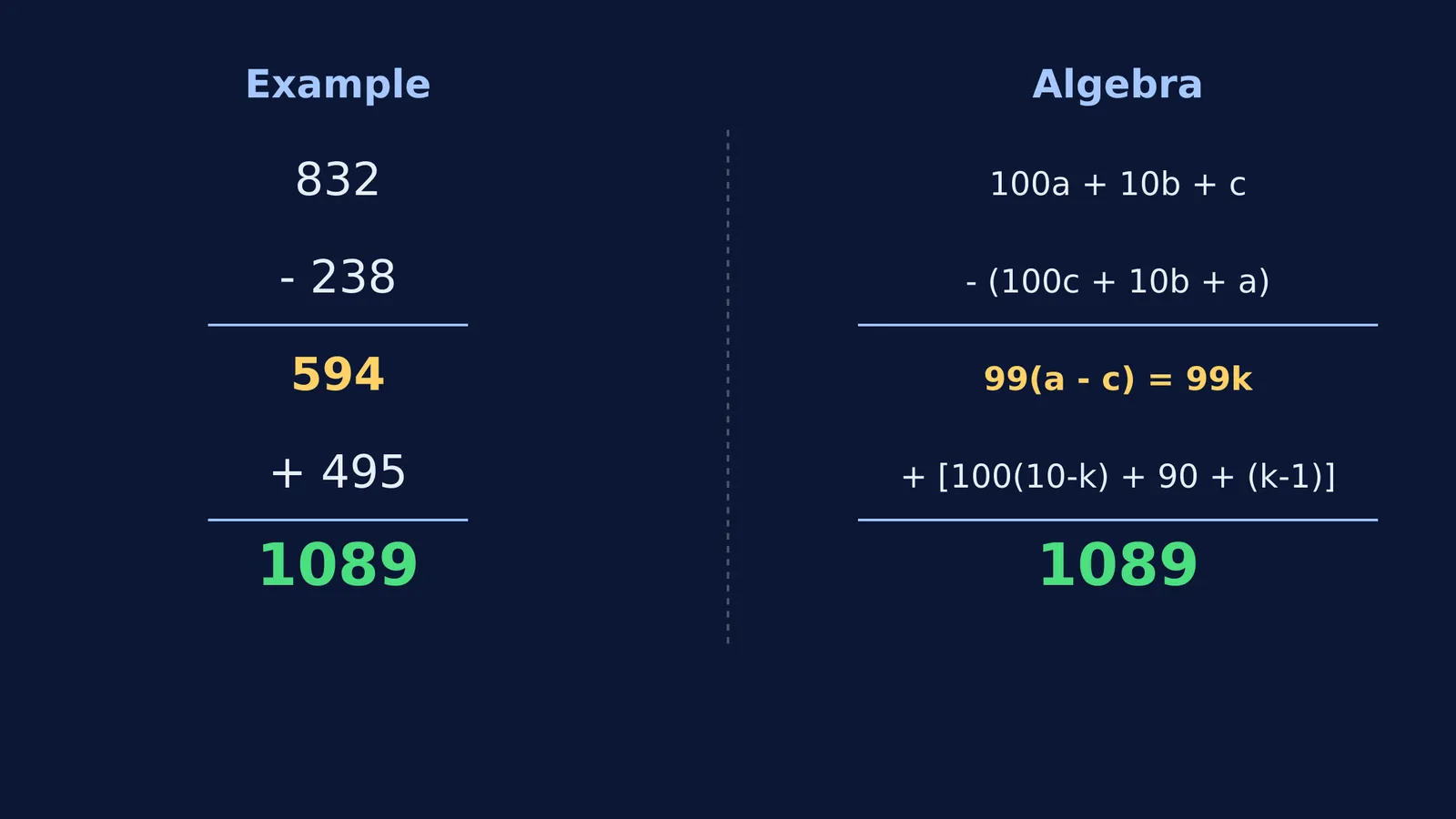
Take any three-digit number where the first and last digits differ by at least two. For instance, let's use 832.
Reverse the digits to create a new number: 238.
Subtract the smaller number from the larger one: 832 - 238 = 594.
Take your new result and reverse its digits: 495.
Add these last two numbers together: 594 + 495.
The answer is 1089. This simple sequence of reverse, subtract, add will always produce 1089, no matter which digits you chose at the start. It is a favourite among educators to show that mathematics has hidden, beautiful structures.
Why does the 1089 trick work?
The magic disappears and the mechanics emerge when we look at the trick through algebra. We can represent any three-digit number based on its place values: hundreds, tens, and ones.
Let your starting digits be a, b, and c. The total value of your chosen number is 100a + 10b + c. We assume a is larger than c by at least 2. The reversed number has the exact same digits, but their place values are swapped: 100c + 10b + a.
When you subtract the reversed number from your original number, the tens digit (the 10b term) cancels out entirely: (100a + 10b + c) - (100c + 10b + a) = 100(a - c) + (c - a)
By factoring, this simplifies perfectly to 99(a - c).
Because a and c are single digits that differ by at least 2, their difference (let's call it k) is always a whole number between 2 and 9. This means your subtraction result is guaranteed to be a multiple of 99, such as 198, 297, 396, or 594.
Notice a strict pattern in all these multiples of 99: the middle digit is always 9, and the first and last digits always add up to exactly 9. We can express this structure algebraically as 100(k - 1) + 90 + (10 - k).
When you reverse this specific result and add the two together, the k terms (which represent your original choice of digits) completely cancel out: [100(k - 1) + 90 + (10 - k)] + [100(10 - k) + 90 + (k - 1)]
Group the hundreds, tens and ones together: = 100(k - 1 + 10 - k) + 180 + (10 - k + k - 1) = 100(9) + 180 + 9 = 900 + 180 + 9 = 1089.
The algebra guarantees that the internal structure of base-10 numbers funnels you to 1089. If you want to build an intuition for how fixed physical or mathematical outcomes emerge from different starting conditions, the Fermi Simulation Lab provides interactive simulations for the ideas that are easier to see than to read.
When does the 1089 trick fail?
The trick relies on one crucial constraint: the first and last digits of your starting number must differ by at least 2.
What happens if they differ by only 1? Let's try starting with 322.
Reverse it: 223.
Subtract: 322 - 223 = 99.
If you treat 99 as a two-digit number, reverse it (still 99), and add them (99 + 99), you get 198. The pattern seems to break. However, the algebra is not wrong. If you remember that you are strictly working with three-digit numbers and write your subtraction result as 099, the trick survives:
Subtraction result: 099.
Reverse it: 990.
Add: 099 + 990 = 1089.
To avoid this confusing step during the trick, mathematicians add the "differ by at least 2" rule. This ensures the subtraction step produces a clean, recognizable three-digit number every single time. It is helpful to ask AI for intuition before the formula in physics, just as we break down the logic behind a math trick before memorising its steps.
How can you use this proof in your studies?
Working through algebraic proofs for number tricks builds a strong foundation for higher mathematics. When you rely on place value equations rather than arbitrary steps, you are actively learning how to model real-world problems.
If you are exploring other complex algebraic patterns, like the binomial theorem for negative and fractional index, explained, mapping the mechanics step by step is crucial. This is exactly how Fermi's AI tutor teaches—it works out what you already know, builds a plan for the session, and guides you through the reasoning, rather than simply printing an answer. Number tricks are an excellent way to see that math is not just rules to memorize, but logical structures waiting to be unpacked.