On this page
Most coaching institutes and textbooks jump straight to equations like F = ma or T = 2π√(l/g). This forces students into a "plug-and-chug" trap: memorising which numbers go into which letters without picturing the actual physics.
But research shows that students who build a solid physical picture before touching the mathematics do not just understand the concepts better—they actually score higher on quantitative exams.
Here is why learning the physical picture matters, and how you can use AI to build that intuition before you calculate.
Why do we learn the formula first?
Traditional lectures often present physics as a series of derivations on a chalkboard. Students scramble to copy down the steps, assuming the formula itself contains the understanding.
This leads to fragile knowledge. When an exam question looks slightly different from the textbook example, students who only know the formula often freeze because they cannot "sense-check" their setup. A landmark 1998 study of 6,542 students found that interactive, conceptual methods produced learning gains of 0.48, nearly double the 0.23 gain seen in traditional lectures (DOI: 10.1119/1.18809). By focusing on the *why* before the *how*, students build robust mental models that survive exam pressure.
What happens when you build physical intuition?
Building intuition means learning to "walk before you run." You describe what is happening in plain language, draw a diagram, and predict how the system behaves before looking for the right equation.
Does focusing on ideas take time away from exam-style numericals? Surprisingly, no. In a 2001 study on Peer Instruction at Harvard University, researchers tracked ten years of introductory physics classes to see how a conceptual focus affected problem-solving (DOI: 10.1119/1.1374249). They found that dedicating class time to conceptual reasoning actually improved students' scores on standard quantitative exams. When your intuition guides your mathematics, you avoid the careless errors that plague rote memorisers.
How to ask an AI tutor for physics intuition
If you are stuck on a physics topic, your instinct might be to ask an AI, "How do I solve this problem?" Instead, you should prompt it to explain the physical picture first.
Here is a simple framework to use with an AI tutor:
Hide the maths: Say, "Explain what is happening in this system using only plain English, without any formulas."
Find the extremes: Ask, "What happens if the mass, speed or charge becomes extremely large, or drops to zero?"
Connect to the equation: Finally, ask, "Now show me the formula and explain how each part matches the physical description you just gave."
If you do not know where to start, Fermi's AI tutor works out what you already know and builds a plan for the session, teaching through the concept before rushing to the equations. And when you are ready to tackle the numericals, the Fermi Problem Library has worked problems with a step-by-step solver that explains the reasoning rather than printing an answer.
A worked example: The simple pendulum
Let us put this into practice with a classic Class 11 topic: the time period of a simple pendulum.
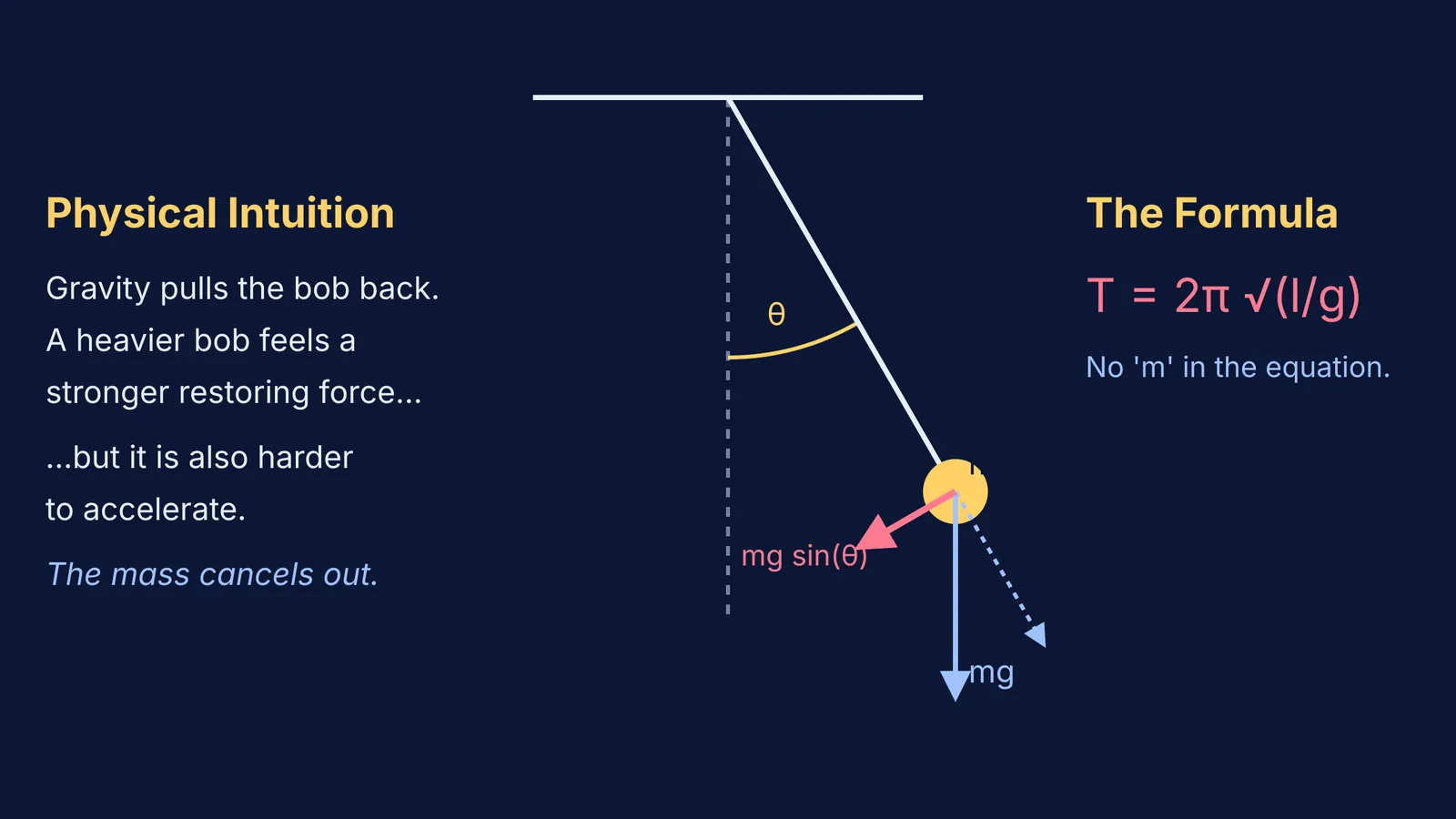
If you jump straight to the formula, you see T = 2π√(l/g). You might wonder why the mass (m) of the bob is missing. Did we forget it?
If you ask for the physical intuition first, the picture is clear. A pendulum swings because gravity pulls the bob back toward the centre. If you swap a light wooden bob for a heavy iron one, gravity pulls down on it with much more force. However, that heavy iron bob is also much harder to accelerate because it has more inertia. The extra pulling force is exactly cancelled out by the extra inertia. Therefore, the mass does not matter, and it vanishes from the final formula.
Once you see the forces, the mathematics becomes a shorthand summary of your intuition, not a mystery to memorise. For a harder variation, try picturing a Pendulum in an electric field: effective g for a charged bob—if you understand the physical picture of gravity, adding an electric force feels completely natural.