On this page
Without its turntable, a microwave oven heats food in patches. That unevenness is the whole experiment: if the food stays still, the hot spots stay put, and the gap between them is set by the wavelength. Measure the gap, multiply by the frequency, and you have measured the speed of light with a ruler and a bar of chocolate.
Before you switch anything on, make a prediction. Writing down a number first turns a kitchen trick into a real test.
Why does chocolate melt in spots in a microwave?
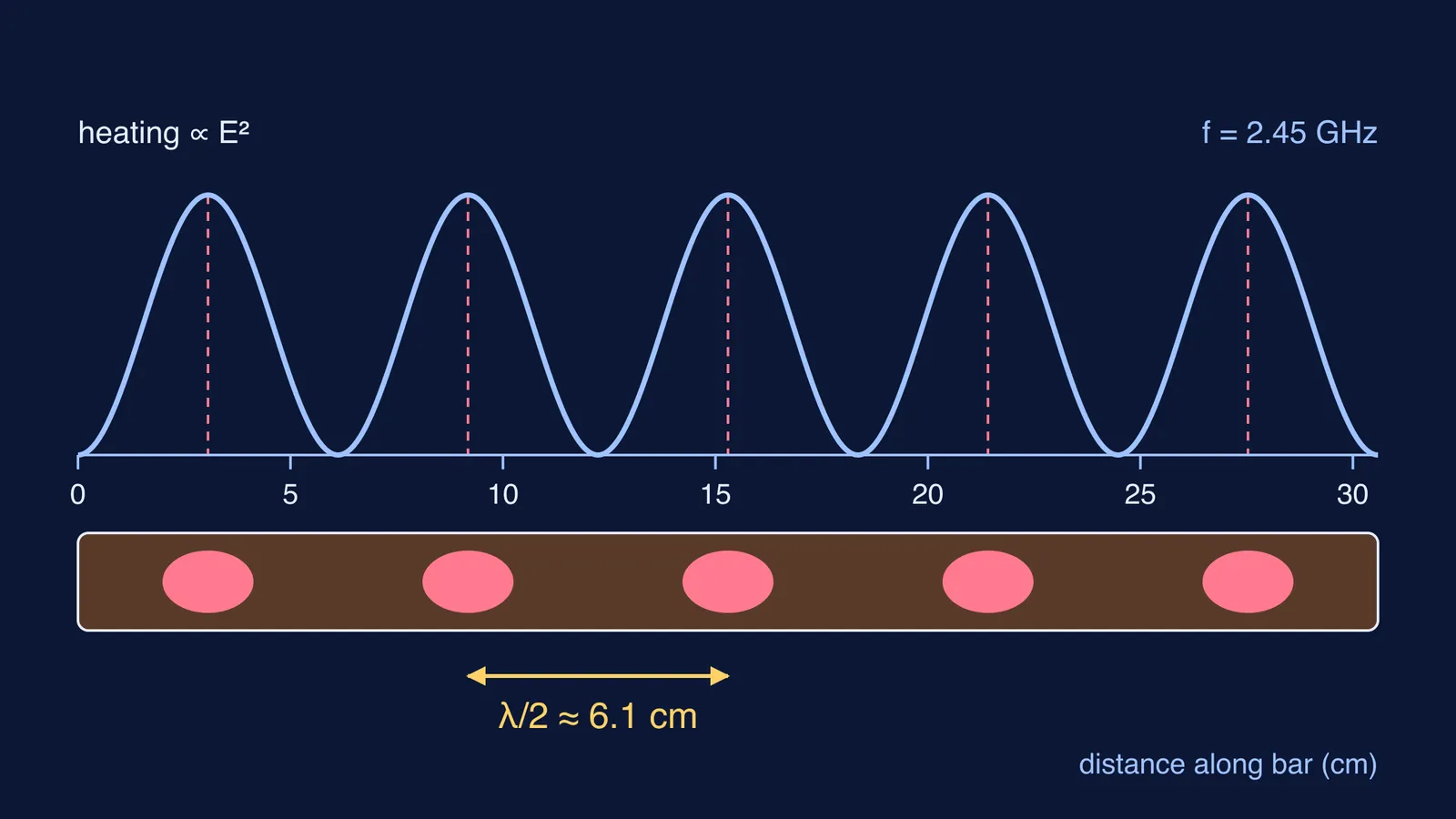
Microwaves bounce off the metal walls of the oven. The waves going one way overlap with the reflections coming back and form a standing wave. It has fixed places where the electric field swings strongly (antinodes) and places where it hardly moves (nodes).
Food heats fastest at the antinodes. Our explainer on how a microwave oven heats food covers why water molecules soak up this energy. The key geometric fact is simple: neighbouring antinodes in a standing wave are half a wavelength apart. So the gap between two neighbouring melted spots should be λ/2.
How far apart should the melted spots be?
You need two numbers. The speed of light in vacuum is exactly 299,792,458 m/s, a defined value with no uncertainty (NIST CODATA). Microwave ovens use a band reserved for industrial, scientific and medical equipment. Under US rules, that band is centred on 2450 MHz with a tolerance of ±50 MHz (47 CFR 18.301).
Now predict:
Wavelength: λ = c ÷ f = 299,792,458 ÷ 2,450,000,000 ≈ 0.122 m, or 12.2 cm.
Gap between melted spots: λ ÷ 2 ≈ 6.1 cm.
If your oven's rating label shows a frequency, use that instead.
How do you do the chocolate experiment safely?
This version follows a take-home lab by Robert H. Stauffer Jr. of Cimarron-Memorial High School in Las Vegas, published in The Physics Teacher in April 1997 (DOI 10.1119/1.2344657). He used one layer of marshmallows on low heat and wrote that the repeating gap between melted spots, half the microwave wavelength, is about 6 cm (lab write-up). Flat chocolate works the same way.
Ask whoever owns the oven, and do this with an adult nearby.
Take out the glass turntable and the ring it sits on, so nothing rotates.
Lay a large flat bar, or several squares edge to edge, on a microwave-safe plate in the middle of the oven floor.
Heat on low power in short bursts, checking after each one.
Stop as soon as you can see three or more glossy, soft patches.
Lift the plate out with an oven cloth and measure from the centre of one soft patch to the centre of the next.
The US FDA advises not running an oven whose door does not close firmly or is damaged, and notes that some ovens should not be run empty, so follow your oven's manual (FDA on microwave ovens). Keep foil and metal out; here is why metal sparks in a microwave. Melted chocolate can burn, and the turntable goes back in when you finish.
How do you calculate the speed of light from your results?
Here is a worked example with sample readings. Use your own numbers.
Three gaps measured: 6.0 cm, 6.3 cm and 5.9 cm. Mean gap = 6.07 cm.
Wavelength: λ = 2 × 6.07 cm = 12.13 cm = 0.1213 m.
Speed: c = f × λ = 2.45 × 10^9 Hz × 0.1213 m ≈ 2.97 × 10^8 m/s.
Compare: the defined value is 2.998 × 10^8 m/s (NIST), so this result is about 0.9% low.
Stauffer wrote that the method works in his physics class "often with less than 5% error" (lab write-up). If you are further out, check the error sources below.
Where does the error come from?
Frequency. The permitted band runs from 2400 to 2500 MHz (47 CFR 18.301), about 2% either side of 2450 MHz, and you do not know your oven's exact value. With the same 0.1213 m wavelength, 2.40 GHz gives 2.91 × 10^8 m/s and 2.50 GHz gives 3.03 × 10^8 m/s.
Ruler. The centre of a soft patch is hard to judge. Being 2 mm out on a 6 cm gap is an error of about 3%. Measure from the first spot to the last spot across several gaps, then divide by the number of gaps.
Shape of the pattern. The standing wave fills the oven in three dimensions, so measure only between spots on one straight line.
If standing waves still feel abstract, the Fermi Simulation Lab has interactive simulations for ideas that are easier to see than to read, and our walkthrough of finding harmonics on a string in a simulation shows nodes sitting half a wavelength apart, the same spacing as your melted spots.
Write down your prediction, melt the chocolate, and see how close your ruler gets you to 299,792,458 m/s.